
New wooden buildings can slash upfront emissions by nearly a third, study shows
4.6.2025 12:44:18 EEST | Aalto-yliopisto | Press release
New research highlights the climate benefits of wood in construction and calls for clearer definitions for hybrid buildings.
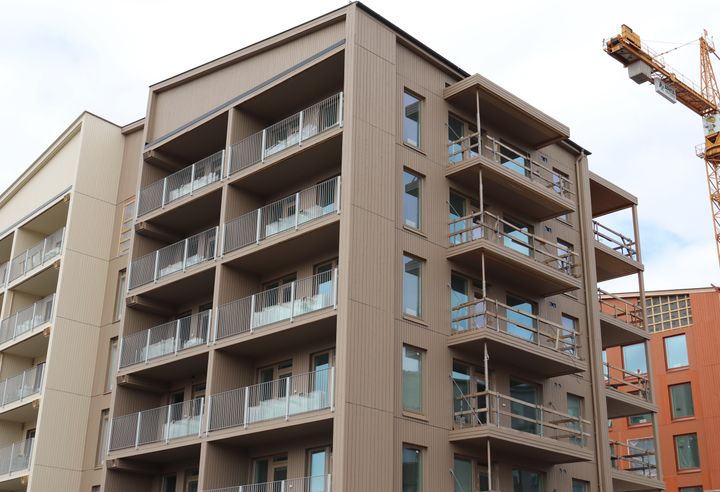
Wooden buildings produce significantly fewer upfront greenhouse gas emissions (UE-GHG) than those built with concrete, steel, or masonry, according to a new study published in Environmental Research: Infrastructure and Sustainability.
The research, conducted by researcher Ali Amiri and Professor Seppo Junnila at Aalto University, shows that on average, new wooden buildings demonstrated approximately 30% lower UE-GHG emissions than their non-wooden counterparts.
‘Our findings show that wood is not just a renewable material — it’s a powerful tool for climate mitigation in the built environment,’ says lead author Ali Amiri.
The researchers analysed life-cycle assessment (LCA) data from 92 case buildings to calculate the displacement factor (DF), which measures the GHG savings achieved when wood replaces more emission-intensive materials.
Key findings from the study:
- Low-rise wooden buildings, particularly detached homes, showed the highest displacement factors.
- Process-specific LCA studies yielded higher DF values than input–output LCA studies, underscoring the importance of detailed, project-specific analysis.
- Displacement factors ranged from −0.15 to 0.69, highlighting the need for thoughtful design and technical planning to maximize environmental benefits.
The study also addresses the increasing popularity of hybrid wooden buildings — particularly in mid- and high-rise construction — and calls for a more precise definition of what qualifies as a “wooden” building.
‘Some buildings are being marketed as wooden despite having very limited wood content. To ensure transparent carbon accounting, we need clearer criteria for hybrids,’ says Amiri.
With the construction sector accounting for a significant share of global emissions, the study offers valuable guidance for architects, engineers, and policymakers seeking to reduce climate impacts through material choices.
‘This research provides a concrete reference point for moving toward lower-carbon buildings,’ adds Professor Junnila.
Full article: Amiri, A., & Junnila, S.: How much upfront-embodied GHG emissions can wooden buildings save—displacement factors for wooden buildingsin Environmental Research: Infrastructure and Sustainability. DOI: 10.1088/2634-4505/addc16
Keywords
Contacts
Dr. Ali Amiri
University of Washington
amiria1@uw.edu
Seppo Junnila
Professor, Aalto University
seppo.junnila@aalto.fi
p. 358505115816
Links
Information about the publisher
Aalto University is where science and art meet technology and business. We shape a sustainable future by making research breakthroughs in and across our disciplines, sparking the game changers of tomorrow and creating novel solutions to major global challenges. Our community is made up of 13 000 students, 400 professors and close to 4 100 other faculty and staff working on our dynamic campus in Espoo, Greater Helsinki, Finland.

Alternative languages
Subscribe to releases from Aalto-yliopisto
Subscribe to all the latest releases from Aalto-yliopisto by registering your e-mail address below. You can unsubscribe at any time.
Latest releases from Aalto-yliopisto
Ennakkoluulot ovat monimutkaisempia kuin stereotypiat antavat ymmärtää9.10.2026 08:56:24 EEST | Tiedote
Uusi aivotutkimus osoittaa, että ensi kertaa tavatun ihmisen herättämät tunteet riippuvat paitsi siitä, koetaanko hänet omaan vai toiseen ryhmään kuuluvaksi, myös hänen tunnetilastaan ja etäisyydestään katsojaan. Ryhmien väliset erot tunteissa tulevat esiin erityisesti, kun toiseen ryhmään kuuluva ihminen tulee lähelle katsojaa.
Tutkimus selvitti pk-yritysten kansainvälistymisen sudenkuoppia – näin vältetään ulkoisen rahoituksen ”kultainen häkki”7.10.2026 09:55:00 EEST | Tiedote
Valtiollinen tuki voi vauhdittaa pk-yrityksen kansainvälistymistä, mutta se voi myös hidastaa prosessia tai aiheuttaa merkittävää vahinkoa. Uuden tutkimuksen mukaan ratkaisevaa on, kuinka paljon päätösvaltaa yrityksen johdolle jää ja kuinka hyvin tarjottu tuki vastaa yrityksen tarpeisiin. Hyvä uutinen on, että johtajat voivat omilla toimillaan merkittävästi vaikuttaa lopputulokseen.
Energiatehokkuus vaikuttaa jo asuntolainaasi – seuraavaksi katse kääntyy ilmastoriskeihin30.9.2026 07:55:00 EEST | Tiedote
Tuoreen tutkimuksen mukaan kiinteistön energialuokalla on jo nyt vaikutusta asuntolainapäätökseen. Hyvä energialuokka voi oikeuttaa vihreään lainaan tai muihin etuihin, kun taas heikko energialuokka voi tehdä kohteesta pankin silmissä rahoituskelvottoman. Tulevaisuudessa lainapäätökseen voivat vaikuttaa myös esimerkiksi tulva- ja muut ilmastoriskit.
Pitsinnypläyksellä voidaan valmistaa muotoaan muuttavia tekstiilirakenteita28.9.2026 13:30:00 EEST | Tiedote
Tutkijat ovat kehittäneet pitsinnypläykseen perustuvia tekstiilirakenteita, jotka voivat muuttaa muotoaan ympäristön muutosten seurauksena. Tutkimuksessa yhdistyvät perinteinen käsityötekniikka, aktiiviset materiaalit ja tietokonemallinnus.
Elokuvataiteen väitös: Elokuvaohjaaja ei johda vain visiota – myös luova ryhmä tarvitsee johtamista17.9.2026 08:45:00 EEST | Tiedote
Aalto-yliopistossa tarkastettava Hanna Maylettin väitöstutkimus tunnistaa elokuvaohjaajan taiteellisessa johtajuudessa kaksi toisiinsa kietoutuvaa ulottuvuutta: teoksen sisällön sekä työryhmän sosiaalisten prosessien säätelyn. Vuorovaikutus, luottamus, valtasuhteet ja tunteet muovaavat sitä, miten yhteistyö ja luova toimijuus rakentuvat elokuvanteon prosessissa.
In our pressroom you can read all our latest releases, find our press contacts, images, documents and other relevant information about us.
Visit our pressroom