
Sickness absences in the municipal sector started to increase sharply
22.5.2023 08:31:41 EEST | Työterveyslaitos | Press release
Finnish Institute of Occupational Health media release 22 May 2023
In 2022, sickness absences increased regardless of occupation, gender or age group, although the first years of the pandemic, 2020 and 2021, did not yet result in increased sickness absences.
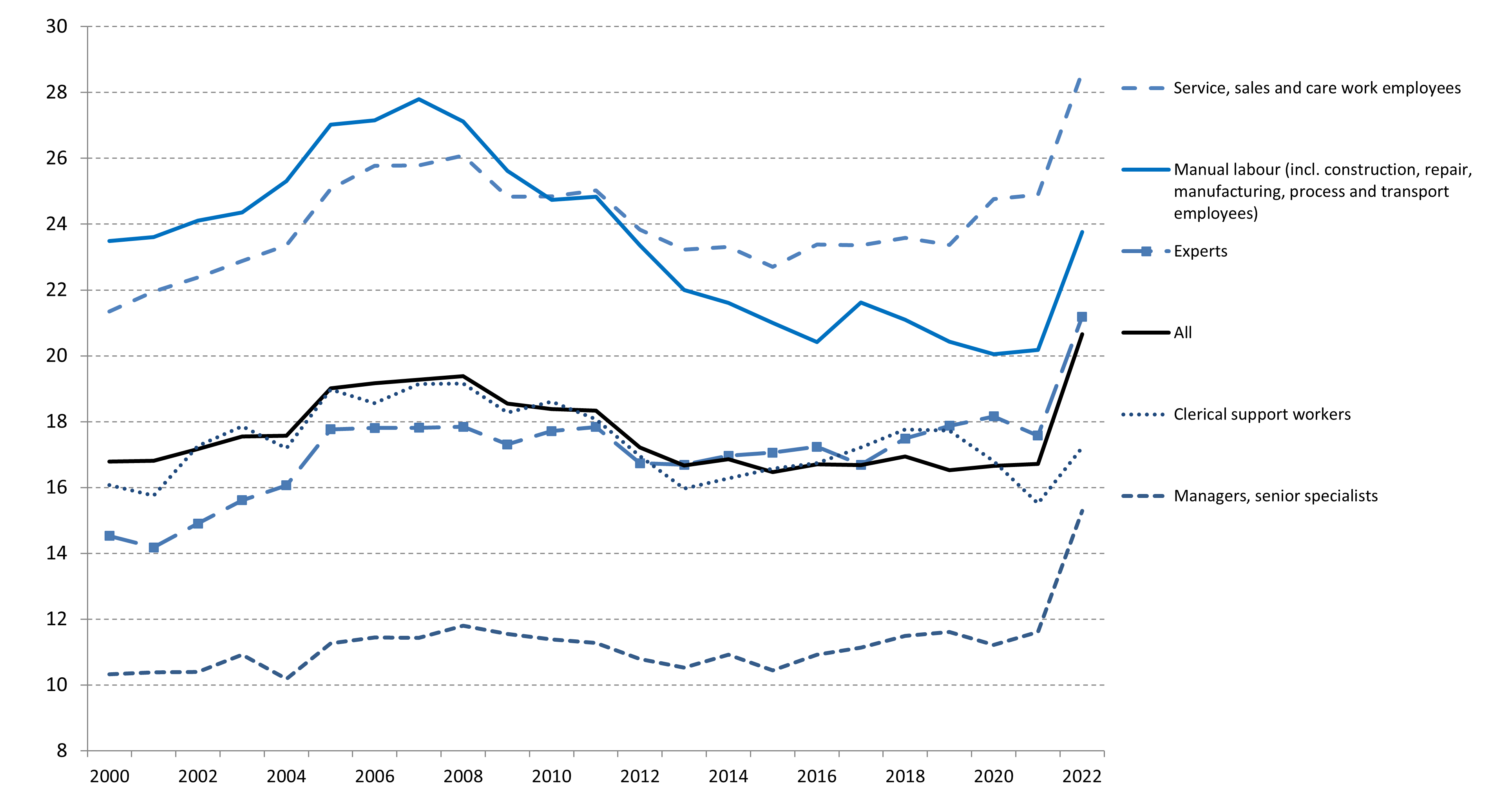
On average, municipal employees were absent from work for 20.7 days due to their own illness, which is four days more than in the previous year.
The Kunta10 study of the Finnish Institute of Occupational Health has monitored employees' sickness absences since 2000. The statistics are based on employers' register data. The statistics in the Kunta10 study cover all absences due to the employees’ own illness from the first day of absence, but do not include information on the reasons for sickness absences.
“It is likely that the increase observed now can be explained by absences caused by COVID-19,” says Senior Researcher Jenni Ervasti from the Finnish Institute of Occupational Health.
This can be deduced from Kela's sickness allowance statistics, which provide information on long absences of more than 9 days and the reasons for them.
“Absences due to COVID-19 increased in Kela's statistics in 2022. However, sickness allowances granted on the basis of mental health disorders, musculoskeletal diseases and respiratory diseases remained at the previous year's level,” says Jenni Ervasti.
The largest number of absences occurred in health care professions
Health care professions are still among the top in terms of average sickness absences: early childhood educators, family day care providers, ward domestics, practical nurses, child care providers, school assistants and home care workers were, on average, absent from work for more than 25 days due to their own illness in 2022.
The lowest rates of absences due to one's own illness were among managers, senior specialists, finance secretaries and publicists (9–11 days on average).
In relative terms, park workers, housekeepers, firefighters, security guards, managers in education, ward domestics, child care providers and early childhood education teachers had the highest increase in sickness absence days compared to the previous year.
Employees aged under 30 were absent the most, but the differences between age groups have not increased from last year.
In 2022, all employee groups have been ill
In 2022, the proportion of those who were absent for zero days decreased in all occupations in the municipal sector. In previous years, switching to remote work and avoiding contacts had increased the proportion of employees who were not absent for a single day during the year due to their own illness.
The proportion of employees who were sick for zero days was 29% in 2021 and only 16% in 2022.
“Last year, being absent for at least one day due to sickness was most common in jobs with a lot of personal contacts, such as health care, social work, early childhood education, education and rescue services. This, too, supports the assumption that COVID-19 is the underlying cause of absences,” Ervasti says.
Sickness absences in all occupational groups have increased.
“Compared to the previous year, the proportion of those who were absent for zero days decreased the most in management positions, although there are still more people in this group who were absent for zero days than in many other positions,” Ervasti continues.
Learn more
- Updated information on sickness absences in the municipal sector can be found in the Finnish Institute of Occupational Health's Work-Life Knowledge service at: Sickness absence in Finnish municipalities | Work-life knowledge service | www.worklifedata.fi (tyoelamatieto.fi)
- The data is available in Finnish, Swedish and English.
- Kela’s sickness allowance statistics 2022 (in Finnish): Sairauspäivärahat jatkavat kasvu-uralla – vuonna 2022 koronavirus näkyi aiempaa selvemmin sairauspäivärahaa saaneiden määrässä | Kela Info Tray (available in Finnish only)
- Attached Figure 1. Development of sickness absences per occupation. Full-time employees. Kunta10 study, Finnish Institute of Occupational Health.
The Kunta10 study
- The Finnish Institute of Occupational Health’s Kunta10 study is the most extensive nationwide follow-up study in the Finnish municipal sector.
- The Kunta10 study involves Helsinki, Espoo, Vantaa, Tampere, Turku, Oulu, Naantali, Raisio, Nokia, Valkeakoski and Virrat.
- The annual sickness absences of more than 90,000 municipal employees is monitored from the personnel registers of employers in a uniform manner in proportion to the actual sickness absence days and the number of person-years worked.
- These statistics do not include the causes of sickness absences.
- One municipality's statistics in 2021 and another municipality's statistics in 2022 had to be excluded from the total results.
Further information
- Jenni Ervasti, Senior Researcher, PhD, Adjunct Professor, jenni.ervasti@ttl.fi, +358 (0)30 474 2806
Keywords
Contacts
Juha Hietanensenior specialistTyöterveyslaitos | Finnish Institute of Occupational Health | Arbetshälsoinstitutet
Tel:+358504773267juha.hietanen@ttl.fiPäivi Lehtomurtosenior specialistTyöterveyslaitos | Finnish Institute of Occupational Health | Arbetshälsoinstitutet
Tel:+358504156309paivi.lehtomurto@ttl.fiImages
Links
About Työterveyslaitos

Well-being through work
The Finnish Institute of Occupational Health (FIOH) researches, develops and specializes in well-being at work. It promotes occupational health and safety and the well-being of workers. It is an independent institution under public law, working under the administrative sector of the Ministry of Social Affairs and Health. It has five regional offices, and its headquarters are in Helsinki. The number of personnel is about 500.
For the media | Finnish Institute of Occupational Health (ttl.fi)
Subscribe to releases from Työterveyslaitos
Subscribe to all the latest releases from Työterveyslaitos by registering your e-mail address below. You can unsubscribe at any time.
Latest releases from Työterveyslaitos
DEMO Talks 2.6.: Miksi Suomesta lähdetään ja miksi Suomeen palataan?28.5.2026 09:17:52 EEST | Kutsu
Tervetuloa DEMOGRAPHY Talks -webinaariin 2.6. klo 14 - 15. Webinaarissa tarkastellaan niitä pelkoja, toiveita ja yhteiskunnallisia oloja, jotka muokkaavat muuttopäätöksiä eri aikakausina. Ketkä lopulta ovat tervetulleita ja millä ehdoilla? Äänessä ovat tutkijat Seija Jalagin Oulun yliopistosta ja Minna Toivanen Työterveyslaitoksesta.
Undersökning: Social- och hälsovårdsföretag visar samma oro för arbetshälsan som välfärdsområden26.5.2026 06:00:00 EEST | Pressmeddelande
Arbetshälsoinstitutets undersökning ger för första gången jämförbara data om arbetshälsan i privata social- och hälsovårdsföretag. Enligt resultaten är skillnaderna mellan den privata och den offentliga sektorn till många delar små. Särskilt oroande är återhämtningen: 40 procent av respondenterna återhämtade sig bra.
Tutkimus: Sote-yritysten työhyvinvoinnissa näkyy samoja huolia kuin hyvinvointialueilla26.5.2026 06:00:00 EEST | Tiedote
Työterveyslaitoksen tutkimus antaa ensimmäistä kertaa vertailukelpoista tietoa yksityisten sote-yritysten työhyvinvoinnista. Tulosten mukaan yksityisen ja julkisen sektorin erot ovat monin osin pieniä. Huolta herättää erityisesti jaksaminen: hyvin palautuneita oli 40 prosenttia vastaajista.
Study: Social welfare and healthcare companies face similar well-being at work concerns as wellbeing services counties26.5.2026 06:00:00 EEST | Press release
A study by the Finnish Institute of Occupational Health is the first to provide comparable data on the well-being at work in private social welfare and healthcare companies. The results show small differences between the private and public sectors. Recovery is a key concern: 40 per cent of respondents reported recovering well.
Työterveyslaitoksen tutkimuskatsaus: toukokuu 202620.5.2026 08:05:36 EEST | Uutinen
Tässä tutkimuskatsauksessa on esitelty tiiviisti viisi tuoreinta tutkimusta Työterveyslaitoksen tutkijoilta. Niissä on tarkasteltu esimerkiksi sairauspoissaoloja, työhön palaamista tekonivelleikkauksen jälkeen ja sitä, miten ympäristöosaamista kehitetään työpaikoilla. Tutkimuskatsauksen avulla pääset nopeasti ajan tasalle tuoreista tutkimusjulkaisuista.
In our pressroom you can read all our latest releases, find our press contacts, images, documents and other relevant information about us.
Visit our pressroom