In sea areas, the risk of extensive blue-green algae blooms remains significant
10.6.2024 08:00:00 EEST | Suomen ympäristökeskus | Press release
Blue-green algae risk is significant in the Gulf of Finland, the Archipelago Sea and also in the southern and central parts of the Bothnian Sea.

As in previous years, the risk of extensive blue-green algae blooms in open sea areas close to Finland continues to be high, as the seawater's nutrient situation is largely unchanged. This summer, the risk of the formation of rafts of blue-green algae is considerable in the northern part of the main basin of the Baltic Sea, in the Gulf of Finland, the Archipelago Sea and in a large part of the Bothnian Sea. The risk remains low in the Bothnian Bay. The extent of algae rafts is affected by the temperature and wind conditions of the summer.
The nutrient situation, weather conditions and the annual cycle of phytoplankton create the preconditions for the blue-green algae blooms
The Baltic Sea main basin’s deeps still contain plenty of phosphorus. Different water layers get mixed during winter, which brings deep water nutrients to the surface layer. With deep currents, nutrients are often transferred from the main basin to the eastern Gulf of Finland, where nutrient-rich deep water is mixed with surface water during the winter. After winter, as the light increases, growth of phytoplankton algae starts. This is known as the spring bloom of phytoplankton, and is mainly made up of diatoms and dinoflagellates.
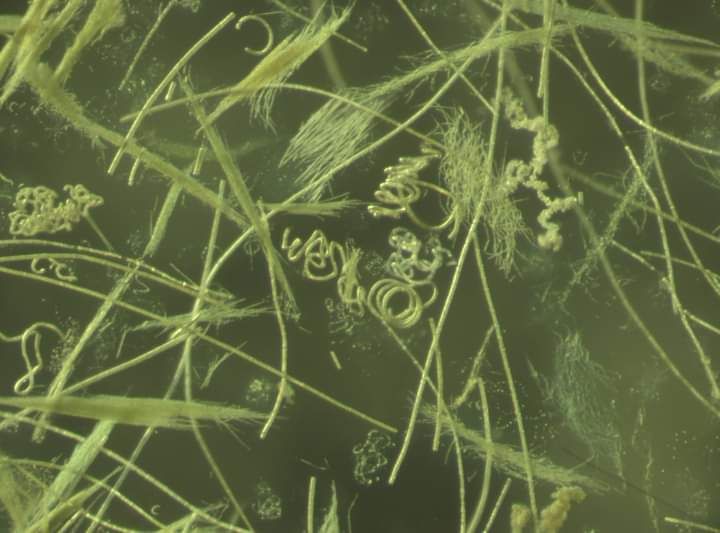
During spring bloom, the amount of phytoplankton in the water is many times higher than during blue-green algae blooms in summer. Water is often discoloured to brownish and fish nets can get slimy, but the spring bloom of phytoplankton does not form algae rafts, as with blue-green algae, nor does it cause any health hazard. During the 2000s, the spring bloom season has started a couple of weeks earlier than before. The spring bloom ends when the nitrogen limiting the growth of diatoms and dinoflagellates is almost used up. Nowadays, after nitrogen is used up, phosphorus nutrients remain as a surplus in surface water in offshore areas close to Finland, with the exception of the Bothnian Bay. Nitrogen scarcity favours the mass formations of blue-green algae during the summer, as Aphanizomenon, Dolichospermum and Nodularia blue-green algae are able to utilise nitrogen gas dissolved from air into water, which, in practice, is almost unlimitedly available. In other words, the ability to bind nitrogen gives blue-green algae species a competitive advantage compared to other phytoplankton species.
In summer, warm water accelerates the growth of blue-green algae. Even abundant blue-green algae do not necessarily attract attention if it is mixed in the water column. The formation of large blue-green algae rafts, which can also be seen from satellites, will require favourable growth conditions for a couple of weeks: warm and sunny weather, as well as sufficient phosphorus, and at least a few days of calm wind conditions. Algae rafts consist mainly of old blue-green algae cells that are no longer able to regulate their depth position in water. At the end of the bloom, most blue-green algae cells break down in water and only some settle down to the bottom. Blue-green algae species winter as resting-state cysts at the bottom of the sea or as vegetative cells in the water column.
In other words, the risk of the mass formation of blue-green algae in the open sea is affected by the weather conditions in the winter, the nutrient situation in the spring, the intensity and species of spring bloom, and the nutrients bound with them, as well as the weather conditions in the summer. Upwelling of phosphorus-rich water into the surface layer during the summer can also favour the growth of blue-green algae.
Blue-green algae risk in the Bothnian Sea has increased significantly
Over the past ten years, the regional risk of blue-green algae in open sea areas has remained largely unchanged, but the risk has increased significantly in the Bothnian Sea. The occurrence of blue-green algae is mainly affected by summer weather conditions. The local blue-green algae situation on the coast and in the archipelago varies faster than in the open sea. An improvement in the state of the Baltic Sea main basin would significantly reduce the mass occurrence of blue-green algae in large areas.
Monitoring the state of the sea also produces information for forecasting blue-green algae risk
Data from a variety of sources are used to assess the risk of occurrence of blue-green algae. This forecast used data from extensive monitoring cruises conducted by the Finnish Environment Institute and the Swedish Meteorological and Hydrological Institute (SMHI), and from the coastal monitoring of ELY Centres. Additionally, information was used from satellite observations, weather data and from Alg@line monitoring utilising automated sampling on merchant ships. The forecast for blue-green algae has been prepared using AI-based modelling methods.
Weekly cyanobacterial reviews start in Midsummer week
This summer, the Finnish Environment Institute will report weekly on the general blue-green algae situation, between 20 June and 8 August 2024. The report will be published on Thursdays at 13:00. Monitoring of the blue-green algae situation has started in the beginning of June and will continue until the end of September.
Blue-green algae can form various toxins, including skin or eye irritants. Blue-green algae blooms should always be treated with caution. Municipalities and cities monitor the algae situation of bathing waters.
Keywords
Contacts
Risk evaluation of blue-green algae blooms in Finnish marine areas:
Senior Research Scientist Jouni Lehtoranta, Finnish Environment Institute Syke, firstname.lastname@syke.fi, tel. +358 295 251 363
Communications Specialist Eija Järvinen,
Finnish Environment Institute Syke, firstname.lastname@syke.fi, tel. +358 295 251 242
Media service at Finnish Environment Institute
Our Media Service provides information on research, helps journalists find experts for interviews and provides photos for media use.
Our Communication experts will answer your inquiries on weekdays from 9 am to 4 pm.
Links
Finnish Environment Institute - We build hope through research.
Finnish Environment Institute
Latokartanonkaari 11
00790 Helsinki
+358 295 251 000
It is time to move beyond solving environmental problems one by one, to systemic sustainability transformations. The Finnish Environment Institute (Syke) contributes to building a sustainable society through research, information and services. The Finnish Environment Institute is a research institute with 700 experts and researchers located in Helsinki, Oulu, Jyväskylä and Joensuu.

Subscribe to releases from Suomen ympäristökeskus
Subscribe to all the latest releases from Suomen ympäristökeskus by registering your e-mail address below. You can unsubscribe at any time.
Latest releases from Suomen ympäristökeskus
Nostot medialle 1.10.–9.10.2026: Ympäristö osana kokonaisturvallisuutta, Ennallistamissuunnitelma 50 minuutissa.1.10.2026 14:22:59 EEST | Tiedote
Hei! Tässä tiedoksesi meillä Suomen ympäristökeskuksessa pian ilmestyviä tiedotteita, uutisia, kampanjoita, blogeja ja uutiskirjeitä. Mukana myös tulevia tapahtumia ja webinaareja. Jakelemme mediakatsauksen torstaisin STT:n kautta. Koosteet löytyvät myös STT-uutishuoneesta, josta voit tilata kaikki Suomen ympäristökeskuksen tiedotteet.
Public defence: Just transformative conservation requires challenging existing structures and strengthening local agency25.9.2026 08:56:00 EEST | Press release
In her doctoral dissertation, Liisa Varumo, M.Sc.Admin, a researcher at the Finnish Environment Institute (Syke), examines questions of environmental justice in diverse nature conservation instruments and their potential to contribute to just transformative conservation. The public defence will take place at the University of Eastern Finland on Friday 2 October 2026 at 12.00.
Väitös: Reilu kestävyysmurros luonnonsuojelussa vaatii rakenteiden haastamista ja toimijuuden vahvistamista25.9.2026 08:55:00 EEST | Tiedote
Suomen ympäristökeskuksen tutkija, HTM Liisa Varumo tarkastelee väitöskirjassaan erilaisten luonnonsuojelukeinojen oikeudenmukaisuutta ja niiden mahdollisuuksia edistää reilua kestävyysmurrosta. Väitöstilaisuus pidetään Itä-Suomen yliopistossa perjantaina 2.10.2026 klo 12.00.
Nostot medialle 24.9.–2.10.202624.9.2026 15:57:23 EEST | Tiedote
Hei! Tässä tiedoksesi meillä Suomen ympäristökeskuksessa pian ilmestyviä tiedotteita, uutisia, kampanjoita, blogeja ja uutiskirjeitä. Mukana myös tulevia tapahtumia ja webinaareja. Jakelemme mediakatsauksen torstaisin STT:n kautta. Koosteet löytyvät myös STT-uutishuoneesta, josta voit tilata kaikki Suomen ympäristökeskuksen tiedotteet.
Östersjöns tillstånd är fortfarande långt från målen – uppföljning som sträcker sig från kustvatten till öppet hav visar varför18.9.2026 08:30:00 EEST | Pressmeddelande
I augusti genomförde Finlands miljöcentral två uppföljningsresor i Östersjön: havsforskningsfartyget Aranda samlade in information från öppet hav och ms Hessu från Skärgårdshavet och kusten. Övergödning är fortfarande Östersjöns största miljöproblem. Enligt den statusbedömning av kustvattnen som publicerades i juni har endast sex procent av Finlands kustvatten god status. Färska mätningar och modelleringar ger en uppdaterad lägesbild av hur näringsbelastningen från land syns i kustvattnen och på öppet hav och varför havets tillstånd fortfarande är långt från målen.
In our pressroom you can read all our latest releases, find our press contacts, images, documents and other relevant information about us.
Visit our pressroom