
In 2025, other financial institutions granted more loans to non-financial corporations than the previous year
4.12.2025 10:00:00 EET | Suomen Pankki | Press release
New loans to non-financial corporations were drawn down significantly more both in the third quarter of 2025 and in January–September 2025 than one year earlier. In 2024, drawdowns of corporate loans from other financial institutions were limited.
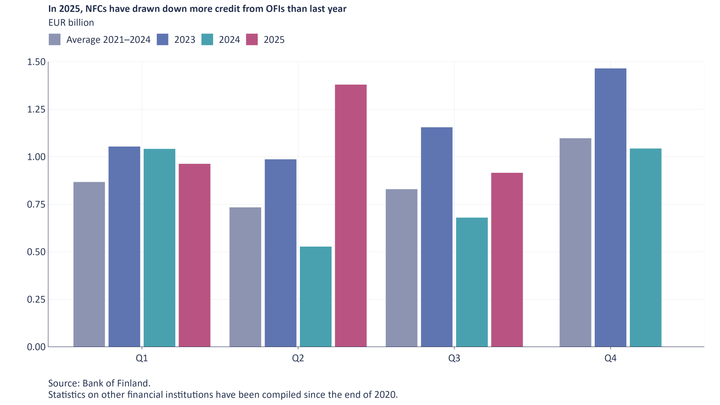
Finnish non-financial corporations (NFCs) drew down new loans[1] from other financial institutions (OFIs) in the third quarter of 2025 for a total of EUR 916 million, which is 35% more than in the corresponding period of 2024 and 21% less than in the corresponding period of 2023. In January–September 2025, new loans to NFCs totalled EUR 3.3 billion, which is 45% more than in the corresponding period of 2024 and 2% more than in the corresponding period of 2023. Of the loans to NFCs drawn down in the third quarter of 2025, EUR 502 million consisted of factoring[2], EUR 153 million of finance leasing and EUR 261 million of conventional corporate loans. At the end of September, the stock of loans granted by OFIs to NFCs stood at EUR 4.8 billion, with an average interest rate[3] of 4.11%.
By comparison, banks[4] granted new loans to NFCs for a total of EUR 4.2 billion in the third quarter of 2025, which is 9% less than in the corresponding period of 2024 and 10% more than in the corresponding period of 2023. In January–September 2025, NFCs drew down EUR 16.8 billion of new bank loans, which is 25% more than in the corresponding period of 2024 and 16% more than in the corresponding period of 2023.[5] Of the loans to NFCs drawn down from banks in the third quarter of 2025, EUR 306 million consisted of factoring, EUR 96 million of finance leasing and EUR 2.0 billion of conventional corporate loans. Hence, the nature of corporate financing granted by OFIs differs significantly from corporate financing granted by banks. At the end of September, the stock of loans granted by banks to NFCs stood at EUR 62.1 billion, with an average interest rate of 3.46%.
The average interest rate on new loans to NFCs drawn down from OFIs in the third quarter of 2025 was 7.87%, which is 1.28 percentage points lower than a year earlier. Of the new drawdowns, 71% were at fixed rates and 25% tied to Euribor rates. At the end of September, 20% of the OFI corporate loan stock was at fixed rates and 75% tied to Euribor rates. The significant difference between the reference rates of new drawdowns and the loan stock is due to factoring. Factoring is granted in large volumes and is typically at fixed rates, whereas conventional corporate loans and finance leasing with longer repayment periods are more often tied to Euribor rates. In the third quarter of 2025, the average interest rate on factoring drawn down from OFIs was 10.42%, on finance leasing 4.26% and on conventional corporate loans 5.09%.
By comparison, the average interest rate on new loans to NFCs drawn down from banks in the third quarter of 2025 was 4.01%, which is 1.31 percentage points lower than a year earlier. Of the new bank loans, 85% were tied to Euribor rates and 14% were at fixed rates. The average interest rate on factoring drawn down was 5.10%, on finance leasing 3.76% and on conventional corporate loans 3.77%.
Revision to the Standard Industrial Classification
Lending by other financial institutions to non-financial corporations is heavily concentrated in a few main industries[6]. The four largest industries by loan stock – electricity, gas and steam supply; manufacturing; construction; and transportation and storage – accounted for approximately two-thirds of the total NFC loan stock at the end of September 2025. There are considerable differences between industries in the nature of the financing sought and in the characteristics of the companies, and consequently also, for example, in average interest rates on loans. In the third quarter, 59% of new corporate loans in manufacturing went to large enterprises and 19% to micro-enterprises, at an average interest rate of 4.52%, whereas in construction only 5% went to large enterprises and 62% to micro-enterprises, at an average interest rate of 6.50%.
The industry classification used in the statistical reporting of both other financial institutions and banks will be revised at the beginning of 2026. We have published a topical review of the effects of the classification renewal on statistical releases, available here. Industry-specific data on other financial institutions are published on the stock of loans granted to Finnish non-financial corporations, the average interest rate on the loan stock, new drawdowns and the average interest rate on new drawdowns. The data are available both via the dashboard and the time-series API.
Further information
- Pauli Korhonen, tel. +358 9 183 2280, email: pauli.korhonen(at)bof.fi
- Markus Aaltonen, tel. +358 9 183 2395, email: markus.aaltonen(at)bof.fi
The next news release on other financial institutions will be published on 4 March 2026 at 10 am.
[1] New drawdowns and the information reported on them do not include overdrafts, card credits or non-recourse factoring.
[2] Factoring is short-term financing of trade receivables in which a company pledges its trade receivables (invoices) in return for credit.
[3] Excluding non-recourse factoring.
[4] Credit institutions operating in Finland.
[5] In October 2025, non-financial corporations drew down a large volume of new bank loans. Read the statistical release on the topic here.
[6] Standard Industrial Classification TOL 2008.
Links
Bank of Finland
The Bank of Finland is the national monetary authority and central bank of Finland. At the same time, it is also a part of the Eurosystem, which is responsible for monetary policy and other central bank tasks in the euro area and administers use of the world’s second largest currency – the euro.
Alternative languages
Subscribe to releases from Suomen Pankki
Subscribe to all the latest releases from Suomen Pankki by registering your e-mail address below. You can unsubscribe at any time.
Latest releases from Suomen Pankki
BOFITs prognos: Rysslands ekonomiska tillväxt 2026 ligger kvar på fjolårsnivån30.3.2026 13:00:00 EEST | Pressmeddelande
Den ekonomiska tillväxten i Ryssland saktade in till 1 % under 2025. Framför allt den svagare utvecklingen i den privata konsumtionen och i fasta investeringar hämmade den ekonomiska tillväxten, då inkomstökningen mattades av, skattebördan växte och räntorna låg på en hög nivå. Nettoexportens bidrag till BNP-tillväxten var negativt 2025. Rysslands export tyngdes i fjol särskilt av de nya sanktionerna mot oljebranschen
BOFIT-ennuste: Venäjän talouskasvu edellisvuoden tasolla vuonna 202630.3.2026 13:00:00 EEST | Tiedote
Venäjän talouden kasvu hidastui vuoden 2025 aikana yhteen prosenttiin. Erityisesti yksityisen kulutuksen ja kiinteiden investointien aiempaa heikompi kehitys vaimensi talouskasvua, kun palkkatulojen kasvu hidastui, verorasitus kasvoi ja korkotaso oli korkea. Vuonna 2025 nettoviennin vaikutus bruttokansantuotteen kasvuun oli negatiivinen. Vientiä painoivat viime vuonna varsinkin uudet öljysektorin pakotteet.
BOFIT Forecast for Russia 2026–2028: Economic growth at last year’s level in 202630.3.2026 13:00:00 EEST | Press release
Russia’s economic growth last year slowed to 1 percent. Particularly weak trends in private consumption and fixed investment dragged down growth following decelerated wage growth, an increased tax burden and high interest rates. Net exports had a negative impact on GDP growth in 2025. Russian exports last year were hit hard by new sanctions on the oil sector.
Bostadslånens återbetalningstider har blivit längre27.3.2026 10:00:00 EET | Pressmeddelande
Den genomsnittliga återbetalningstiden för nya bostadslån har förlängts i ett år. Betalningstiderna har förlängts framför allt för ägarbostadslån. I en del av bostadslånen kan också räntejusteringar inverka på den slutliga återbetalningstiden för lånet.
Asuntolainojen takaisinmaksuajat ovat pidentyneet27.3.2026 10:00:00 EET | Tiedote
Uusien asuntolainojen keskimääräinen takaisinmaksuaika on pidentynyt vuoden ajan. Maksuajat ovat pidentyneet etenkin omistusasumiseen otetuissa lainoissa. Osassa asuntolainoista myös korontarkistus voi vaikuttaa lainan lopulliseen takaisinmaksuaikaan.
In our pressroom you can read all our latest releases, find our press contacts, images, documents and other relevant information about us.
Visit our pressroom