FEV analysis: TCO cut by up to 33 percent through range extender trucks
11.2.2026 13:47:07 EET | FEV Group | Press release
Aachen – FEV has published new analysis results on the economic efficiency of electrified commercial vehicles as part of an internal research program. The evaluation of extensive techno-economic data shows: depending on the driving cycle, through trucks with range extender architecture (REEV/Hybrid BEV) the total cost of ownership (TCO) can be reduced by up to 33 percent compared to conventional diesel trucks – while also significantly reducing CO₂ emissions. Even in the most unfavorable long-haul scenario, the TCO declined by approximately 14 percent.
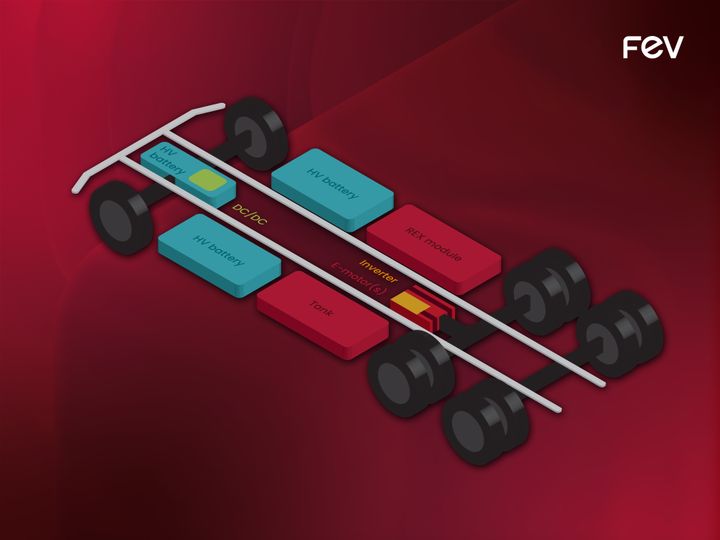
Calculations are based on realistic European usage profiles with overnight charging at industrial electricity prices of around 19 cents per kilowatt hour. In regions with lower electricity costs, the advantage is correspondingly higher.
Cost-effectiveness without megawatt charging infrastructure
A key lever of the REEV architecture is the reduced battery size compared to purely battery-electric long-haul trucks. While typical BEV trucks require battery capacities of around 560 kWh, a REEV truck can manage with around 280 kWh. Even with slower AC charging at 22 kW, around 240 kWh can be recharged overnight – enough to power the vehicle almost entirely electrically for the next day. Thus, a megawatt charging infrastructure is not necessary for economical operation.
Significant TCO advantage in the cost-critical commercial vehicle market
The economic advantage of the range extender architecture results from several factors. The smaller battery of a REEV truck reduces vehicle costs and weight while increasing payload. Also, the high proportion of electric driving enables low energy costs, especially when charging at depots at night at industrial electricity prices.
Due to their low dependence on public high-performance charging infrastructure, REEV trucks can be seamlessly integrated into existing depot structures.
Keywords
Contacts
Marius Strasdat, T +49 241 5689-6452, strasdat@fev.com
Images
Links
Subscribe to releases from FEV Group
Subscribe to all the latest releases from FEV Group by registering your e-mail address below. You can unsubscribe at any time.
Latest releases from FEV Group
Daimler Buses teams up with FEV to launch the first hydrogen-powered Setra demonstrator vehicle4.2.2026 12:30:00 EET | Press release
Aachen, FEV has teamed up with Daimler Buses to create the first coach with a hydrogen fuel cell drive system. The starting point for the “H₂ Coach” technology demonstrator, which is intended for testing purposes, was a conventional Setra coach. This marks an important step toward locally emission-free long-distance travel: short refueling times, ranges of at least 800 kilometers per tank filling, and quiet operation underscore its practicality.
FEV expands portfolio with advanced robotics and bundles expertise for sustainable and economical applications16.10.2025 12:28:55 EEST | Press release
Aachen, Technological advances in artificial intelligence and humanoid robotics are opening up new potential for commercial applications. In parallel, requirements for efficiency, scalability, and cost-effectiveness are constantly increasing. FEV is expanding its portfolio to encompass the field of ‘advanced robotics’, offering companies from numerous industries new opportunities to further develop humanoid systems in a targeted manner, integrate them into products, and leverage value creation potential.
FEV and Nature Architects collaborate on the development of AI-supported, innovative vehicle structures25.9.2025 13:13:07 EEST | Press release
Aachen/Tokyo – Leading international engineering service provider FEV and Japanese technology company Nature Architects (NA) have agreed on a strategic collaboration. The goal is to jointly develop novel vehicle structures that set new standards in lightweight construction, functionality, and development dynamics through innovative design methods using artificial intelligence.
FEV and Chiyoda combine expertise for sustainable energy solutions12.9.2025 08:20:06 EEST | Press release
Aachen – FEV, a leading global engineering and consulting service provider for the energy industry has announced a strategic partnership with the Japan-based Chiyoda Corporation (Chiyoda). The company is one of the world's leading integrated engineering firms, active in a wide range of business areas including energy, decarbonization, and life sciences.
Generative AI accelerates homologation: FEV simplifies country-specific type approval processes10.7.2025 12:00:00 EEST | Press release
Aachen – Vehicle development doesn’t end with technical readiness: The road to global market launches is only complete once homologation has been successfully achieved. The increasing complexity of national regulations poses growing challenges to OEMs and suppliers. FEV addresses these with an innovative, AI-based approach: The company-wide used ‘FEV GenAI Hub’ significantly simplifies and accelerates the analysis of regulatory requirements across different global markets, offering time and cost savings that can provide customers with a decisive competitive edge.