
Klara Kristalova, Benjamin Orlow and Tori Wrånes present How Many Angels Can Dance on the Head of a Pin? at the Nordic Countries Pavilion at 61st International Art Exhibition – La Biennale di Venezia
4.5.2026 11:00:00 EEST | KIASMA | Press release
Myth, matter and bodies blur in a world shaped by collapse and renewal.
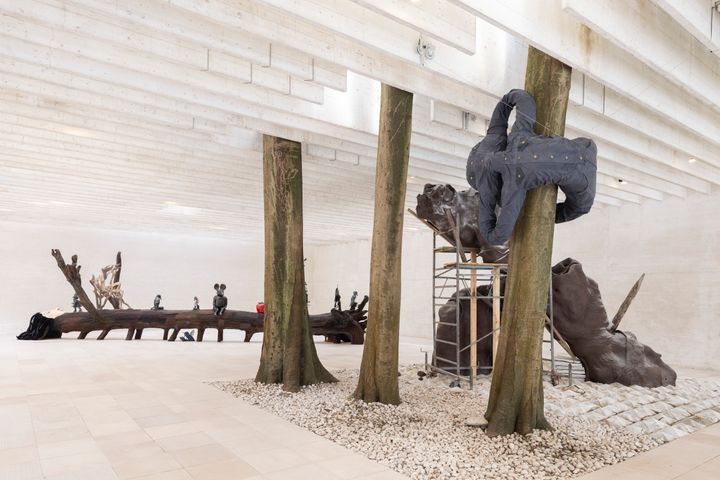
How Many Angels Can Dance on the Head of a Pin? is a collaborative exhibition presented by the Nordic Countries Pavilion at the 61st International Art Exhibition - La Biennale di Venezia. Bringing together works by Klara Kristalova, Benjamin Orlow and Tori Wrånes, and curated by Anna Mustonen (Chief Curator, Museum of Contemporary Art Kiasma), the exhibition transforms the pavilion into a sculptural, mythical environment where bodies, materials and architecture interact in shifting and unstable ways. The exhibition is commissioned by Kiasma and co-commissioned by Moderna Museet, Sweden, and OCA – Office for Contemporary Art Norway. The exhibition runs from 9 May to 22 November 2026.
The exhibition’s title draws on a medieval philosophical question concerning how multiple entities may occupy the same space. Here, it opens onto broader reflections on coexistence - between bodies, systems and perspectives - at a time marked by increasing social, environmental and geopolitical division. Visitors are invited to consider their relationship to one another, to the natural world and to the passage of time.
Drawing from myth, folklore and fairytale traditions, the three artists respond to contemporary conditions of disconnection. Central to the exhibition is the influence of the Kalevala, the 19th-century epic of Finland and Karelia, particularly the myth of the Sampo: a magical ‘vessel of abundance’ that is ultimately destroyed with its pieces scattered into the sea. This narrative serves as a framework for exploring what happens when systems of order collapse, and how processes of fragmentation give rise to renewal. Within the pavilion designed by Sverre Fehn, the works unfold as interconnected elements that explore instability, interdependence and transformation.
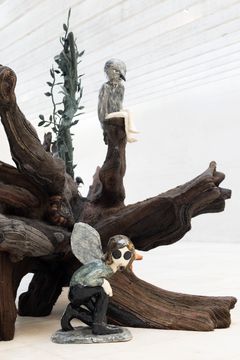
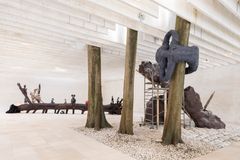
Klara Kristalova’s Lust for Life centres on a monumental fallen tree that simultaneously suggests the form of a reclining or fallen female figure. Populated by hybrid creatures in ceramic, bronze and wood, the installation balances playfulness with an uncanny sense of vulnerability. The work blurs distinctions between human and non-human life, challenging fixed identities while emphasising the dignity of all living beings. Perched outside, Bird Disguise, an enigmatic owl-like figure casts its gaze toward nearby pavilions, as if caught in transit, its point of origin and destination unclear, subtly dissolving notions of national belonging.
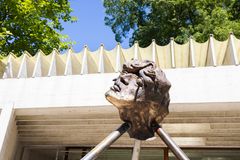
Benjamin Orlow’s Ritual City fills the pavilion’s interior with a colossal sculptural form, improvised in situ from raw clay. Emerging from behind the trees, it takes the shape of a disembodied, partitioned figure, held in a precarious tension between cohesion and collapse. On the pavilion’s façade, a severed head is propped on steel piles, with wooden spikes shooting from its eyes. The sculpture echoes enduring mythological symbols of destruction and simultaneous rebirth. As the clay dries, cracks and disintegrates over the course of the exhibition, Orlow’s practice emphasises process over permanence: the body not an ideal to be realised, but a site of continual negotiation.
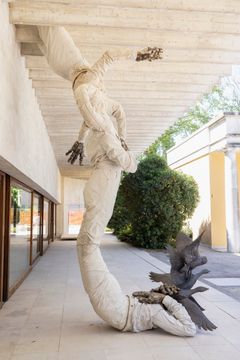
Tori Wrånes’ installation integrates sculptural, performative and sonic elements. In Human Lace, towering headless figures interlock and extend through the architecture, dissolving distinctions between interior and exterior space. Their forms suggest a metamorphosis into birds, echoing the moment of the Sampo’s theft in the Kalevala. In Erotic poetry by the architect, nature and me, a kinetic figure repeatedly moves up and down a tree, introducing endurance and temporality as central themes. Wrånes also incorporates a sonic: A foghorn, vital in low visibility, signals every hour to warn off hazards and make you navigate safely. The pavilion will be activated by a unique live performance during its opening ceremony on Wednesday 6 May at 15:00, which will reoccur on Saturday 9 May at 13.00.
Together, Kristalova, Orlow and Wrånes transform the Nordic Countries Pavilion into a living environment - one that is grown and inhabited as much as it is constructed. The exhibition proposes a space of coexistence shaped by continual change, asking how we might inhabit systems that are inherently unstable, and how transformation can become a shared condition rather than a point of rupture.
Anna Mustonen, Chief Curator at Kiasma, commented: “With this exhibition, I wanted to create a space where the works are not simply placed within the Pavilion, but actively shape and transform it. The artists approach myth not as something distant or symbolic, but as a living method - one that allows us to think through collapse, fragmentation and renewal in relation to the present. At a time marked by division, the exhibition asks how we might inhabit a world that is fundamentally shifting, and how we can begin to imagine forms of connection that do not rely on fixed structures, but emerge through change itself.”
Kiira Miesmaa, Director of Museum of Contemporary Art Kiasma and commissioner of the Nordic Countries Pavilion 2026, commented: “Seeing the Nordic Pavilion come together has been a powerful reminder of what cross-cultural collaboration can achieve. I have been struck by how a shared cultural heritage, mutual respect, and trust make it possible for distinct artistic voices and visual languages to coexist within a single, sculpturally charged space. This way of working not only brings the exhibition into being, but also reinforces the values we share and highlights the essential role of art in society.”
The exhibition is supported by Finnish Cultural Foundation, Galleri Magnus Karlsson, Jane and Aatos Erkko Foundation, Kiasma Support Foundation, Ministry of Education and Culture, Nelimarkka-Foundation, Niemistö Art Foundation Ars Fennica, Saastamoinen Foundation, Tiftö Foundation, Svenska Kulturfonden, Perrotin and Nazarian / Curcio.
Keywords
Contacts
For international press enquiries, please contact:
Rel Hayman at Pelham Communications: rel@pelhamcommunications.com
Lucy Groom at Pelham Communications: lucy@pelhamcommunications.com
For Finnish press enquiries, please contact:
Kiira Koskela at Museum of Contemporary Art Kiasma: kiira.koskela@kiasma.fi
Images
Links
Museum of Contemporary Art Kiasma
Mannerheiminaukio 2,
FIN-00100
Helsinki, Finland
The Finnish National Gallery is the national museum of fine arts. It operates three of Finland’s best-known museums: the Ateneum Art Museum, the Museum of Contemporary Art Kiasma and the Sinebrychoff Art Museum. It also manages the national art collection and its archives, develops Finnish cultural heritage and promotes art to the wider public. www.kansallisgalleria.fi/en
Alternative languages
Subscribe to releases from KIASMA
Subscribe to all the latest releases from KIASMA by registering your e-mail address below. You can unsubscribe at any time.
Latest releases from KIASMA
Inbjudan till media: Presskonferens för Emma Ainalas utställning Like a Prayer på Kiasma torsdagen den 8 oktober17.9.2026 09:30:32 EEST | Pressinbjudan
Utställningen Like a Prayer visar verk av Emma Ainala från de senaste tio åren. Temana som flödar fram ur kvinnligheten och blickens betydelser får nya nyanser i de verk Ainala har framställt för utställningen, där hon borrar sig ännu djupare ner i undermedvetna och delade erfarenheter i nutiden. Välkommen till presskonferensen på Museet för nutidskonst Kiasma torsdagen den 8.10. Vänligen anmäl ditt deltagande: kiira.koskela@kiasma.fi
Tervetuloa Emma Ainalan näyttelyn lehdistötilaisuuteen Kiasmaan 8.10.202617.9.2026 09:30:32 EEST | Kutsu
Like a Prayer -näyttely esittelee Ainalan teoksia viimeisten kymmenen vuoden ajalta. Naiseudesta ja katseen merkityksistä kumpuavat teemat saavat uusia sävyjä näyttelyyn valmistuneissa teoksissa, joissa Ainala porautuu entistä syvemmälle alitajuisiin ja jaettuihin kokemuksiin nykyajasta. Tervetuloa näyttelyn lehdistötilaisuuteen Kiasmaan torstaina 8.10.2026. Ilmoittauduthan: kiira.koskela@kiasma.fi
Invitation to media: Press conference for Emma Ainala's exhibition Like a Prayer on 8 October at Kiasma17.9.2026 09:30:32 EEST | Press invitation
Like a Prayer shows Emma Ainala’s artworks from the last ten years. Welcome to the press conference at the Museum of Contemporary Art Kiasma on Thursday 8 October 2026. Please register: kiira.koskela@kiasma.fi
Kiasma presenterar den hittills mest omfattande utställningen i Norden över den hyllade brittiska nutidskonstnären Antony Gormley16.9.2026 12:00:00 EEST | Pressmeddelande
Hold kommer att vara museets huvudutställning 2027. Den visar en bred översikt över Gormleys verk, spårar hur hans arbete har utvecklats från 1970-talet fram till nuet.
Kiasma esittää nykytaiteen suurnimen Antony Gormleyn tähän asti laajimman näyttelyn Pohjoismaissa16.9.2026 12:00:00 EEST | Tiedote
Kiasman suurnäyttely vuonna 2027 esittelee britannialaisen kuvanveistäjän Antony Gormleyn taidetta. Hold-näyttely tarjoaa laajan katsauksen Gormleyn tuotantoon ja siihen, miten hänen taiteellinen työskentelynsä on kehittynyt 1970-luvulta lähtien. Näyttely avautuu Kiasmassa 12. helmikuuta.
In our pressroom you can read all our latest releases, find our press contacts, images, documents and other relevant information about us.
Visit our pressroom