
Europeans call for greater independence: Support for U.S. as Europe’s Top Ally Drops Sharply
7.5.2026 09:00:00 EEST | Bertelsmann Stiftung | Press release
Europe is rethinking its place in the world. After decades of close cooperation with the United States, nearly three in four EU citizens now say the Union should ‘go its own way’. A clear majority of Europeans do not see the U.S. as a trustworthy partner any longer. A year and a half into the Trump presidency, the share of respondents identifying the U.S. as Europe’s most valuable ally has fallen by 20 percentage points. While China fails to gain ground as an alternative partner, Europeans are recalibrating alliances within the West. A new study by Bertelsmann Stiftung illustrates this shift.
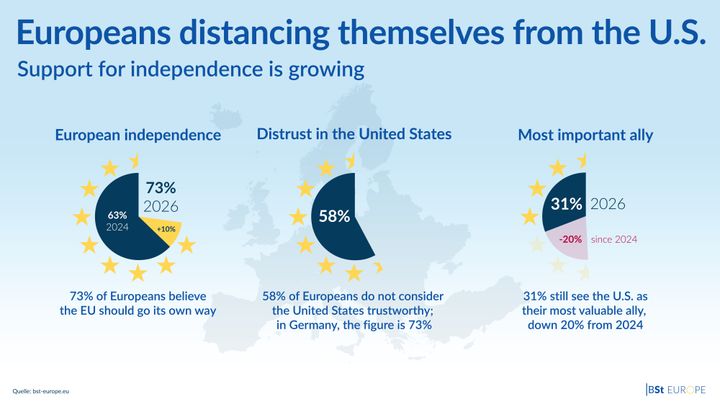
Gütersloh/Berlin, May 7, 2026 – Ahead of this year’s Europe Day on May 9, Europeans are edging towards a strategic reset. A new study by Bertelsmann Stiftung, based on surveys conducted between September 2024 and March 2026, shows a continent willing to stand on its own feet. 73 percent of EU citizens now say the Union should go its own way after decades of close alignment with the United States; up from 63 percent in 2024. The shift cuts across all demographic groups, with particularly strong gains among older Europeans.
The Trump presidency has left deep scars on the transatlantic relationship. Trust in the United States is low, with 58 percent of Europeans now saying they do not see Washington as a trustworthy partner. While the U.S. remains the EU’s most important ally in relative terms (31 percent), its standing has fallen by 20 percentage points since 2024. A polarizing American president and mounting geopolitical tensions have pushed European public opinion towards a more self-reliant stance.
Yet, Europe’s search for independence does not translate into a shift towards Beijing. China is viewed with persistent skepticism. Large majorities support reducing dependencies; even at economic costs. Instead, preferences are shifting within the existing alliance system. The United Kingdom and Canada are gaining importance as strategic partners, suggesting that Europeans are rebalancing rather than abandoning the transatlantic framework. Support for NATO remains solid, with clear majorities seeing it as a cornerstone of security (63 percent).
Florian Kommer, Senior Expert for European Strategic Issues at the Bertelsmann Stiftung, argues: “The message ahead of this year’s Europe Day is unmistakable: Europeans want to become more independent from the United States. Trust has eroded, America’s standing as Europe’s central partner has fallen. The partnership is not beyond repair, but our data point to a deeper, structural rift in transatlantic relations. European citizens are calling for greater independence, notably in foreign and security policy. Policymakers need to translate this call into detailed policies and a real investment in Europe’s own capabilities.”
Brandon Bohrn, Senior Expert for Transatlantic Relations at the Bertelsmann Stiftung, adds: “In this context, building a stronger and more self-reliant Europe goes hand in hand with expanding its partnerships to ensure greater resilience and strategic stability.”
For more information: www.eupinions.eu
Keywords
Contacts
Brandon Bohrn
Phone: +49 30 275788-174
E-Mail: brandon.bohrn@bertelsmann-stiftung.de
Images
Links
Subscribe to releases from Bertelsmann Stiftung
Subscribe to all the latest releases from Bertelsmann Stiftung by registering your e-mail address below. You can unsubscribe at any time.
Latest releases from Bertelsmann Stiftung
Many advanced economies remain ill-prepared for present challenges28.5.2025 12:00:00 EEST | Press release
A shifting geopolitical landscape, sluggish growth, digital transformation, the climate crisis and demographic change are testing the capacity of OECD and EU countries to innovate and adapt like never before. Denmark, Finland, Sweden and Norway are among the best positioned. But the analysis of 144 indicators from the Bertelsmann Stiftung's Sustainable Governance Indicators (SGI) reveals a troubling pattern: most advanced economies are still not adequately equipped to deliver sustainable policy.
New white paper: Public AI as a democratic alternative to the concentration of private power20.5.2025 13:00:00 EEST | Press release
Gütersloh, May 20, 2025 The most powerful AI systems of our time were developed and are controlled by a small number of private companies – including OpenAI, Anthropic, Google DeepMind, Meta, and DeepSeek. These companies don’t just dominate the development of models, they control the basic infrastructure of the AI ecosystem: computing capacities, training data, and cloud services. This concentration of power is not just a technological reality – it is a political challenge. It raises a central question: Who designs the systems that are increasingly influencing our society? To counteract this growing imbalance, the Bertelsmann Stiftung, with the support of Open Future, has presented a new white paper on Public AI. This publication outlines a strategic and actionable framework for an alternative approach to the development and application of AI, based on greater transparency, open access to critical infrastructure, and a stronger focus on the common good. Societies should not just use A
Growth and innovation as cornerstones of a strong de-mocracy and a digitally sovereign Europe29.4.2025 13:00:00 EEST | Press release
Germany should be restored to a growth path and should give new impulse to innovation, along with its European partners. Because prosperity is a significant guarantor of a stable democracy. Digital sovereignty is the anchor of a strong Europe. Germany can once again be a country of pioneering innovation and a pacesetter for the continent. For this, comprehensive modernization of the state is indispensable. The Bertelsmann Stiftung presented its proposals at the annual press conference.
Reinhard Mohn Prize awarded to Maia Sandu and Michael Otto20.2.2025 16:00:00 EET | Press release
Gütersloh – February 20, 2025. The Bertelsmann Stiftung today awarded the 2025 Reinhard Mohn Prize to the President of the Republic of Moldova, Maia Sandu, and to entrepreneur and philanthropist Michael Otto. In keeping with the title of this year’s prize – “Strengthen democracy!” – it presented the award in recognition of both recipients’ commitment to democratic values and a free society. At Gütersloh Theater, before an audience of some 500 guests, Germany’s Federal President Frank-Walter Steinmeier and Liz Mohn, honorary member of the Bertelsmann Stiftung’s Board of Trustees and the foundation’s global representative, gave the presentation speeches. The two award winners will share the prize money totaling €200,000 euros and will donate it to non-profit projects and initiatives. The Bertelsmann Stiftung broadcast the ceremony via livestream. “In a crisis-torn world, democracy faces enormous challenges,” said Liz Mohn. “Maintaining, developing and strengthening democracy was one of t
Climate neutrality: The OECD and EU countries best equipped to lead the way17.12.2024 09:00:00 EET | Press release
How determined are OECD and EU countries in pursuing the goal of climate neutrality by 2050? A recent monitoring report by the Bertelsmann Stiftung reveals that Sweden, Denmark, Finland and Spain are setting the pace with their effective policy strategies. In contrast, Canada, Australia, Israel, Poland and Hungary need to significantly ramp up their efforts. The analysis compares the effectiveness of national policies in climate protection, energy transition and circular economy practices.