
Radiation doses of radiation workers were moderate in 2025
4.6.2026 08:15:00 EEST | Säteilyturvakeskus (STUK) | Press release
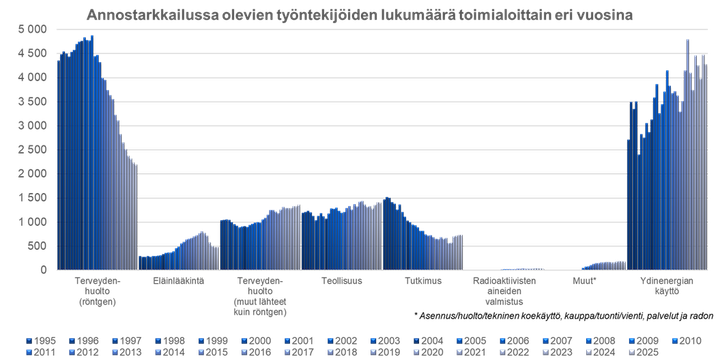
Thousands of people in different fields, from health care to industry and air transport, work with radiation in Finland. The majority of people in such professions are exposed to very low levels of radiation. The level of exposure is often significantly lower than exposure caused by natural background radiation
Principal Advisor Maaret Lehtinen from the Radiation and Nuclear Safety Authority (STUK) states that last year was usual in terms of occupational radiation exposure. Dose limits set for the occupational doses were not exceeded.
Highest doses from airline work
In radiation work, pilots and cabin crew form a group of their own. Their radiation doses mainly come from cosmic radiation from space. The total radiation dose of people who work in airplanes is higher than in any other worker group, and the radiation doses per worker are also the highest.
‘The higher and longer you fly, the bigger the radiation dose you get,’ Maaret Lehtinen says. The flight path and the activity of the sun, which varies in cycles of about 11 years, also have an impact on the level of cosmic radiation.
Last year, the annual doses that aircrew were exposed to was well below the limit values.
This means that cosmic radiation has not had an adverse effect on the health of pilots or cabin crew. However, it is important that cosmic radiation is taken seriously. For example, airlines limit the flying hours of pregnant workers - one reason for which is cosmic radiation.
Health care workers exposed to low radiation doses
A large proportion of radiation workers work in health care, for example in examinations that utilise X-ray radiation or procedures that use radioactive substances.
When using radiation in health care, it is important that the safety of both patients and workers is ensured. The safety aspect must also be taken into account when introducing new forms of treatment and technology.
‘The use of radiation and radioactive substances has increased in health care, but at the same time, exposure is being managed better with significant developments in technology and processes,’ says Maaret Lehtinen. “For example, the use of X‑ray radiation in healthcare resulted in a total exposure for all employees that was nearly the same as the exposure a patient receives from a single CT scan.”
Unlike for patients, radiation exposure for employees is purely harmful and is kept as low as possible. In contrast, patients are considered to benefit from the radiological examination performed on them, and the benefit is assessed to be greater than the risk caused by the radiation exposure.
Operators are obliged to protect their workers
The operator is always responsible for the radiation safety of employees, patients, and bystanders. Worker exposure to radiation is monitored using personal dosimeters, and the results are recorded in the Dose Register maintained by the Radiation and Nuclear Safety Authority. The operator must always notify the Radiation and Nuclear Safety Authority whenever dose limits are exceeded or other deviations in radiation safety occur.
Monitoring exposure conditions and personal monitoring of doses ensure that workers are not exposed more than planned and not more than the dose limits. In addition, the purpose of monitoring is to identify deviations in radiation safety and to improve radiation safety.
STUK updated the regulations on investigating occupational exposure, and the new regulations entered into force on 1 May 2026.
See the full regulations on the investigation, assessment, and monitoring of occupational exposure (STUK S/2/2026) and other STUK regulations here: https://stuk.fi/en/stuk-regulations
Keywords
Contacts
Maaret LehtinenPrincipal adviserSTUK
Tel:+358 975 988 244Media contacts
Tel:+358(10)8504761Alternative languages
Subscribe to releases from Säteilyturvakeskus (STUK)
Subscribe to all the latest releases from Säteilyturvakeskus (STUK) by registering your e-mail address below. You can unsubscribe at any time.
Latest releases from Säteilyturvakeskus (STUK)
Mycket små mängder radioaktivt kobolt i luften i Imatra i augusti10.9.2026 13:32:57 EEST | Pressmeddelande
Strålsäkerhetscentralen (STUK) upptäckte radioaktivt kobolt i ett luftpartikelprov som samlades in i Imatra i augusti.
Imatran ilmassa oli elokuussa hyvin vähän radioaktiivista kobolttia10.9.2026 13:32:57 EEST | Tiedote
Säteilyturvakeskus havaitsi Imatralla elokuussa kerätyissä ilman hiukkasnäytteessä radioaktiivista kobolttia.
IAEA:n tiedote: Kansainvälinen atomienergiajärjestö IAEA arvioi Suomen ydin- ja säteilyturvallisuusvalmiutta3.9.2026 12:01:51 EEST | Tiedote
Kansainvälisen atomienergiajärjestön (IAEA) asiantuntijaryhmä on päättänyt kymmenen päivää kestäneen arviointitehtävänsä, jonka aikana se arvioi Suomen ydin- ja säteilyvaaratilanteisiin varautumista ja valmiusjärjestelyjä. Emergency Preparedness Review (EPREV) -arviointi tehtiin Suomen hallituksen pyynnöstä, ja sen käytännön järjestelyistä Suomessa vastasi Säteilyturvakeskus (STUK).
IAEA Press Release: IAEA Reviews Finland's Nuclear and Radiological Emergency Preparedness and Response3.9.2026 12:01:51 EEST | Press release
An International Atomic Energy Agency (IAEA) team of experts has concluded a ten-day mission to review Finland's preparedness and response framework for nuclear and radiological emergencies. The Emergency Preparedness Review (EPREV) Service was carried out at the request of the Government of Finland and hosted by the Radiation and Nuclear Safety Authority (STUK).
Första internationella utvärderingen av Finlands beredskap för strålningsfaror25.8.2026 11:05:58 EEST | Pressmeddelande
En internationell expertgrupp som sammankallats av Internationella atomenergiorganet (IAEA) utvärderar Finlands beredskap för strålningsfarasituationer. Den del av utvärderingen som omfattar informationsinsamling och besök vid finländska organisationer inleddes måndagen den 25 augusti och pågår fram till den 1 september.
In our pressroom you can read all our latest releases, find our press contacts, images, documents and other relevant information about us.
Visit our pressroom