
Regional differences in rates of work disability growing – morbidity statistics show rise in occurrence of diabetes and sleep apnoea nationwide
11.6.2026 06:00:00 EEST | Kela/FPA | Press release
According to the latest results from the National Health Index, rates of work disability are on the decline among the population in Uusimaa while primarily increasing elsewhere in Finland. Morbidity, however, is changing in different ways in different diagnostic categories. For example, the occurrence of coronary disease is declining in all of Finland while diabetes and sleep apnoea are on the rise nationwide. Mental health also remains a concern.
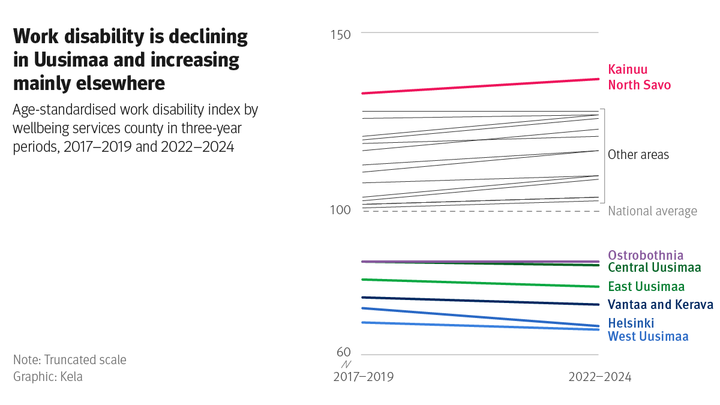
The statistics on work disability exhibit regional variance in Finland: In Uusimaa, work disability rates have declined from before while primarily remaining the same or increasing in other parts of the country. The work disability index included in the National Health Index provides shows developments in work disability statistics. The work disability index tracks granted disability pensions, longer sickness allowance periods and positive decisions on vocational rehabilitation.
The differences in sickness allowance periods between Uusimaa and the rest of Finland have increased between 2017 and 2024. The incidence of sickness allowance periods has increased further in regions where sickness allowance periods were already more prevalent than in Finland on average. Correspondingly, sickness allowance periods have decreased further in regions with a lower incidence of sickness allowance periods compared to the rest of Finland.
Regional differences have remained fairly small in terms of disability pensions, while regional differences in vocational rehabilitation have narrowed.
Mental health remains a concern
Regions show significant variation in the development of strain caused by different diagnostic categories between 2017 and 2024. The developments in morbidity are reflected in the morbidity indices included in the National Health Index.
When examined by diagnostic category, the largest regional differences can be observed in alcohol morbidity and mental health disorders. Regional differences exist not only in morbidity but also in the use and availability of services.
The mental health index has decreased, on average, nationwide and in almost all wellbeing services counties. The index tracks special rates of reimbursement for medications granted on the grounds of psychosis and disability pensions granted for mental health reasons as well as suicide attempts and suicide mortality.
Disability pensions granted for mental health reasons have decreased in all regions. This may be due to growing rejection rates for applications for disability pension made on mental health related grounds. There have been no major changes in the statistics for special rates of reimbursement granted for antipsychotics. Suicide mortality was on the decline for a long time but has stagnated in recent years.
Concurrently, other mental health indicators are showing developments that give cause for alarm. Mental strain has increased especially among young people of working age, suicidal ideation has become more prevalent, and the use of antidepressants has become more common especially among young women.
“Mental health remains a concern in Finland. Early access to care needs to be improved and mental health problems should be addressed quickly to prevent them from becoming chronic if we do not want to lose entire careers,” says Kati Sarnola, Senior Researcher at Kela.
Incidence of cardiovascular disease continues to decline – stagnation in the south
For coronary disease and cerebrovascular disease, morbidity has fallen sharply in many regions where their morbidity was high in 2017 based on the indices for coronary disease and cerebrovascular disease. Such regions include, for example, South Karelia, South Savo and Päijät-Häme.
However, the decline in the incidence of cardiovascular disease appears to have stagnated in southern Finland where morbidity was already lower to begin with. This suggests that new measures are needed.
“Disease prevention remains the most effective way to support health. Reliable information on what a healthy lifestyle looks like is already available, but there is a need for societal incentives that encourage the population to make healthy choices, such as health-based taxation,” says Suvi Parikka, Research Manager at the Finnish Institute for Health and Welfare.
Diabetes and sleep apnoea on the rise nationwide
The incidence of diabetes and chronic pulmonary diseases is growing sharply in all wellbeing services counties. The increase in the occurrence of pulmonary diseases is explained by the growing prevalence of sleep apnoea diagnoses, which in turn is caused especially by the increase in obesity rates among the working-age population. Obesity is also closely associated with the prevalence of diabetes.
In addition, obesity and a lack of exercise are linked to many other medical conditions, and they may contribute to the increase of e.g. mental health problems, musculoskeletal disorders and circulatory diseases in the long term.
“Obesity and its comorbidities are clearly a growing public health problem. If we cannot stop the rise in obesity rates, morbidity and work disability will increase in the future,” says Kati Sarnola.
National Health Index supports regional decision-making
The National Health Index compiles comprehensive data on morbidity and work disability in one place, allowing reliable comparisons between regions. The indices support decision-making in the wellbeing service counties and help identify regional needs more accurately.
The compiled indices compare the prevalence of morbidity and work disability in regional populations against the national average so that the indicator for the whole country is 100. A figure higher than 100 translates into higher incidence and a figure smaller than 100 to lower incidence of morbidity or work disability in the specific region.
More information
Publication and materials:
Keywords
Contacts
Suvi ParikkaResearch ManagerFinnish Institute for Health and Welfare
Tel:029 524 7959suvi.parikka@thl.fiKati SarnolaSenior Researcher, Adjunct ProfessorKela
Tel:020 635 7885kati.sarnola@kela.fitietotarjotin.fi/en/contact-information/114828/kati-sarnolaKela's Communications UnitFor media enquiries, please contact us between 9:00 and 16:00, Monday to Friday. This number can be used for interview requests, which we will be happy to forward to an appropriate source at Kela. You can also submit interview requests by email.
Tel:+358 20 634 7745viestinta@kela.fiKela has a responsibility to provide basic support in life’s ups and downs to everyone covered by the Finnish social security system.

Alternative languages
Subscribe to releases from Kela/FPA
Subscribe to all the latest releases from Kela/FPA by registering your e-mail address below. You can unsubscribe at any time.
Latest releases from Kela/FPA
Korrigerat pressmeddelande: FPA ber cirka 25 000 studerande lämna in en utredning om varför studierna inte framskridit tillräckligt – studiestöd och bostadstillägg kan dras in för en del2.10.2026 15:06:09 EEST | Pressmeddelande
FPA följer årligen upp studietakten hos studerande på andra stadiet och hos högskolestuderande. En studerande ska göra tillräckliga framsteg i sina studier för att FPA ska kunna betala ut studiestöd och bostadstillägg.
Korjattu tiedote: Kela pyytää noin 25 000 opiskelijalta selvitystä siitä, miksi opinnot eivät ole edistyneet – opintotuki ja asumislisä voidaan lakkauttaa osalta2.10.2026 15:06:09 EEST | Tiedote
Läs meddelandet på svenska (fpa.fi). Pressrelease in English (kela.fi). Kela seuraa vuosittain, etenevätkö toisen asteen ja korkeakoulujen opiskelijat opinnoissaan riittävästi. Opiskelijan täytyy edetä opinnoissaan riittävästi, jotta Kela voi maksaa opintotukea ja asumislisää.
Corrected press release: Kela asks approximately 25,000 students to explain lack of progress in their studies – some may lose their student financial aid and housing supplement2.10.2026 15:06:09 EEST | Press release
Kela monitors the study progress of students in upper secondary education and higher education on a yearly basis. Students are required to make satisfactory progress with their studies in order to get financial aid for students and housing supplement from Kela.
FPA ber cirka 25 000 studerande lämna in en utredning om varför studierna inte framskridit tillräckligt – studiestöd och bostadstillägg kan dras in för en del2.10.2026 08:00:00 EEST | Pressmeddelande
FPA följer årligen upp studietakten hos studerande på andra stadiet och hos högskolestuderande. En studerande ska göra tillräckliga framsteg i sina studier för att FPA ska kunna betala ut studiestöd och bostadstillägg.
Kela pyytää noin 25 000 opiskelijalta selvitystä siitä, miksi opinnot eivät ole edistyneet – opintotuki ja asumislisä voidaan lakkauttaa osalta2.10.2026 08:00:00 EEST | Tiedote
Läs meddelandet på svenska (fpa.fi). Pressrelease in English (kela.fi). Kela seuraa vuosittain, etenevätkö toisen asteen ja korkeakoulujen opiskelijat opinnoissaan riittävästi. Opiskelijan täytyy edetä opinnoissaan riittävästi, jotta Kela voi maksaa opintotukea ja asumislisää.
In our pressroom you can read all our latest releases, find our press contacts, images, documents and other relevant information about us.
Visit our pressroom