
A decade after the Brexit referendum: Time for European pragmatism
22.6.2026 09:37:25 EEST | Bertelsmann Stiftung | Press release
On June 23, 2016, British voters chose to leave the European Union, sending shockwaves across the continent. To mark the anniversary, the Bertelsmann Stiftung is publishing exclusive data tracking public opinion in the UK and the EU over the past ten years. The findings suggest that Brexit has neither triggered further EU fragmentation nor driven British and European public opinion permanently apart. Instead, they point to a shared preference for pragmatic cooperation.
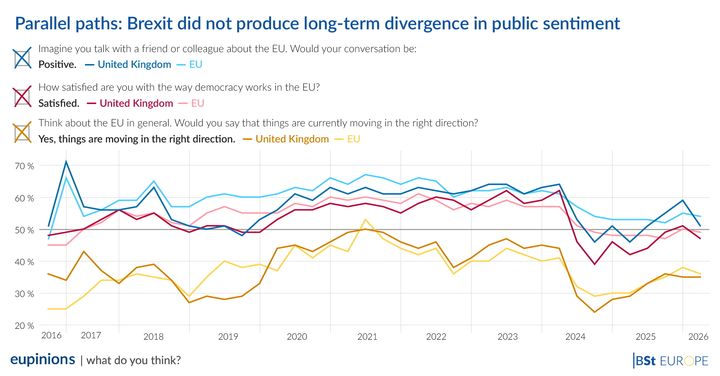
Gütersloh/Berlin, June 22, 2026 – Fears that Brexit would trigger a wider exodus from the EU never materialised. By March 2026, only 21 per cent of Britons and 18 per cent of EU citizens believed that other member states would follow the UK’s example and leave the Union; less than half the level recorded in March 2018. While the result of the Brexit referendum in 2016 was narrow, such a majority has not reappeared since. Asked how they would vote in a referendum on EU membership, more than 50% of Britons have consistently said they would vote to remain over the past ten years. The most recent figures, from March 2026, show a stable majority for Remain, at 57 per cent.
The populist promise that people would be better off after Brexit proved false. Shortly after the referendum, Britons were relatively optimistic about their future outside the EU. A decade later, this Brexit optimism collapsed. In March 2026, only 41 per cent of Britons said they felt positive about their personal outlook for the future; a decline of 27 percentage points. Only 23 per cent said their economic situation had improved over the previous two years, down 21 percentage points. Overall, early Brexit optimism has given way to a wave of pessimism in the UK.
Brexit has not created a lasting psychological divide between British and European public opinion. Ten years on, Britons and continental Europeans increasingly share common concerns and expectations about Europe’s future. By March 2026, attitudes were remarkably similar: support for a stronger EU role in world affairs stood at 66% in the UK and 71% across the EU, around half of respondents on both sides viewed the EU positively, and levels of satisfaction with EU democracy and perceptions of the EU’s direction were almost identical.
Jake Benford, Bertelsmann Stiftung’s UK expert, argues: " The public has moved on faster than politics. Citizens increasingly recognise that European fragmentation comes at a cost: less security, less resilience and less influence in the world. The question is whether politicians can move beyond the divisions of the past and respond to this growing public pragmatism."
Florian Kommer, Bertelsmann Stiftung’s Europe Expert, commented: “In 2016, many believed the Brexit referendum marked the beginning of the end for the European Union. A decade later, the picture looks very different. Our findings suggest that the space for EU–UK cooperation may be wider today than is often assumed.”
The full dataset is available on our website: www.eupinions.eu.
Keywords
Contacts
Jake Benford, +49 173 7306478, jake.benford@berteslamnn-stiftung.de
Images
Subscribe to releases from Bertelsmann Stiftung
Subscribe to all the latest releases from Bertelsmann Stiftung by registering your e-mail address below. You can unsubscribe at any time.
Latest releases from Bertelsmann Stiftung
Many advanced economies remain ill-prepared for present challenges28.5.2025 12:00:00 EEST | Press release
A shifting geopolitical landscape, sluggish growth, digital transformation, the climate crisis and demographic change are testing the capacity of OECD and EU countries to innovate and adapt like never before. Denmark, Finland, Sweden and Norway are among the best positioned. But the analysis of 144 indicators from the Bertelsmann Stiftung's Sustainable Governance Indicators (SGI) reveals a troubling pattern: most advanced economies are still not adequately equipped to deliver sustainable policy.
New white paper: Public AI as a democratic alternative to the concentration of private power20.5.2025 13:00:00 EEST | Press release
Gütersloh, May 20, 2025 The most powerful AI systems of our time were developed and are controlled by a small number of private companies – including OpenAI, Anthropic, Google DeepMind, Meta, and DeepSeek. These companies don’t just dominate the development of models, they control the basic infrastructure of the AI ecosystem: computing capacities, training data, and cloud services. This concentration of power is not just a technological reality – it is a political challenge. It raises a central question: Who designs the systems that are increasingly influencing our society? To counteract this growing imbalance, the Bertelsmann Stiftung, with the support of Open Future, has presented a new white paper on Public AI. This publication outlines a strategic and actionable framework for an alternative approach to the development and application of AI, based on greater transparency, open access to critical infrastructure, and a stronger focus on the common good. Societies should not just use A
Growth and innovation as cornerstones of a strong de-mocracy and a digitally sovereign Europe29.4.2025 13:00:00 EEST | Press release
Germany should be restored to a growth path and should give new impulse to innovation, along with its European partners. Because prosperity is a significant guarantor of a stable democracy. Digital sovereignty is the anchor of a strong Europe. Germany can once again be a country of pioneering innovation and a pacesetter for the continent. For this, comprehensive modernization of the state is indispensable. The Bertelsmann Stiftung presented its proposals at the annual press conference.
Reinhard Mohn Prize awarded to Maia Sandu and Michael Otto20.2.2025 16:00:00 EET | Press release
Gütersloh – February 20, 2025. The Bertelsmann Stiftung today awarded the 2025 Reinhard Mohn Prize to the President of the Republic of Moldova, Maia Sandu, and to entrepreneur and philanthropist Michael Otto. In keeping with the title of this year’s prize – “Strengthen democracy!” – it presented the award in recognition of both recipients’ commitment to democratic values and a free society. At Gütersloh Theater, before an audience of some 500 guests, Germany’s Federal President Frank-Walter Steinmeier and Liz Mohn, honorary member of the Bertelsmann Stiftung’s Board of Trustees and the foundation’s global representative, gave the presentation speeches. The two award winners will share the prize money totaling €200,000 euros and will donate it to non-profit projects and initiatives. The Bertelsmann Stiftung broadcast the ceremony via livestream. “In a crisis-torn world, democracy faces enormous challenges,” said Liz Mohn. “Maintaining, developing and strengthening democracy was one of t
Climate neutrality: The OECD and EU countries best equipped to lead the way17.12.2024 09:00:00 EET | Press release
How determined are OECD and EU countries in pursuing the goal of climate neutrality by 2050? A recent monitoring report by the Bertelsmann Stiftung reveals that Sweden, Denmark, Finland and Spain are setting the pace with their effective policy strategies. In contrast, Canada, Australia, Israel, Poland and Hungary need to significantly ramp up their efforts. The analysis compares the effectiveness of national policies in climate protection, energy transition and circular economy practices.