Contactless payments reached almost EUR 10 billion in April–June
3.9.2026 10:00:00 EEST | Suomen Pankki | Press release
Finnish bank cards were used for more payments in April–June than in the corresponding period last year. Already more than one-fifth of card payments were remote payments, i.e. card payments initiated on a computer or in a mobile application.
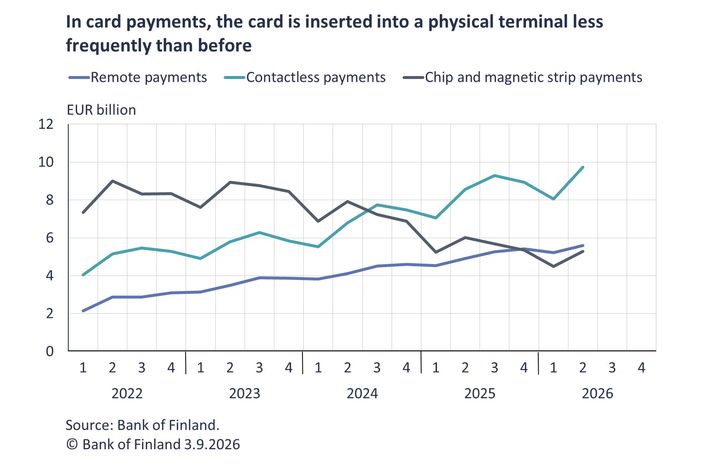
In the second quarter of 2026, Finnish payment cards were used in card payments totalling EUR 20.6 billion, which was 6% more than in April–June 2025. The total number of card payments made with Finnish payment cards over the same period was 680 million, representing an increase of 4% year-on-year.
The total value of contactless payments in the second quarter of 2026 was EUR 9.7 billion, which was EUR 1.2 billion (13%) more than in the corresponding period a year earlier. In April–June 2026, 47% of the total value of card payments was paid using the contactless feature, meaning that the share of contactless payments increased by 3 percentage points in value terms from a year earlier. Meanwhile, a total of 463 million card payments were made by contactless payment, 5% more than in the second quarter of 2025.
Finnish payment cards were used for 141 million remote payments in the second quarter of 2026, which was 13% more than in the same period a year earlier. The total value of remote card payments (EUR 6 billion) was 14% higher than in the second quarter a year earlier. Cards are used to pay remotely, for example, for online shopping in web browsers, in-app purchases and person-to-person card payments. Remote card payments accounted for 27% of the value of all card payments in April–June 2026. The share has increased steadily, having been more than 10 percentage points lower four years ago.
Payments by chip or magnetic stripe have been decreasing. In the second quarter of 2026, payments by chip or magnetic stripe totalled EUR 5.3 billion, which was 12% less than in the corresponding period a year earlier.
Some of the figures discussed in this news release have been published in the payment statistics dashboard.
The statistical data are also available via an API from the Bank of Finland’s open data portal. For details, see https://www.suomenpankki.fi/en/statistics/open-data/?epslanguage=en
The next quarterly news release on payment statistics will be published at 10 a.m. on 16 December 2026.
Further information
- Usva Topo, tel. +358 9 183 2056, email: usva.topo(at)bof.fi.
- Olli Tuomikoski, tel. +358 9 183 2925, email: olli.tuomikoski(at)bof.fi.
Links
Bank of Finland
The Bank of Finland is the national monetary authority and central bank of Finland. At the same time, it is also a part of the Eurosystem, which is responsible for monetary policy and other central bank tasks in the euro area and administers use of the world’s second largest currency – the euro.
Alternative languages
Subscribe to releases from Suomen Pankki
Subscribe to all the latest releases from Suomen Pankki by registering your e-mail address below. You can unsubscribe at any time.
Latest releases from Suomen Pankki
Finlands Banks interimsprognos: Den positiva trenden i Finlands ekonomi fortsätter15.9.2026 07:00:00 EEST | Pressmeddelande
Den ekonomiska tillväxten i Finland har tagit fart pådriven av export och investeringar, och under de närmaste åren väntas ekonomin växa i betydligt raskare takt än under de senaste åren. I takt med att ekonomin stärks börjar den ihållande höga arbetslösheten gradvis sjunka. Energipriserna driver tillfälligt upp inflationen, men omfattningen av effekterna beror i väsentlig grad på hur länge störningarna i energitillgången varar.
Suomen Pankin väliennuste: Suomen talouden hyvä vire jatkuu15.9.2026 07:00:00 EEST | Tiedote
Suomen talouskasvu on voimistunut viennin ja investointien vetämänä, ja kasvun arvioidaan jatkuvan lähivuosina aiempia vuosia selvästi ripeämpänä. Talouden vahvistuessa huomattavana pysynyt työttömyys alkaa vähitellen pienentyä. Energian hinnat kiihdyttävät inflaatiota väliaikaisesti, mutta niiden vaikutusten laajuus riippuu oleellisesti energian tarjontahäiriöiden kestosta.
Bank of Finland’s interim forecast: Positive track in Finland’s economy will continue15.9.2026 07:00:00 EEST | Press release
Growth in the Finnish economy has gathered pace, driven by exports and investment. Growth is projected to continue at a significantly brisker rate in the forecast period compared with earlier years. As the economy strengthens, the unemployment rate – which has remained high – will gradually start to fall. Inflation will be pushed up temporarily by energy prices, but the extent of this impact will primarily depend on the duration of energy supply disruptions.
Eurosystemets penningpolitiska beslut10.9.2026 15:18:07 EEST | Pressmeddelande
ECB-rådet beslutar om penningpolitiken i euroområdet. ECB-rådet beslutade idag att höja ECB:s tre styrräntor med 25 punkter.
EKP:n rahapoliittisia päätöksiä10.9.2026 15:18:07 EEST | Tiedote
EKP:n neuvosto päättää euroalueen rahapolitiikasta. EKP:n neuvosto päätti tänään nostaa EKP:n kaikkia kolmea ohjauskorkoa 0,25 prosenttiyksikköä.
In our pressroom you can read all our latest releases, find our press contacts, images, documents and other relevant information about us.
Visit our pressroom