Recent study: Trust in digitalisation strengthens even though most Finns encounter digital scams
16.9.2026 06:00:00 EEST | Digi- ja väestötietovirasto | Press release
Finns’ trust in the digital world has begun to improve for the first time in four years. The Digital Security Barometer 2026, published on Wednesday 16 September 2026, shows that the decline in trust has stopped, the sense of security has strengthened, and citizens now protect themselves more actively.
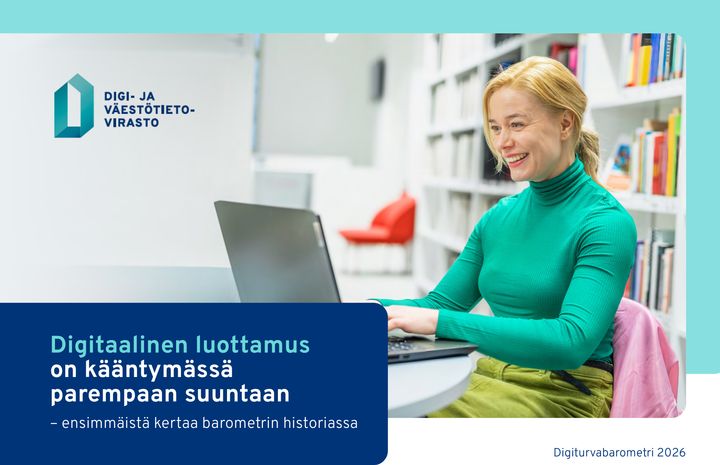
According to the Digital Security Barometer published by the Digital and Population Data Services Agency, trust in the security of digital services and devices has begun to rise after several years. The confidence index improved by seven points in one year and is already close to the 2023 level. At the same time, 86 per cent of Finns consider their everyday life in the digital environment safe.
“For the first time, we see several key indicators of digital security developing in a positive direction at the same time. There are also many grounds for the strengthening of trust: security has been improved in services, in scam prevention and in people’s own activities,” says Kimmo Rousku, Chief Senior Specialist at the Digital and Population Data Services Agency.
Strong trust in the authorities and Finnish services
Finnish people trust the authorities, the finance sector and Finnish digital services, in particular.
In the processing of personal data, 87 per cent of the respondents trust the authorities and actors in the financial sector. Eighty-two per cent of Finns trust the Suomi.fi service a lot.
Seventy per cent of the respondents also consider the digital operating environment in Finland secure.
Use of AI is increasing rapidly, but trust in AI is not
The use of AI has more than doubled in two years. Almost one half of Finnish people already use AI services at least on a monthly basis.
However, trust has not increased alongside use. Only 23 per cent of Finns trust the information security of AI services or the content produced by the services a lot.
At the same time, trust in social media content has further declined. Only 21 per cent of Finns now trust social media content a lot.
“Artificial intelligence has quickly become part of everyday life, but trust is built clearly more slowly than use. At the same time, the importance of source criticism and AI literacy increases,” says Rousku.
Digital scams are still commonplace
Although trust is strengthening, digital scams still affect a large proportion of Finns. Eighty-one per cent of Finns have encountered a digital scam or an attempted scan in the past 12 months. The corresponding figure in the EU is 75 per cent
Ten per cent of Finns say they have lost money as a result of a digital scam. This is approximately 450,000 people. Almost one third of those who have lost money say that scams have caused significant financial concerns to them. This may be up to about 135,000 Finns. Private individuals are estimated to have lost approximately EUR 128 million.
“The prevalence of digital scams in Finland can be partly explained by the high level of digitalisation in our society: we have a comprehensive and well-functioning digital infrastructure, almost everyone uses some kind of smart device, and electronic services and payment systems are used widely. In addition, the population’s digital competence and language proficiency are at a good level. These factors also make Finland an attractive target for international cybercrime,” says Rousku.
Digital crisis resilience of Finns has improved
The Digital Security Barometer provides a more positive picture of the digital crisis resilience of Finns, however. The threats have not disappeared, but people’s abilities to identify them and protect themselves from them seem to have improved.
Furthermore, it has been possible to limit the operation of cybercriminals in Finland by technical means through wide-ranging cooperation between the authorities and the business sector.
“The financial sector, telecommunications operators and the authorities have developed solutions that can, for example, prevent access to scam websites that have been set up by criminals and make it more difficult to falsify and use SMS sender IDs in scams,” explains Rousku.
Keywords
Contacts
Kimmo RouskuChief Senior SpecialistDigitalisaatio ja digitaalinen turvallisuus / Digitalisering och digital säkerhet / Digitalization and digital security
Digitalization and digital security
Images

Documents
What Digital Security Barometer?
- The Digital Security Barometer is an annual study on digital security. It is produced by the Digital and Population Data Services Agency and has been published annually since 2020.
- The target group of the study is persons aged 18 or over who live in Finland.
- In the 2026 survey, responses were received from 1,250 people in July 2026. The results have been weighted so that the data form a nationally representative sample by gender, age and area of residence.
- In the 2026 Digital Security Barometer, the results are compared to the results of the 2023–2025 Digital Security Barometers.
- The study has been implemented by Tutkimustoimisto Vastakaiku Oy. The research data are collected by using the M3 panel maintained by Bilendi Oy.
Digital and Population Data Services Agency (The Finnish Digital Agency)
Digital and Population Data Services Agency (The Finnish Digital Agency) serves people at different stages of life, promotes the smooth functioning and stability of Finnish society and secures the availability of reliable data.
The Digital and Population Data Services Agency sees to the maintenance of the Population Information System, which is the foundation for our society, and to the digitalisation of society.
The agency’s tasks include civil marriages, name and address changes, guardianship and administrative guardianship, maintenance of the Population Information System, development of solutions for electronic identification, as well as the development and maintenance of centralised support services for e-services. E-service support services include the Suomi.fi Web Service, electronic messages from authorities (Suomi.fi Messages) as well as authorisation for acting on behalf of another party (Suomi.fi e-Authorization).
The Digital and Population Data Services Agency leads the way, reforms society and supports citizens in their interaction with public administration. Our aim is to further promote the smooth functioning of Finnish society. Digitalisation is one important way to achieve this.
Alternative languages
Subscribe to releases from Digi- ja väestötietovirasto
Subscribe to all the latest releases from Digi- ja väestötietovirasto by registering your e-mail address below. You can unsubscribe at any time.
Latest releases from Digi- ja väestötietovirasto
Nästan 400 organisationer övar på digitala störningssituationer i november30.10.2026 08:13:58 EET | Pressmeddelande
Allvarliga sårbarheter i informationssäkerheten har i betydande omfattning stört organisationerna och påmint dem om vikten av beredskap och övning. Under Taisto-övningen i november övar team från nästan 400 organisationer på att agera under digitala störningssituationer. Taisto-övningen ordnas av Myndigheten för digitalisering och befolkningsdata.
Lähes 400 organisaatiota harjoittelee digitaalisten häiriötilanteiden varalta marraskuussa30.10.2026 08:13:58 EET | Tiedote
Vakavat tietoturvahaavoittuvuudet ovat häirinneet laajasti organisaatioiden toimintaa ja muistuttaneet varautumisen ja harjoittelun tärkeydestä. Marraskuun Taisto-harjoituksessa lähes 400 organisaation tiimit harjoittelevat toimintaa digitaalisten häiriötilanteiden aikana. Taisto-harjoituksen järjestää Digi- ja väestötietovirasto.
Myndigheten för digitalisering och befolkningsdata utreder om personer över 100 år fortfarande är vid liv14.10.2026 10:05:41 EEST | Pressmeddelande
Myndigheten för digitalisering och befolkningsdata har publicerat en offentlig kungörelse om personer som kan antas vara avlidna, men vars död inte har registrerats officiellt i befolkningsdatasystemet. Det handlar huvudsakligen om personer över 100 år som vistas utomlands och vars senare livsskeden myndigheterna inte känner till.
Digi- ja väestötietovirasto selvittää yli 100-vuotiaiden henkilöiden elossaoloa14.10.2026 10:05:41 EEST | Tiedote
Digi- ja väestötietovirasto on julkaissut julkisen kuulutuksen henkilöistä, joiden voidaan olettaa olevan kuolleita, mutta joiden kuolemasta ei ole saatu virallista tietoa väestötietojärjestelmään. Kyse on pääosin yli 100-vuotiaista ulkomailla oleskelevista henkilöistä, joiden myöhemmistä elämänvaiheista viranomaisilla ei ole tietoa.
The Digital and Population Data Services Agency is investigating whether persons aged over 100 years are still alive14.10.2026 10:05:41 EEST | Press release
The Digital and Population Data Services Agency has issued a public notice regarding persons who may be presumed deceased but whose death has not been officially recorded in the population information system. The public notice mainly concerns people over 100 years old who reside abroad and about whose later life the authorities have no information.
In our pressroom you can read all our latest releases, find our press contacts, images, documents and other relevant information about us.
Visit our pressroom