
Helsinki leading the way in turning learning outcomes around
17.11.2026 11:00:00 EET | Helsingin kaupunki, kasvatuksen ja koulutuksen toimiala | Press release
A joint pilot study by the City of Helsinki and Education for the Future Flagship, EDUCA, identified effective solutions for everyday school life and improving literacy.
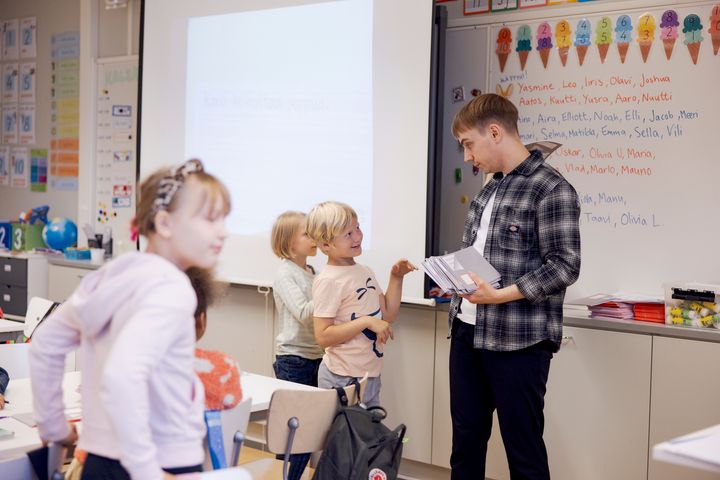
Helsinki aims to lead the way in the national work to improve learning outcomes. The public discussion on the decline in PISA results calls for concrete action. In collaboration with the EDUCA Flagship project led by the University of Jyväskylä and funded by the Academy of Finland, the City has launched a long-term, experimental and research-based development programme aimed at identifying what kind of measures yield the best results in children’s learning.
A randomised trial focusing on literacy was carried out during the 2024–2025 school year at schools receiving needs-based funding, using a co-teaching operating model. The time and expertise of teachers were increased in the classroom in such a way that second-grade students were also provided with a second teacher for four weekly lessons in the subject of mother tongue and literature.
The trial showed that students benefited from having two teachers working in the classroom at the same time. The study yielded reliable new information on how to effectively allocate needs-based funding to co-teaching.
Students benefited from co-teaching
Literacy appeared to develop slightly faster in classrooms featuring another teacher in addition to the class teacher – usually a special educational needs teacher or Finnish or Swedish as a second language teacher. The literacy of the students in the trial groups improved to some extent during the trial when compared to control groups. The effects were clearly positive for learners who were the most skilled to begin with. Students with lower starting skills made equally good progress in both the trial and control groups.
“Needs-based resource facilitated co-teaching, which appeared to slightly improve the literacy of students on average. Thanks to co-teaching, the teachers had time to also focus on learners who were more skilled to begin with, and whose skills developed significantly during the trial,” says Comprehensive Education Director Ville Raatikainen from the City of Helsinki.
Making management by data a reality
The co-teaching pilot yielded important information on how teaching and learning might change as the result of co-teaching.
“The overall picture will be completed later by analysing the experiences of the teachers who took part in the pilot,” comments Professor Marja-Kristiina Lerkkanen from the University of Jyväskylä.
“Helsinki’s openness to organising trials in a way that enables a reliable assessment of their impact is exemplary,” remarks Professor Matti Sarvimäki from Aalto University, who took part in the study.
“Education is often discussed in rather general terms. Real progress, however, happens one concrete step at a time. This trial shows how we can ensure that the steps that we are taking are heading in the right direction,” Sarvimäki continues.
The aim of the pilot carried out is to achieve a long-term impact on teaching and learning.
“All development work requires an understanding of the current state of affairs, and this calls for research and the application of knowledge to everyday life. Helsinki is now building up its own strong capacity to research and examine this subject itself, so that we can bring about a lasting change in the trajectory of learning outcomes,” states Development Services Director Marjo Kyllönen from the City of Helsinki.
Concrete follow-up measures set to begin
As part of the EDUCA research collaboration, Helsinki carried out its first study on the effectiveness of teaching. From a learning perspective, the overall result is positive. It should be noted that the study had certain limitations, such as the short duration of the intervention (one school year) and the adoption of new operating models at schools.
The study showed that there is a need for further research on effective ways to strengthen the skills of learners. The piloting of needs-based funding for literacy provided one perspective on the targeting of needs-based funding.
“We need research-based information on aspects such as how we can more effectively support every child’s learning of Finnish or Swedish and their transition from the S2 syllabus (Finnish or Swedish as a second language) to the S1 syllabus (Finnish or Swedish as a first language) in the subject of mother tongue and literature. We are focusing on the learning of the teaching language, and we need information on the phenomenon so that we can allocate resources and organise teaching as effectively as possible,” says Head of the Education Division Satu Järvenkallas from the City of Helsinki.
Long-term data from the literacy profile
Research into the phenomenon continues in Helsinki. In collaboration with the EDUCA Flagship project, the City is preparing a new kind of digital tool – the literacy profile – which will provide long-term monitoring data on the development of children’s and young people’s literacy and the effectiveness of interventions. The literacy profile will provide teachers with a tool for teaching, thus supporting the progress of learners.
The comprehensive schools of the City of Helsinki are currently also running a study on the reading enthusiasm of third-graders, and the City’s early childhood education providers are running a study on dialogic reading. The results of these studies, which are also being carried out in collaboration with the EDUCA Flagship project, will be available in early 2027.
The intervention study on co-teaching was conducted by Aalto University, the University of Jyväskylä and the University of Turku in collaboration with the City of Helsinki. The literacy intervention also forms part of the City of Helsinki’s assessment of the effectiveness of needs-based funding. The working paper reporting on the effectiveness assessments can be read here.
Keywords
Contacts
Marjo KyllönenDevelopment Services DirectorHelsinki Education Division
Tel:+358 9 310 86208marjo.kyllonen@hel.fiMarja-Kristiina LerkkanenProfessorUniversity of Jyväskylä, EDUCA Flagship
Tel:+358 40 805 3347marja-kristiina.lerkkanen@jyu.fiMatti SarvimäkiProfessorAalto University, EDUCA Flagship
Tel:+358 40 304 5515matti.sarvimaki@aalto.fiAlternative languages
Subscribe to releases from Helsingin kaupunki, kasvatuksen ja koulutuksen toimiala
Subscribe to all the latest releases from Helsingin kaupunki, kasvatuksen ja koulutuksen toimiala by registering your e-mail address below. You can unsubscribe at any time.
Latest releases from Helsingin kaupunki, kasvatuksen ja koulutuksen toimiala
Päätöstiedote kasvatus- ja koulutuslautakunnan kokouksesta 10.11.202610.11.2026 20:35:27 EET | Tiedote
Lautakunnan tiistaina 10. marraskuuta pidetyn kokouksen päätöstiedote on julkaistu kasvatuksen ja koulutuksen toimialan verkkosivuilla. Kokouksen esityslista on saatavilla toimialan verkkosivuilta.
Ennakkotiedote: Helsingin kasvatus- ja koulutuslautakunta kokoontuu tiistaina 10.11.20266.11.2026 12:16:25 EET | Tiedote
Kasvatus- ja koulutuslautakunnan seuraava kokous pidetään tiistaina 10. marraskuuta klo 16.15. Kokouksen esityslista on julkaistu kasvatuksen ja koulutuksen toimialan verkkosivuilla. Esityslistalla on muun muassa toimialan talousarvion 2026 kolmas toteutumisennuste. Tilahankkeista esityslistalla ovat päätös Sibelius-lukion tarveselvityksestä päätös Kannelmäessä osoitteessa Kannelpolku 5 sijaitsevan päiväkoti Kanteleen Kannelpolun toimipisteen perusparannuksen tarveselvityksestä päätös päiväkoti Kivikon toiminnan lakkauttamisesta 1.8.2027 alkaen Lautakunnan kokouksen päätöstiedote julkaistaan kokouksen päätyttyä toimialan verkkosivuilla.
Antalet förstaklassare som studerar A1-svenska inom den finskspråkiga grundläggande utbildningen mångdubblades i Helsingfors6.11.2026 07:59:54 EET | Pressmeddelande
Helsingfors stad har satsat stort på att kommunicera ut fördelarna med att lära sig olika språk. Barnen har fått bekanta sig med A1-språk redan i förskoleundervisningen.
A1-ruotsia opiskelevien ekaluokkalaisten määrä moninkertaistui Helsingissä6.11.2026 07:59:54 EET | Tiedote
Kaupunki on panostanut voimakkaasti eri kielten opiskelemisen hyödyistä tiedottamiseen. Lapset ovat tutustuneet mahdollisiin A1-kieliinsä jo esiopetuksessa.
Number of first-graders studying Swedish as first foreign language in Helsinki multiplies6.11.2026 07:59:54 EET | Press release
The City has made a strong effort to raise awareness of the benefits of learning different languages. Children have already been introduced to their potential first foreign language choices, also known as the A1 languages, during pre-primary education.
In our pressroom you can read all our latest releases, find our press contacts, images, documents and other relevant information about us.
Visit our pressroom