
DNA compared: Data volumes at many schools appear to have undergone a lasting change after the mobile phone ban
27.11.2026 08:00:00 EET | DNA Oyj | Press release
Base-station-level data volumes in DNA's mobile network indicate that the decline associated with the mobile phone ban introduced in schools in autumn 2025 appears to have become a lasting change at many schools. In the schools included in the comparison, the autumn 2026 level was typically still approximately 40 per cent lower than in spring 2025. However, there was substantial variation between schools.
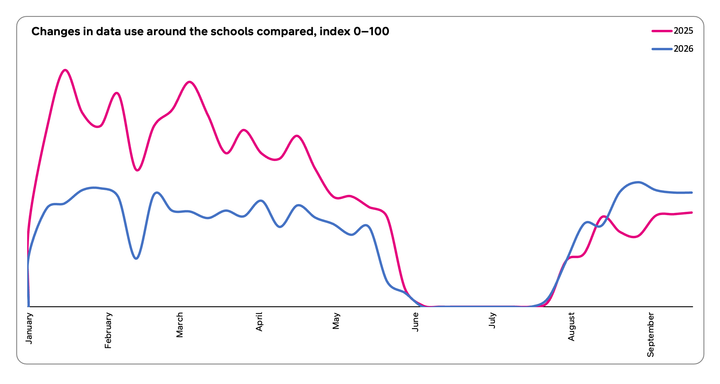
In August 2025, a statutory ban on mobile phone use during lessons in comprehensive schools entered into force in Finland. Before this, schools' practices had varied considerably across Finland, and schools also applied the statutory mobile phone ban in different ways. At the time, DNA analysed data volumes at mobile base stations serving the surrounding areas of schools before and after the law entered into force. The analysis already showed that data use had declined clearly between spring and autumn around many schools, although the differences between schools were substantial.
The new follow-up comparison assesses whether the change has persisted. The final comparison examined weekly data volumes at 16 schools in spring 2025, autumn 2025, spring 2026 and autumn 2026. A level was calculated for each school for each period, after which the typical trend across the full sample was described using the median of the school-specific changes.
According to the comparison, data volumes at the schools examined fell by more than 50 per cent from spring 2025 to the first autumn under the mobile phone ban, measured using the median of the school-specific changes. From autumn 2025 to autumn 2026, data use at the schools examined increased by approximately 16 per cent, measured using the median of the school-specific changes. This was in line with the approximately 16 per cent growth trend across DNA's entire mobile network between autumn 2025 and autumn 2026.
“It is essential to look at the entire time span. Around many schools, data volumes fell from spring 2025 to the first autumn under the mobile phone ban. Between the two autumn periods, data use increased only in line with the general mobile network trend. The continuing growth in data volumes is primarily driven by customers' migration to 5G and improvements in service quality, such as higher image resolution and an increase in the volume of video and live content, rather than by people spending more time using their phones. It is therefore reasonable to conclude that, where data volumes have grown only in line with the trend, mobile phone use near these base stations has remained unchanged,” explains Jarkko Laari, VP, Networks at DNA.
The autumn 2025 decline is still reflected in the autumn 2026 level
In autumn 2026, data volumes above the summer baseline at the base stations serving the schools in the comparison were still approximately 40 per cent lower than in spring 2025, measured using the median of the school-specific changes. The spring 2026 data volumes also support the assessment that the drop in data volumes associated with the first autumn under the mobile phone ban was not merely a temporary autumn phenomenon.
Nevertheless, there are substantial differences between schools. At some sites, the decline from spring 2025 to autumn 2026 was considerable, while at some schools data volumes recovered slightly or even increased. From autumn 2025 to autumn 2026, data volumes declined at five schools, and at eight schools the change was below the general growth trend of 16 per cent in DNA's mobile network.
“The results do not mean that the same trend can be seen at every school. Schools differ considerably in the restrictions they already had in place on mobile phone use before the legislative amendment. In addition, factors such as school-specific pupil numbers may have changed in either direction. Looking at the broader picture, however, the lower data volumes recorded in the first autumn under the mobile phone ban appear to have persisted,” Laari says.
DNA recommends postponing the purchase of a child's first smartphone
Parents strongly support restrictions on mobile phone use in schools. In DNA's 2026 School Survey, 91 per cent of parents of children aged 5–16 said they were satisfied with the amendment to the Basic Education Act prohibiting the use of smart devices during lessons without permission. In addition, 79 per cent felt that their child's school also restricted phone use sufficiently during breaks and transitions between lessons.
DNA supports the national recommendations on children's use of digital devices issued by the Finnish Institute for Health and Welfare and recommends postponing the purchase of a child's first smartphone for as long as possible. As a rule, children under the age of 13 should not have their own smartphone. If a phone is needed, for example to keep in touch during the journey to and from school, a children's smartwatch with calling features or another device with limited features is a good alternative. Regardless of the device, a present and engaged adult is always needed when children practise digital skills.
How the follow-up comparison of mobile data volumes was conducted
The initial sample was limited to Finland's 15 largest cities by population, together with Kerava and Mikkeli. DNA then selected sufficiently large schools whose surrounding areas had a technically identifiable mobile base station suitable for the comparison. The school sites in Kuopio and Lappeenranta were already found unsuitable for the comparison method during the technical preliminary assessment. After the data had been collected, base-station sites where traffic above the summer holiday baseline was very small in relation to total autumn traffic were also excluded from the comparison. In these cases, distinguishing data potentially associated with school activity from total traffic would have been too unreliable.
The final comparison comprised 16 schools in 11 cities: Saunalahden koulu and the Olarinniityntie site of Olarin koulu in Espoo; the Kohmankaari school building of Tesoman koulu and the Koivistontie school building of Hatanpään koulu in Tampere; S:t Olofsskolan and Luostarivuoren koulu in Turku; Vaajakosken yhtenäiskoulu in Jyväskylä; Salpausselän koulu, Lähteen peruskoulu at the Laune community centre, and Kivimaan peruskoulu in Lahti; Kuninkaanhaan koulu in Pori; Urheilupuiston koulu in Kouvola; Merenkurkun koulu in Vaasa; Lyseon koulu in Hämeenlinna; Keravanjoen koulu in Kerava; and Kalevankankaan koulu in Mikkeli.
The analysis includes the total volume of data transferred by DNA subscriptions on the 4G and 5G networks at the selected base stations. All data is fully anonymous and aggregated, and the analysis does not make it possible to identify individual users. Because base stations always serve an area wider than a school, DNA used the typical traffic level during the June–July holiday period as a rough estimate of data use unrelated to the school.
The impact of exceptional weeks at individual schools was reduced by comparing them with the typical traffic in the surrounding weeks. The median traffic for June–July was then subtracted from each school's weekly data so that traffic from the base station's wider surroundings would have as little effect on the comparison as possible. The final analysis compared four periods: spring 2025, autumn 2025, spring 2026 and autumn 2026. For autumn 2026, the analysis ended at week 40. The typical change across the full sample was described using the median of the school-specific changes. The results are indicative and do not measure the data use of individual pupils.
There was substantial school-specific variation in data volumes at the base stations serving the schools included in the comparison. DNA has not investigated possible changes in pupil numbers, use of facilities, base-station orientation or the surrounding areas of the schools examined. A change in base-station traffic at an individual school should therefore not be interpreted as a direct measure of pupils' mobile phone use. However, the data provides an indication of the trend over time in data volumes at base stations serving the areas surrounding schools after the mobile phone ban entered into force.
Further information for the media:
DNA Communications, tel. +358 44 044 8000, communications@dna.fi
Images

DNA is one of the leading telecommunications companies in Finland. With you, we face forward to a safer and smarter future. We offer connections, services and devices for homes and workplaces, contributing to the digitalisation of society. Already for years, DNA customers have been among the world leaders in mobile data usage. DNA has about 3.7 million subscriptions in its fixed and mobile communications networks. The company has been awarded numerous times as an excellent employer and family-friendly workplace. In 2025, our total revenues were EUR 1,128 million and we employ about 1,600 people around Finland. DNA is a part of Telenor Group, a leading telecommunications company across the Nordics. More information: www.dna.fi, Facebook @DNA.fi, Instagram and Threads @dna_fi and LinkedIn @DNA-Oyj.
Alternative languages
Subscribe to releases from DNA Oyj
Subscribe to all the latest releases from DNA Oyj by registering your e-mail address below. You can unsubscribe at any time.
Latest releases from DNA Oyj
Flunssakausi on täällä: 5 vinkkiä puhelimen pitämiseksi puhtaana20.11.2026 09:05:00 EET | Tiedote
Etenkin pienten lasten vanhemmat tunnistavat ilmiön selvästi: samalla kun lehdet ovat tippuneet puista ja ensilumi on ajankohtainen, alkaa ympäriltä kuulua niiskutusta ja köhimistä. Flunssakausi ajoittuu Suomessa tyypillisesti juuri marras–helmikuulle, jolloin useat eri hengitystievirukset kiertävät samanaikaisesti. Puhelin on monella pitkin päivää käsissä, joten myös sen pinnalle kertyy helposti käsistä ja ympäristöstä peräisin olevia mikrobeja. DNA:n laitemyynnin puhelimista vastaava valikoimapäällikkö Tuomo Seppänen kertaa tärkeimmät ohjeet puhelimen hygieniasta huolehtimiseen.
Cold and flu season is here: 5 tips for keeping your phone clean20.11.2026 09:05:00 EET | Press release
Parents of young children in particular will recognise the signs: as the leaves fall and the first snow approaches, sniffles and coughs begin to be heard all around. In Finland, the cold and flu season typically falls between November and February, when several respiratory viruses circulate at the same time. Many of us handle our phones throughout the day, allowing microbes from our hands and surroundings to accumulate easily on their surfaces. Tuomo Seppänen, Category Manager responsible for phones at DNA, shares some simple rules for good phone hygiene.
Kovimmat datapäivät 2026: Viikonloput, urheilu ja pelijulkaisut näkyivät mobiiliverkon superpäivissä – jouluaatto yllättää iloisesti18.11.2026 12:05:00 EET | Tiedote
DNA:n mobiiliverkon vuoden kaksi vilkkainta peräkkäistä latauspäivää osuivat maaliskuun poikkeuksellisen runsaaseen suoratoistoviikonloppuun. Lauantaina 14. maaliskuuta liikenne ylitti tarkastelujakson päivämediaanin 35 prosentilla ja sunnuntaina 15. maaliskuuta lähes 49 prosentilla. Yksittäisen tapahtuman sijaan piikkejä selittää todennäköisimmin useiden kansainvälisten moottori- ja talviurheilutapahtumien sekä muun viikonlopun urheilutarjonnan sekä ohjelmistopäivitysten yhteisvaikutus.
Busiest data days of 2026: Weekends, sports and game releases drove mobile network superdays - with a welcome Christmas Eve surprise18.11.2026 12:05:00 EET | Press release
The two busiest consecutive download days of the year on DNA's mobile network fell during an exceptionally streaming-heavy weekend in March. On Saturday 14 March, traffic was 35% above the daily median for the review period, and on Sunday 15 March it was nearly 49% higher. Rather than a single event, the peaks were most likely caused by a combination of several international motor racing and winter sports events, other sports coverage over the weekend, and software updates.
DNA on Perhevapaamyönteinen työpaikka 2026 – perheelle on tilaa työelämässä6.11.2026 15:00:00 EET | Tiedote
Mothers in Business (MiB) on valinnut DNA:n Perhevapaamyönteiseksi työpaikaksi 2026. Tunnustuksen perusteluissa korostuvat työntekijän mahdollisuus vaikuttaa perhevapaidensa järjestämiseen sekä tuki työhön paluuseen ja oman uran suunnitteluun. DNA:lla perheystävällisyys on osa pitkäjänteisesti rakennettua työkulttuuria, jossa työn ja erilaisten elämäntilanteiden yhteensovittamista tuetaan käytännön ratkaisuilla.
In our pressroom you can read all our latest releases, find our press contacts, images, documents and other relevant information about us.
Visit our pressroom