
Solar Energy Harvesting Through Biomimicking the Wings of a Butterfly
26.6.2020 15:45:00 EEST | University of Oulu | Tiedote
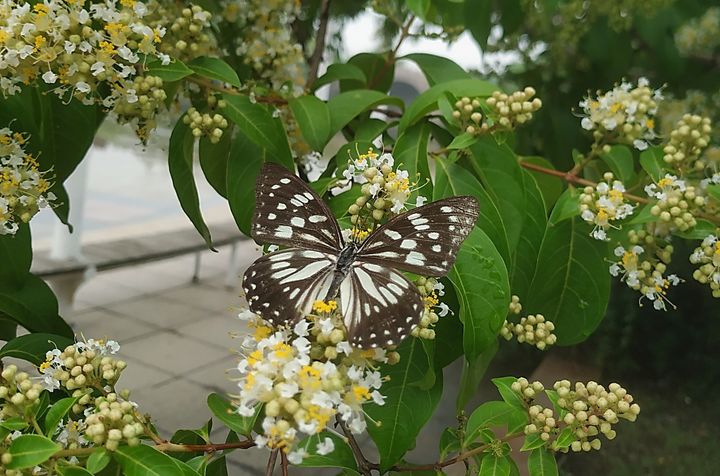
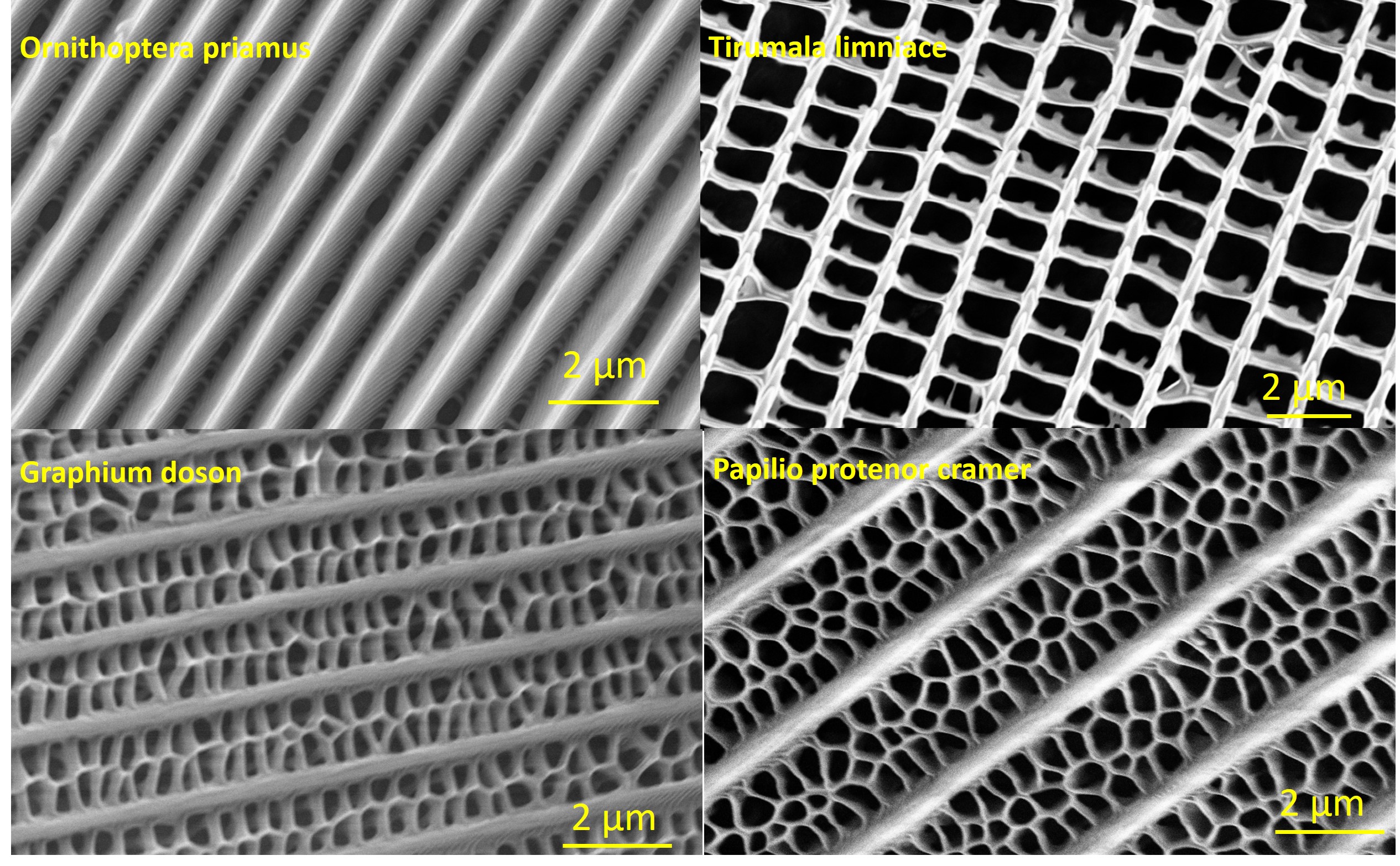
The color of butterflies is mainly attributed to structural color as a result of diffraction of natural light. However, black color denotes trapping of sunlight within the butterfly scales. In some extreme cases, a butterfly will be rapidly de-iced through light-heat conversion within black scales on wings. Inspired by such a natural light harvesting process, scientists in the NANOMO unit carefully examined nanostructures of black scales obtained from different butterflies and assessed their light trapping abilities when placed on Si-based solar panels.
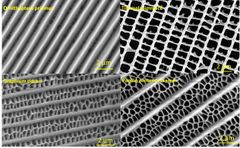
Even with apparently the same dark color, butterfly scales have varied nanostructures depending on their species. For example, the morphology of Ornithoptera priamus scale consists of parallel V-shaped gullies formed between two ridges and connected by thin layers. This is very different from the scale structure of other three species, Tirumala limniace, Graphium doson, and Papilio protenor cramer, where the structures consist of round ridges spaced by arrays of 1, 2, and 3 holes. Correspondingly, light reflection on the black scales differs, with the one on the black part of Ornithoptera priamus owing minimum values ranging from 1-5% at the visible light region.
Using these structures as antireflective patterns will help sunlight harvesting on Si based photovoltaics. Computer simulated results showed that after placing these nanostructures on Si solar panels, surface backscattering decreased substantially. The scale structure of Ornithoptera priamus gave the best antireflection. Light reflection decreased from more than 35% on bare Si panel down to less than 5%. As a result, the short-circuit current, i.e. the largest current that can be obtained from the photovoltaic cell, was increased by 66%. Experimental realizations of such a strategy have also been proposed.
The latest research progress continues the world-leading role of NANOMO in biomimicry. The unit pioneers in applying fundamental concepts in physics to applied photonics and solar energy harvesting. A very recent TUTLI funding from BusinessFinland was granted to NANOMO to scale up bio-inspired designs for new surface functionality applications in an industrial scale.
The newest study is published in a forthcoming Solar Energy publication. The research was coordinated by Associate Professor Wei Cao and Professor Marko Huttula from the University of Oulu.
Considering the large volume of Si solar panels in use, it is foreseen that the butterfly wings can provide a major contribution to clean energy production.
Avainsanat
Yhteyshenkilöt
Associate Professor Wei Cao, University of Oulu, NANOMO Research Unit, tel. +358 400 897 982, e-mail: Wei.Cao@oulu.fi
Professor Marko Huttula, University of Oulu, NANOMO Research Unit, tel. +358 400 566 218, e-mail: Marko.Huttula@oulu.fi
Communications Specialist Tiina Pistokoski, University of Oulu, tel. +358 40 7161 387, e-mail: Tiina.Pistokoski@oulu.fi
Kuvat
Linkit
Tietoja julkaisijasta

Tilaa tiedotteet sähköpostiisi
Haluatko tietää asioista ensimmäisten joukossa? Kun tilaat tiedotteemme, saat ne sähköpostiisi välittömästi julkaisuhetkellä. Tilauksen voit halutessasi perua milloin tahansa.
Lue lisää julkaisijalta University of Oulu
Driving global leadership in next-generation connectivity -the 11th Edition of 6G Waves Magazine9.12.2025 07:11:12 EET | Tiedote
The University of Oulu’s 6G Flagship programme continues to set the pace for next-generation wireless communication by blending cutting-edge research with real-world testing. As the world’s first 6G research initiative, 6G Flagship offers a unique environment where academia and industry collaborate to shape the future of connectivity.
Building Resilience into Networks - 6G Flagship’s 15th White Paper24.11.2025 09:53:37 EET | Tiedote
Resilience in 6G is a critical design objective. It connects reliability, security, and adaptability into one framework that allows networks to withstand, recover, and evolve through disruption.
Multibeam antennas to play an important role in 6G27.5.2025 07:07:00 EEST | Tiedote
Professor Yingjie Jay Guo is the Director of Global Big Data Technologies Centre at University of Technology Sydney. He has over thirty years of international academic, and industrial experience. We sat down with him to discuss about the role of antennas in the future of 6G development.
6G test centre´s strategic role – pioneering dual-use innovation within NATO DIANA21.5.2025 09:09:00 EEST | Tiedote
The 6G Test Centre (6GTC) in the University of Oulu is at the forefront of dual-use innovation. It leverages the Arctic's extreme conditions to push the boundaries of 5G and 6G validation. Also, 4G testing is available. The centre addresses critical challenges in the defence and commercial sectors by integrating AI-driven network optimisation and seamless network transitions.
Harri Pennanen - writing the future of 6G, one blink at a time14.5.2025 07:07:00 EEST | Tiedote
There are researchers who define their field, and then there are those who, by force of intellect and persistence, redefine what is possible. Harri Pennanen, a Postdoctoral Researcher at the University of Oulu's Centre for Wireless Communications (CWC), belongs to the latter category. His recent work, the most comprehensive survey of 6G technology to date, not only pushes the boundaries of wireless communication but also embodies resilience, the disciplined pursuit of knowledge despite constraints, and the refusal to accept imposed limitations.
Uutishuoneessa voit lukea tiedotteitamme ja muuta julkaisemaamme materiaalia. Löydät sieltä niin yhteyshenkilöidemme tiedot kuin vapaasti julkaistavissa olevia kuvia ja videoita. Uutishuoneessa voit nähdä myös sosiaalisen median sisältöjä. Kaikki tiedotepalvelussa julkaistu materiaali on vapaasti median käytettävissä.
Tutustu uutishuoneeseemme