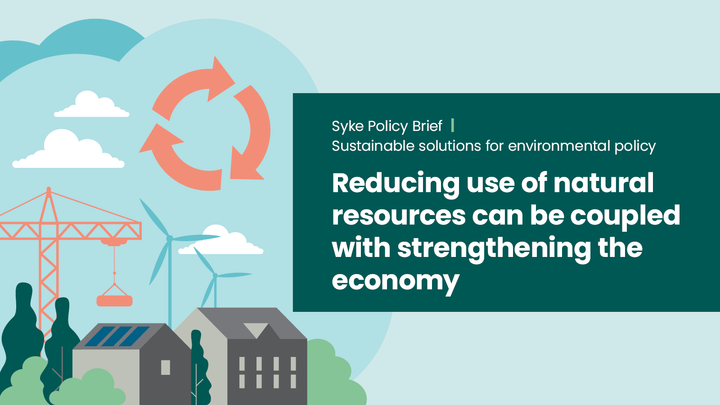
Policy Brief: Reducing use of natural resources can be coupled with strengthening the economy
7.5.2024 10:45:37 EEST | Suomen ympäristökeskus | Press release
The Finnish economy can grow even if the raw material consumption is reduced. At the same time, climate change and biodiversity loss will be mitigated, and pollution reduced. Finland should transition to a circular economy, as it reduces the use of natural resources and promotes crisis resilience. The new Policy Brief published by the Finnish Environment Institute explains how decoupling raw material consumption and economic growth is possible and what the transition to a carbon-neutral circular economy society requires.
Biodiversity loss, climate change and pollution are largely due to the use of virgin natural resources. By reducing the extraction of virgin natural resources and paying more attention to nature, biodiversity loss will be curbed.
"The transition to a carbon-neutral circular economy enables sustainable and efficient use of natural resources while solving climate and environmental challenges and opening up new economic opportunities for Finland," emphasises Professor Jyri Seppälä from the Finnish Environment Institute (Syke).
Economic growth can be decoupled from resource consumption and environmental impacts
There is a great need for the transition to a circular economy, as Finland's raw material consumption per capita is more than three times higher than the EU average, and the added value of natural resource use is among the lowest in the EU.
The objective of Finland's Circular Economy Programme is to transition to a carbon-neutral circular economy society, where the raw material consumption growth will halt by 2035.
"The transition is feasible without weakening the economy. At the same time, greenhouse gas emissions and air pollution can be reduced, and biodiversity loss can be slowed down. However, decoupling economic growth from the consumption of natural resources and environmental impacts requires that circular economy and low-carbon measures are widely adopted in different sectors of society, such as construction, industry, consumption, energy sector and food system," highlights Senior Research Scientist Hannu Savolainen from Syke.
Key circular economy measures in the transition include more efficient use of materials, increased supply and use of recycled materials, increased added value in industry, and consumption focusing on long-lasting products and services instead of goods.
There are ways for sustainable use of natural resources
The transition to a carbon-neutral circular economy society requires more ambition and effective regulation from Finland. This will strengthen Finland's role as an internationally competitive and sustainable circular economy operator.
"Circular economy is promoted through regulation that maintains and creates markets for sustainable circular materials, products and services. Finland should support EU's circular economy initiatives, such as the Ecodesign regulation promoting the extension of the lifespan and recyclability of products, and the proposal to verify green claims," emphasises Enni Ruokamo, Senior Research Scientist at Syke.
Investments in industries that are resource-efficient and add high value, and clean energy are essential for the transition to a carbon-neutral circular economy. In addition, policies that reduce land use pressures and strengthen carbon sinks should be increased.
Syke Policy Brief:Reducing use of natural resources can be coupled with strengthening the economy (helsinki.fi)
More info:
Senior Research Scientist, Group Manager Hannu Savolainen, Finnish Environment Institute, tel. 029 525 1839, firstname.lastname@syke.fi
Senior Research Scientist Enni Ruokamo, Finnish Environment Institute, tel. +358 295 252 092 firstname.lastname@syke.fi (available from 7.5.)
Professor, Director Jyri Seppälä, Finnish Environment Institute, tel. +358 295 251 629, firstname.lastname@syke.fi
Check out Syke Policy Briefs: syke.fi/policybriefs/en
Keywords
Contacts
Media service at Finnish Environment Institute
Our Media Service provides information on research, helps journalists find experts for interviews and provides photos for media use.
Our Communication experts will answer your inquiries on weekdays from 9 am to 4 pm.
Finnish Environment Institute - We build hope through research.
Finnish Environment Institute
Latokartanonkaari 11
00790 Helsinki
+358 295 251 000
It is time to move beyond solving environmental problems one by one, to systemic sustainability transformations. The Finnish Environment Institute (Syke) contributes to building a sustainable society through research, information and services. The Finnish Environment Institute is a research institute with 700 experts and researchers located in Helsinki, Oulu, Jyväskylä and Joensuu.

Subscribe to releases from Suomen ympäristökeskus
Subscribe to all the latest releases from Suomen ympäristökeskus by registering your e-mail address below. You can unsubscribe at any time.
Latest releases from Suomen ympäristökeskus
Viikkokatsaus 11.–15.5.20267.5.2026 13:53:42 EEST | Tiedote
Hei! Tässä tiedoksesi meillä Suomen ympäristökeskuksessa ensi viikolla ilmestyviä tiedotteita, uutisia, kampanjoita, blogeja ja uutiskirjeitä. Mukana myös tulevia tapahtumia ja webinaareja. Jakelemme viikkokatsauksen torstaisin STT:n kautta. Koosteet löytyvät myös STT-uutishuoneesta, josta voit tilata kaikki Suomen ympäristökeskuksen tiedotteet.
En ny främmande art som väcker oro i Europa har spridit sig till finska kusten7.5.2026 13:19:12 EEST | Pressmeddelande
En ny märlkräfta, större rovmärla, har upptäckts i uppföljningen av främmande arter. Arten, som påträffades i Raumo hamn, utgör ett hot särskilt mot ryggradslösa arter i brackvattnen, men också i inlandsvatten. Dessutom upptäcktes en ny förekomst av kräftdjur Melita nitida i Nådendal. Främmande arter sprids inte bara med fartyg utan också med fritidsbåtar.
A new non-indigenous species causing concern in Europe has spread to the Finnish coast7.5.2026 11:32:48 EEST | Press release
A new amphipod species, known as killer shrimp, has been detected in the non-indigenous species monitoring. The species observed at the Port of Rauma is a threat to invertebrate species, especially in brackish waters, but also in inland waters. In addition, the monitoring revealed a new occurrence of amphipod Melita nitida in Naantali. Non-indigenous species spread not only with ships but also with recreational boats.
Rannikolle on levinnyt Euroopassa huolta aiheuttava uusi vieraslaji7.5.2026 09:00:00 EEST | Tiedote
Itämeren vieraslajiseurannassa on havaittu uusi katkalaji, petokatka. Rauman satamasta havaittu laji on uhka etenkin murtovesien, mutta myös sisävesien selkärangattomille lajeille. Lisäksi seurannassa havaittiin suistokatkan uusi esiintymä Naantalista. Vieraslajeja leviää paitsi laivojen, myös huviveneiden matkassa.
Kansalaiset kutsutaan mukaan sinileväseurantaan Päijät-Hämeessä5.5.2026 09:00:00 EEST | Tiedote
Suomen ympäristökeskus ja Päijät-Hämeen Vesijärvisäätiö tiedottavat Päijät-Hämeessä käynnistyy kesällä Vesivahdit 2026 -kampanja, jossa kansalaisia kannustetaan havainnoimaan sinilevätilannetta. Tavoitteena on täydentää viranomaisten seurantaa ja tuottaa parempi kuva vesistöjen tilasta. Seuranta hyödyttää asiantuntijoita, asukkaita ja lomailijoita, jotka tarvitsevat tietoa vesien tilasta. Kampanja-aika on 6.5.–6.9.2026.
In our pressroom you can read all our latest releases, find our press contacts, images, documents and other relevant information about us.
Visit our pressroom