Blue-green algae observations have increased in coastal and open sea areas
18.7.2024 13:18:58 EEST | Suomen ympäristökeskus | Press release
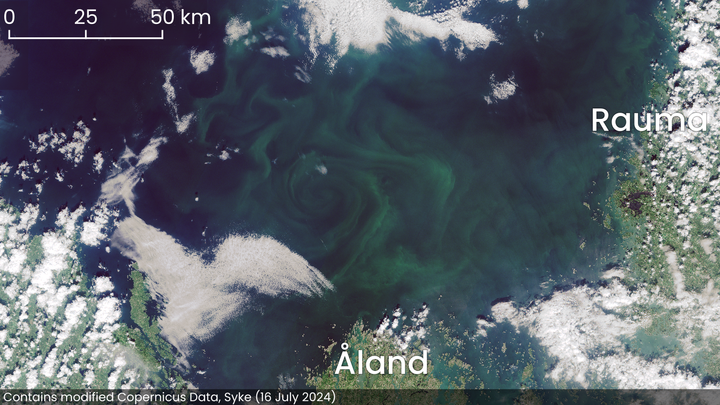
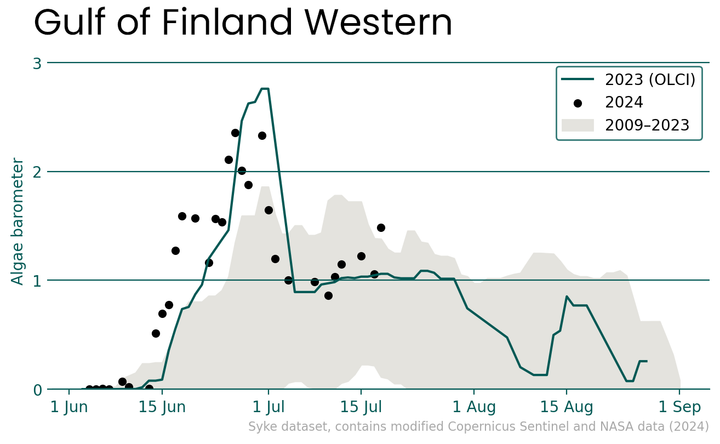
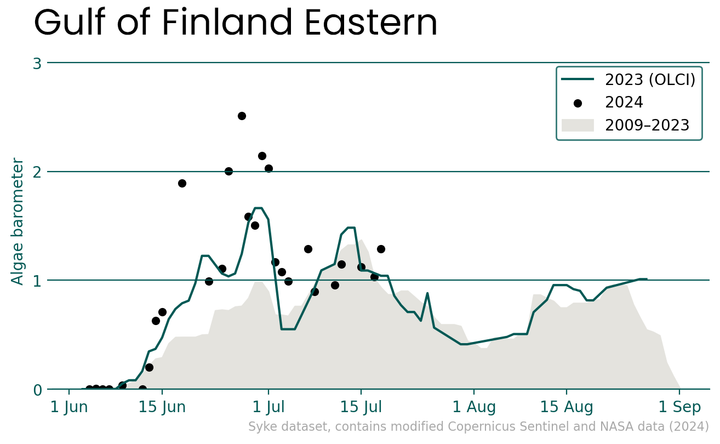
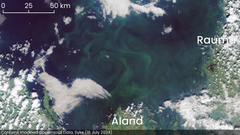
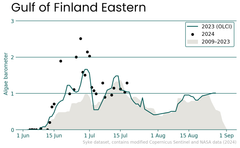
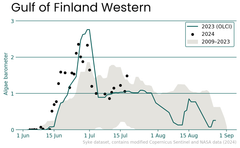
Blue-green algae observations have increased in coastal and open sea areas, but the situation in inland waters is typical of the season. Blue-green algae have been observed especially on the coasts of Southwest Finland, Uusimaa and Kymenlaakso. Abundant blue-green algae occur in the open sea area throughout the Gulf of Finland.
Blue-green algae barometers of the open sea areas
Link to the map
Map of the national blue-green algae monitoring observations on week 29
More in Finnish
Sinilevähavainnot ovat lisääntyneet rannikoilla ja avomerialueilla
Syke observes the cyanobacteria occurrence as part of the monitoring of the state of the environment in Finland
The national cyanobacterial monitoring is carried out as part of the monitoring of the state of the environment in cooperation with the Centres for Economic Development, Transport and the Environment, municipal environmental and health authorities, and the Finnish Environment Institute (Syke). Finnish Rotary Clubs are also actively involved in nationwide cyanobacterial monitoring.
The cyanobacterial monitoring is based on the monitoring of cyanobacterial deposits in surface water. The intention is to provide an overview of the cyanobacterial situation in different water bodies. The monitoring includes about 400 permanent observation sites across the country on inland and coastal waters and in the archipelago.
Information on the cyanobacterial situation in the open sea areas is mainly obtained from satellite images, but also from the Finnish Border Guard, the marine research vessel Aranda, the optical device located at the Utö Atmospheric and Marine Research Station, as well as cruise and merchant ships (MS Finnmaid and MS Silja Serenade) equipped with Alg@line measuring equipment. The drift forecasts for cyanobacterial rafts in open sea areas are prepared in cooperation with the Finnish Meteorological Institute's Maritime Services.
Syke reports on the national cyanobacterial situation on a weekly basis every Thursday from 20 June to 8 August 2024. The weekly algal reporting was launched in 1998.
Several compounds produced by cyanobacteria can cause health hazards
According to the Finnish Institute for Health and Welfare (THL), cyanobacterial occurrences can cause health hazards. Cyanobacteria produce a number of different compounds that can cause symptoms. Some cyanobacteria can produce liver or nerve toxins, but most of the symptoms experienced by swimmers may also be due to other compounds.
Small children and pets should particularly be kept out of water rich with cyanobacteria. Water with cyanobacteria should not be used in a sauna or as washing or irrigation water.
If you suspect a poisoning, seek medical advice, or take the pet to a veterinarian. If necessary, the Poison Information Centre will provide additional instructions.
The municipal health authorities monitor the cyanobacterial situation on beaches.
More information about blue-green algae and health:
- At the the Finnish Institute for Health and Welfare (THL) website
- At the Poison Information Center website
Report your cyanobacterial observations to the Järvi-meriwiki (Lake and sea wiki)
In Järvi-meriwiki, maintained by the Finnish Environment Institute, you can establish your own observation site and share cyanobacterial observations or make individual observations when moving around waterways. You can also report observations via the smartphone-friendly Havaintolähetti website.
The reported observations are shown on the national cyanobacterial observation map, and they support the national algal situation assessment. Observations about the absence of cyanobacteria are also important.
Järvi-meriwiki is an online service produced in collaboration with authorities and citizens. The service provides basic information on all lakes larger than one hectare as well as different areas of the Baltic Sea. Users can share, for example, photos and other observations on the service.
Municipalities and cities monitor the cyanobacterial situation on the beaches, so it is advisable to report rich cyanobacterial occurrences on beaches to the health authorities of the municipality in question.
This is how you identify cyanobacteria
A small amount of cyanobacteria in the water appears as green or yellowish particles. Narrow stripes of algae can drift to a beach. In calm weather, a substantial amount of cyanobacteria forms greenish or yellowish algal rafts and piles up in coastal water. In spring, yellowish pollen from coniferous trees may also be present in the water. Unlike cyanobacteria, pollen is found not only on the surface water but also, for example, on piers or yard furniture.
Cyanobacteria dissolve into tiny particles in the water if you touch the algal mass with a stick. If the algae become attached to the stick, they are something other than cyanobacteria. In a water vessel, cyanobacteria rise to the surface as tiny greenish particles within about an hour.
- Read more: How do you recognize blue-green algae?
Cyanobacterial observations also in the MarineFinland.fi and Waterinfo.fi services
The cyanobacterial maps presented on the websites MarineFinland.fi and Waterinfo.fi combine the observations reported to the Järvi-meriwiki and from the beaches of the City of Helsinki, as well as the observations based on satellite interpretations made by Syke during the last three days.
Keywords
Contacts
Communications:
Valtteri Toikka, Valtteri.Toikka@syke.fi, Tel. +358 295 251 364
Inquiries about blue-green algae situationTelephone 1 pm to 3 pm
Lakes: Tel +358 50 5734 347 or +358 295 251 326
State of the Baltic Sea: Tel +358 50 5693 297 or +358 295 251 314
Satellite observations: Tel 358 50 4707 576 or +358 295 251 329, e-mail: Eotuki@syke.fi
Media service at Finnish Environment Institute
Our Media Service provides information on research, helps journalists find experts for interviews and provides photos for media use.
Our Communication experts will answer your inquiries on weekdays from 9 am to 4 pm.
Images
Links
Finnish Environment Institute - We build hope through research.
Finnish Environment Institute
Latokartanonkaari 11
00790 Helsinki
+358 295 251 000
It is time to move beyond solving environmental problems one by one, to systemic sustainability transformations. The Finnish Environment Institute (Syke) contributes to building a sustainable society through research, information and services. The Finnish Environment Institute is a research institute with 700 experts and researchers located in Helsinki, Oulu, Jyväskylä and Joensuu.

Subscribe to releases from Suomen ympäristökeskus
Subscribe to all the latest releases from Suomen ympäristökeskus by registering your e-mail address below. You can unsubscribe at any time.
Latest releases from Suomen ympäristökeskus
Nostot medialle 19.–23.10.2026 | Kansalaispaneelien oppeja, kasviproteiinien kasvuloikkaa ja Itämeren suojelua15.10.2026 13:53:35 EEST | Tiedote
Hei! Tässä tiedoksesi meillä Suomen ympäristökeskuksessa ensi viikolla ilmestyviä tiedotteita, uutisia, kampanjoita, blogeja ja uutiskirjeitä. Mukana myös tulevia tapahtumia ja webinaareja. Jakelemme mediakatsauksen torstaisin STT:n kautta. Koosteet löytyvät myös STT-uutishuoneesta, josta voit tilata kaikki Suomen ympäristökeskuksen tiedotteet.
Invitation for Media: Can Gypsum Applied to Fields Help Save the Baltic Sea? Join the GYPREG Final Seminar on 28 October 202615.10.2026 13:04:50 EEST | Press invitation
Dear Journalist, Can gypsum applied to fields help save the Baltic Sea? Join us in Helsinki or online on Wednesday, 28 October 2026, to hear the latest results from the international GYPREG project. Register now and reserve your place.
Inbjudan för media: GYPREG:s slutseminarium den 28 oktober 2026 – ny kunskap om gipsbehandlingens potential för att skydda Östersjön15.10.2026 13:04:16 EEST | Pressinbjudan
Bästa journalist, Kan gips som sprids på åkermark bidra till att rädda Östersjön? Välkommen att ta del av de senaste resultaten från det internationella GYPREG-projektet onsdagen den 28 oktober 2026 i Helsingfors eller online. Anmäl dig till seminariet.
Kutsu medialle: GYPREG-loppuseminaari 28.10.2026 - uutta tietoa kipsikäsittelyn mahdollisuuksista Itämeren suojelussa15.10.2026 13:02:58 EEST | Kutsu
Arvoisa toimittaja, Voiko pelloille levitettävä kipsi auttaa pelastamaan Itämeren? Tule kuulemaan uusimmat tulokset kansainvälisestä GYPREG-hankkeesta keskiviikkona 28.10.2026 Helsingissä tai verkossa. Ilmoittaudu mukaan.
Nostot medialle 12.–16.10.2026 | Kasviproteiineista kipsiin – ratkaisuja kestävämpään ruokajärjestelmään8.10.2026 13:52:26 EEST | Tiedote
Hei! Tässä tiedoksesi meillä Suomen ympäristökeskuksessa ensi viikolla ilmestyviä tiedotteita, uutisia, kampanjoita, blogeja ja uutiskirjeitä. Mukana myös tulevia tapahtumia ja webinaareja. Jakelemme mediakatsauksen torstaisin STT:n kautta. Koosteet löytyvät myös STT-uutishuoneesta, josta voit tilata kaikki Suomen ympäristökeskuksen tiedotteet.
In our pressroom you can read all our latest releases, find our press contacts, images, documents and other relevant information about us.
Visit our pressroom