The National Emergency Supply Agency’s Annual Review: times of crisis highlight the importance of security of supply
21.5.2025 06:25:36 EEST | Huoltovarmuuskeskus | Press release
The Annual Review of the National Emergency Supply Agency (NESA) summarises the multidimensional security of supply activities carried out last year. The new strategy prepared in spring 2024 has provided direction for the activities. For the first time, a sustainability report is also published as part of the Annual Review.
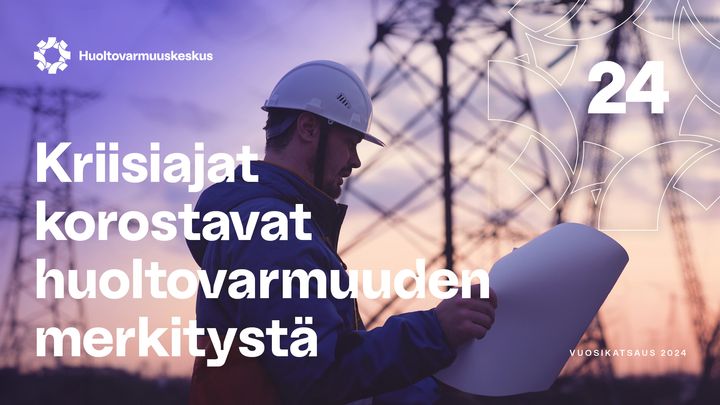
The strategy prepared last year by the National Emergency Supply Agency extends to 2027. According to its vision, the goal of the activities is to make Finland shockproof. The newly published Annual Review highlights focus areas whose importance has recently become more pronounced. As stated by CEO Janne Känkänen, the NESA’s strategy responds to the fundamental change that has taken place in our operating and security environment.
The five focus areas of the strategy are energy supply; transport and supply chains; digital security and security of supply of information; food and water supply; and industrial engineering arrangements for serious crises. Several experts in security of supply elaborate on the backgrounds and outcomes of these focus areas in the Annual Review.
The Annual Review also examines the impact of the security of supply network and exercises in which various parties work together to improve the resilience of different industries.
International interest in Finland’s security of supply has grown due to increased uncertainty and Finland’s accession to NATO. This has attracted a great deal of visitors to Finland from other countries. Finland has intensified its cooperation with Sweden in particular.
The Annual Review also includes excerpts from research activities that the NESA actively engages in together with the National Emergency Supply Organisation’s pools and various research institutes. Additionally, the Annual Review features the key figures on the NESA’s finances and personnel.
The NESA’s first sustainability report as part of the Annual Review
The Annual Review also includes the NESA’s first sustainability report. The report compiles the key goals, actions and metrics with which the NESA seeks to promote sustainable activities. The goal is to integrate sustainability into all activities, decision-making, management and reporting of the organisation.
The sustainability report is based on a materiality analysis conducted in spring 2024 that identified the NESA’s most important sustainability themes on the basis of the views of the NESA’s personnel and stakeholders. The results will guide the NESA’s sustainability efforts during the strategy period 2024–2027 and support impact monitoring of the activities.
The shared framework for the central government’s sustainability reporting is based on the UN’s 2030 Agenda. The NESA adheres to the State Treasury’s recommendation and will, going forwards, prepare an annual sustainability report describing the impacts of its activities on the key Sustainable Development Goals (SDGs).
The central government’s reporting framework is divided into two main elements: the handprint of activities and the footprint of activities, which respectively represent the positive and the negative impacts on the environment and society. Through its sustainability reporting, the NESA demonstrates its commitment to the principles of sustainable development and assesses the impact of its activities.
In autumn 2025, the NESA will also complete its sustainability policy and roadmap, which will guide its activities to be even more impactful and transparent.
The Annual Review and sustainability report are available on the NESA website. The Annual Review will also soon be published in Swedish and English.
Further information:
CEO Janne Känkänen, Assistant Emmi Laaksonen, emmi.laaksonen@nesa.fi
Sustainability Specialist Mathilda Kurki, mathilda.kurki@nesa.fi
Keywords
Alternative languages
Subscribe to releases from Huoltovarmuuskeskus
Subscribe to all the latest releases from Huoltovarmuuskeskus by registering your e-mail address below. You can unsubscribe at any time.
Latest releases from Huoltovarmuuskeskus
Logistikutredning 2025: Ökande risker i leveranskedjorna och kompetensbrist oroar företagen2.6.2026 07:25:54 EEST | Pressmeddelande
Logistikutredning 2025, som publiceras i dag, granskar Finlands logistiska omvärld och särskilt resiliensen i företagens leveranskedjor. Företagen upplever att riskerna i deras leveranskedjor har ökat jämfört med 2022, men bedömer samtidigt att deras resiliens är god.
Logistiikkaselvitys 2025: Toimitusketjujen riskit kasvussa ja osaajapula yritysten huolena2.6.2026 07:25:54 EEST | Tiedote
Tänään julkaistu Logistiikkaselvitys 2025 tarkastelee Suomen logistista toimintaympäristöä ja erityisesti yritysten toimitusketjujen resilienssiä. Yritykset kokevat toimitusketjuihin liittyvät riskit kasvaneiksi verrattuna vuoteen 2022, mutta yritysten resilienssi on hyvä.
National Logistics Survey Finland 2025: supply chain risks increasing and businesses concerned about skills shortages2.6.2026 07:25:54 EEST | Press release
The report ‘National Logistics Survey Finland 2025’, published today, examines Finland’s logistical environment and particularly the resilience of the supply chains of businesses. Businesses feel that supply chain risks have increased compared to 2022, but the resilience of businesses is at a good level.
Utredning inleds om tillgången till hälso- och sjukvårdspersonal vid störningssituationer22.5.2026 10:00:16 EEST | Pressmeddelande
Försörjningsberedskapscentralen (FBC) och Åbo Akademi utreder vilken beredskap och vilja yrkespersoner inom hälso- och sjukvården har att frivilligt ansluta sig till arbetskraften i händelse av en omfattande och allvarlig störning. Målet är att hitta personer som har utbildning inom hälso- och sjukvårdsområdet men som för närvarande arbetar med andra uppgifter.
Selvitys terveysalan ammattilaisten saatavuudesta häiriötilanteessa käynnistyy22.5.2026 10:00:16 EEST | Tiedote
Huoltovarmuuskeskus (HVK) ja Åbo Akademi selvittävät terveydenhuollon ammattilaisten valmiutta ja halukkuutta liittyä vapaaehtoisesti työvoimaan laajamittaisessa ja vakavassa häiriötilanteessa. Tavoitteena on löytää henkilöitä, joilla on terveydenhuoltoalan koulutus, mutta he työskentelevät tällä hetkellä muissa tehtävissä.
In our pressroom you can read all our latest releases, find our press contacts, images, documents and other relevant information about us.
Visit our pressroom