The risk of extensive blue-green algae blooms remains significant in open sea areas
9.6.2025 07:00:00 EEST | Suomen ympäristökeskus | Press release
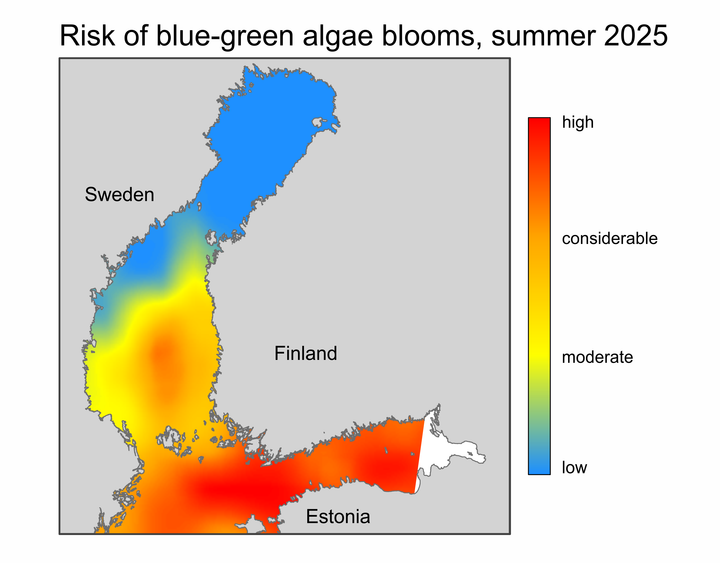
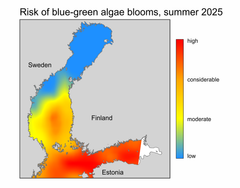
A high risk of blue-green algae blooms in open sea areas persists in the Gulf of Finland, the Archipelago Sea and also in southern and central parts of the Bothnian Sea.
Extensive blue-green algae blooms are likely to occur in the open sea areas close to Finland during the summer as the nutrient situation in the Baltic Sea remains largely unchanged. The risk of the formation of rafts of blue-green algae is considerable in the northern part of the main basin of the Baltic Sea as well as in the Gulf of Finland, the Archipelago Sea and a large part of the Bothnian Sea. The risk remains low in the Bothnian Bay.
The extent of algae rafts and the duration of the blue-green algae bloom are affected by the temperature and wind conditions of the summer. If the nutrient situation in the main basin of the Baltic Sea improved, this would significantly reduce mass occurrences of blue-green algae, as the status of the main basin is reflected in the situation of open sea areas in the north. Local variations in the blue-green algae situation may be great on the coast and in the archipelago and also take place faster than in the open sea. Local blue-green algae blooms have also occurred annually on the Bothnian Bay coast.
Nutrient situation still creates favourable conditions for mass occurrence of blue-green algae
The nutrient situation in the Baltic Sea continues to create favourable conditions for blue-green algae blooms in open sea areas close to Finland, with the exception of the Bothnian Bay. Last winter, the prevailing strong westerly winds promoted the mixing of water layers in the main basin of the Baltic Sea and in the Gulf of Finland. While the oxygen situation in the Gulf of Finland improved considerably, the mixing unfortunately brought plenty of phosphorus up to the surface layers. The phosphorus content in the Bothnian Sea has increased in the 2000s, and the risk of blue-green algae blooms appears to persist in this area.
This year, too, the spring bloom of phytoplankton used up almost all available nitrogen in the surface layer, whereas plenty of phosphorus remained in the surface water. These conditions further provide good preconditions for blue-green algae blooms, as in sea areas the species that form extensive algae blooms are able to use nitrogen gas dissolved from air into water. This gives these blue-green algae species a competitive advantage over others.
Large blue-green algae blooms usually begin to occur in the open sea area after Midsummer. Rafts of blue-green algae form in the open sea following a period of warm and sunny weather of a couple of weeks, especially if it includes a few days of slack winds. In summer, strong northerly winds may cause an upwelling of phosphorus-rich bottom water into the surface layer, which may contribute to blue-green algae growth.
Monitoring the state of the sea also produces information for forecasting blue-green algae risk
To assess the risk of occurrence of blue-green algae, monitoring data collected by the Finnish Environment Institute and the Swedish Meteorological and Hydrological Institute (SMHI) concerning the open seas as well as the ELY Centres' coastal monitoring data were used. In addition, data produced by Alg@line monitoring performed on merchant ships, satellite images and weather data of the EU’s Copernicus service were utilised. The forecast for blue-green algae raft formation was compiled using these datasets, combining forecasting methods based on statistical mathematics and machine learning.
Blue-green algae reports start in Midsummer week
This summer, the Finnish Environment Institute will report weekly on the general blue-green algae situation between 19 June and 7 August 2025. The report will be published on Thursdays at 13:00. However, the monitoring of the blue-green algae situation will continue from the beginning of June until the end of September. For blue-green algae observations, see the national map on Järvi-Meriwiki.
Blue-green algae can produce various toxins, including skin or eye irritants. Significant blue-green algae blooms should always be treated with caution. The blue-green algae situation in public bathing waters is monitored by municipalities and cities.
Keywords
Contacts
Risk evaluation of blue-green algae blooms in Finnish marine areas:
Senior Research Scientist Jouni Lehtoranta, Finnish Environment Institute Syke, firstname.lastname@syke.fi, tel. +358 295 251 363
Blue-green algae ecology in the Baltic Sea:
Senior Research Scientist Sirpa Lehtinen, Finnish Environment Institute Syke, firstname.lastname@syke.fi, tel. +358 295 251 353
Modelling:
Senior Research Scientist Heikki Peltonen, Finnish Environment Institute Syke, firstname.lastname@syke.fi, tel. +358 295 251 304
Communications Specialist Eija Järvinen, Finnish Environment Institute Syke, firstname.lastname@syke.fi, +358 295 251 242
Media service at Finnish Environment Institute
Our Media Service provides information on research, helps journalists find experts for interviews and provides photos for media use.
Our Communication experts will answer your inquiries on weekdays from 9 am to 4 pm.
Images
Links
Finnish Environment Institute - We build hope through research.
Finnish Environment Institute
Latokartanonkaari 11
00790 Helsinki
+358 295 251 000
It is time to move beyond solving environmental problems one by one, to systemic sustainability transformations. The Finnish Environment Institute (Syke) contributes to building a sustainable society through research, information and services. The Finnish Environment Institute is a research institute with 700 experts and researchers located in Helsinki, Oulu, Jyväskylä and Joensuu.

Subscribe to releases from Suomen ympäristökeskus
Subscribe to all the latest releases from Suomen ympäristökeskus by registering your e-mail address below. You can unsubscribe at any time.
Latest releases from Suomen ympäristökeskus
Nostot medialle 19.–23.10.2026 | Kansalaispaneelien oppeja, kasviproteiinien kasvuloikkaa ja Itämeren suojelua15.10.2026 13:53:35 EEST | Tiedote
Hei! Tässä tiedoksesi meillä Suomen ympäristökeskuksessa ensi viikolla ilmestyviä tiedotteita, uutisia, kampanjoita, blogeja ja uutiskirjeitä. Mukana myös tulevia tapahtumia ja webinaareja. Jakelemme mediakatsauksen torstaisin STT:n kautta. Koosteet löytyvät myös STT-uutishuoneesta, josta voit tilata kaikki Suomen ympäristökeskuksen tiedotteet.
Invitation for Media: Can Gypsum Applied to Fields Help Save the Baltic Sea? Join the GYPREG Final Seminar on 28 October 202615.10.2026 13:04:50 EEST | Press invitation
Dear Journalist, Can gypsum applied to fields help save the Baltic Sea? Join us in Helsinki or online on Wednesday, 28 October 2026, to hear the latest results from the international GYPREG project. Register now and reserve your place.
Inbjudan för media: GYPREG:s slutseminarium den 28 oktober 2026 – ny kunskap om gipsbehandlingens potential för att skydda Östersjön15.10.2026 13:04:16 EEST | Pressinbjudan
Bästa journalist, Kan gips som sprids på åkermark bidra till att rädda Östersjön? Välkommen att ta del av de senaste resultaten från det internationella GYPREG-projektet onsdagen den 28 oktober 2026 i Helsingfors eller online. Anmäl dig till seminariet.
Kutsu medialle: GYPREG-loppuseminaari 28.10.2026 - uutta tietoa kipsikäsittelyn mahdollisuuksista Itämeren suojelussa15.10.2026 13:02:58 EEST | Kutsu
Arvoisa toimittaja, Voiko pelloille levitettävä kipsi auttaa pelastamaan Itämeren? Tule kuulemaan uusimmat tulokset kansainvälisestä GYPREG-hankkeesta keskiviikkona 28.10.2026 Helsingissä tai verkossa. Ilmoittaudu mukaan.
Nostot medialle 12.–16.10.2026 | Kasviproteiineista kipsiin – ratkaisuja kestävämpään ruokajärjestelmään8.10.2026 13:52:26 EEST | Tiedote
Hei! Tässä tiedoksesi meillä Suomen ympäristökeskuksessa ensi viikolla ilmestyviä tiedotteita, uutisia, kampanjoita, blogeja ja uutiskirjeitä. Mukana myös tulevia tapahtumia ja webinaareja. Jakelemme mediakatsauksen torstaisin STT:n kautta. Koosteet löytyvät myös STT-uutishuoneesta, josta voit tilata kaikki Suomen ympäristökeskuksen tiedotteet.
In our pressroom you can read all our latest releases, find our press contacts, images, documents and other relevant information about us.
Visit our pressroom