
Scientific panels’ report: Resource efficiency, value added and climate impacts of forest and wood use can be improved simultaneously
15.6.2026 01:00:00 EEST | Ilmastopaneeli | Press release
According to a joint report of the Finnish Climate Change Panel and the Finnish Forest Bioeconomy Science Panel, a more material-efficient utilisation of forest industry side streams and the capture, utilisation and storage of biogenic carbon dioxide could create significant economic value added in Finland, while also producing positive climate impacts.
The report published today examines scenarios up to 2040, in which new technologies are introduced in the forest industry to refine lignin and bark into higher value-added products, such as hard carbon, adhesives and for leather processing, and the burning of wood is reduced by electrification. In the scenarios, biogenic carbon dioxide emissions from the forest industry and bioenergy production are captured and either further refined into aviation and transport fuels and plastics (BECCU, Bio-Energy with Carbon Capture and Utilisation) or stored permanently geologically or by mineralisation, creating technological carbon sinks (BECCS, Bio-Energy with Carbon Capture and Storage). These solutions are examined in relation to different felling volumes.
The scenarios are used to assess the impacts of the changes on the capture and utilisation potential of biogenic carbon dioxide in Finland.
Finland has one of the largest potentials in the EU for biogenic carbon dioxide (CO₂) capture
Compared to other EU countries, Finland has one of the largest potentials for biogenic carbon dioxide capture, as today’s large forest industry and bioenergy production plants generate approximately 28 million tonnes of biogenic carbon dioxide.
– According to our scenario analysis, the availability of biogenic carbon dioxide in Finland remains good, even if side streams are directed away from combustion and the annual timber harvesting level decreases to 64 million cubic metres. For example, Finland could produce a significant share of the synthetic aviation fuel needed in the EU and create technological carbon sinks, says Kati Koponen, member of the Finnish Climate Change Panel.
Significant value creation from forest industry side streams with moderate investments
With regard to new production activities, the scenario analysis focused on those forest industry value-added products that can be manufactured from side streams currently directed to combustion and that have an impact on the availability of biogenic carbon dioxide.
– Tannins from coniferous wood bark can replace carcinogenic chromium compounds in leather processing. The lignin derived from black liquor can be further refined into hard carbon for use in battery materials, for example, helping to reduce reliance on critical raw materials. In addition to bark tannins and lignin, the forest industry also has potential for many other higher value-added products, says Tekla Tammelin-Peltonen, vice chair of the Finnish Forest Bioeconomy Science Panel.
According to the analysis, bark and lignin can generate significant added value with moderate investments. The demand for products based on these should be strengthened at the EU level.
Carbon dioxide utilisation can create significant added value, but requires substantial investments
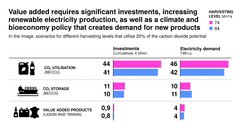
According to the scenario analysis, the utilisation of 20% of the potential of biogenic carbon dioxide by 2040 could create an annual value added of EUR 3 to 5 billion. This will require approximately 42–48 TWh of renewable electricity and EUR 40 to 50 billion of investments. For comparison, last year the total electricity consumption in Finland was 85 TWh.
– Realising the potential of the new carbon dioxide economy requires significant investments in carbon capture, additional production of renewable electricity and new technologies. In addition, EU regulation for stable demand, national support measures and skilled labour are needed, Koponen explains.
The permanent storage of CO₂ requires substantially lower investment and less additional electricity than utilisation, but its economic value added is lower and partly targeted at countries that offer geological storage of CO₂. A domestic solution could be provided by the permanent storage of carbon dioxide in mining waste by mineralisation.
In addition to a stable and ambitious climate policy, the realisation of both the utilisation and storage of biogenic carbon dioxide requires a predictable investment environment.
The climate impacts of the forest industry can be improved by transferring wood from energy use to material use and by increasing the carbon capture rate
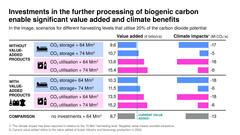
In all scenarios examined in the report, the climate impacts are better than in the current situation. However, in a scenario with a higher harvesting level, new production activities cannot compensate for the emission impact caused by the deterioration of the forest sink compared to a scenario with a lower harvesting level.
Climate impacts are also targeted in different ways. As a result of exports, the benefits of higher value-added products and the utilisation of CO₂ in the forest industry are also visible abroad, while technological carbon sinks support the achievement of the objectives laid down in the Finnish Climate Change Act in their entirety.
New forest industry bark- and lignin-based products, as well as carbon capture and utilisation, may enable the same or even higher value added at more moderate harvesting levels than currently.
– Combining a lower harvesting level with new production activities will better support the achievement of future climate objectives and obligations, as well as compliance with the raw material sustainability criteria. The carbon dioxide economy is an important part of climate change mitigation, but emission reduction measures must be continued alongside it in all sectors, and the growth of natural carbon sinks must be supported, Koponen says.
Based on the calculation model used in the report, a reduction in felling volume from 74 million cubic metres to 64 million would reduce the value added of the forest sector by approximately EUR 1.4 billion.
– If new, higher value-added products are not introduced to the market, decreasing fellings would lead to a decline in the economic activity of the forest sector, to which the national and regional economies would have to adapt. In any case, decoupling from fossil fuel dependency requires the utilisation of biogenic carbon as value-added products and the refining of CO₂ into fuels and plastic raw materials, Tammelin-Peltonen adds.
Further information:
- Kati Koponen, member of the Finnish Climate Change Panel, senior researcher at VTT, tel. +358 40 487 8123
- Tekla Tammelin-Peltonen, Vice Chair of the Finnish Forest Bioeconomy Science Panel, research professor at VTT, tel. +358 400 562 814
Contacts
Laura TicklénSuomen ilmastopaneeli
Tel:050 595 2412laura.ticklen@ilmastopaneeli.fiImages
Links
Alternative languages
- FIN: Tiedepaneelien raportti: Metsien ja puun käytön resurssitehokkuutta, arvonlisäystä ja ilmastovaikutuksia pystytään parantamaan yhtäaikaisesti
- SWE: Rapport från vetenskapspanelerna: Resurseffektiviteten, värdeökningen och klimatkonsekvenserna i fråga om skogar och användningen av trä kan förbättras samtidigt
Subscribe to releases from Ilmastopaneeli
Subscribe to all the latest releases from Ilmastopaneeli by registering your e-mail address below. You can unsubscribe at any time.
Latest releases from Ilmastopaneeli
Klimatpanelens rapport: Ett klimateffektivt jordbruk minskar utsläppen, svarar på förändringar i efterfrågan på mat och ökar kriståligheten1.6.2026 01:00:00 EEST | Pressmeddelande
Finlands klimatpanels färska rapport behandlar stegen mot ett klimateffektivt jordbruk i Finland. Det finns flera effektiva metoder för att minska utsläppen från matproduktionen som tar i beaktande självförsörjningen, försörjningsberedskapen och anpassningen till klimatförändringen.
Ilmastopaneelin raportti: Ilmastotehokas maatalous vähentää päästöjä, vastaa ruoan kysynnän muutoksiin ja lisää kriisinkestävyyttä1.6.2026 01:00:00 EEST | Tiedote
Suomen ilmastopaneelin tuore raportti käsittelee askeleita kohti ilmastotehokasta maataloutta Suomessa. Ruoantuotannon päästöjen vähentämiseen on useita vaikuttavia keinoja, jotka huomioivat omavaraisuuden, huoltovarmuuden ja ilmastonmuutokseen sopeutumisen.
Report of the Finnish Climate Change Panel: Climate-smart agriculture will reduce emissions, respond to changes in food demand and improve crisis resilience1.6.2026 01:00:00 EEST | Press release
The Finnish Climate Change Panel's new report discusses steps towards climate-smart agriculture in Finland. Several effective ways of reducing emissions from food production can be identified that address self-sufficiency, security of supply and climate change adaptation.
Klimatpanelens rapport: Reformen av EU:s klimatpolitik är en möjlighet för Finland9.2.2026 04:00:00 EET | Pressmeddelande
Finlands klimatpanels senaste rapport behandlar framtiden för Europeiska unionens klimatpolitik. Att nå klimatmålet för 2040 framför allt genom prissättning av utsläpp på EU-nivå skapar ekonomiska möjligheter för Finland. Utifrån rapportens resultat ger Klimatpanelen beslutsfattarna rekommendationer för utveckling av EU:s utsläppshandel.
Ilmastopaneelin raportti: EU:n ilmastopolitiikan uudistaminen on Suomelle mahdollisuus9.2.2026 04:00:00 EET | Tiedote
Suomen ilmastopaneelin uusin raportti käsittelee Euroopan unionin ilmastopolitiikan tulevaisuutta. Vuoden 2040 ilmastotavoitteen saavuttaminen ennen kaikkea EU-tasoisen päästöjen hinnoittelun avulla luo Suomelle taloudellisia mahdollisuuksia. Raportin tulosten perusteella Ilmastopaneeli antaa päättäjille suosituksia EU:n päästökaupan kehittämiseksi.
In our pressroom you can read all our latest releases, find our press contacts, images, documents and other relevant information about us.
Visit our pressroom