Companies, regulators, and stakeholders shape sustainability reporting
25.8.2026 11:12:22 EEST | Svenska handelshögskolan | Press release
Sustainability reporting is shaped by the social, economic, and political environment in which companies operate. New research shows how corporate culture, cross-border regulatory influences, and stakeholder involvement in standard setting shape how reporting practices evolve over time.
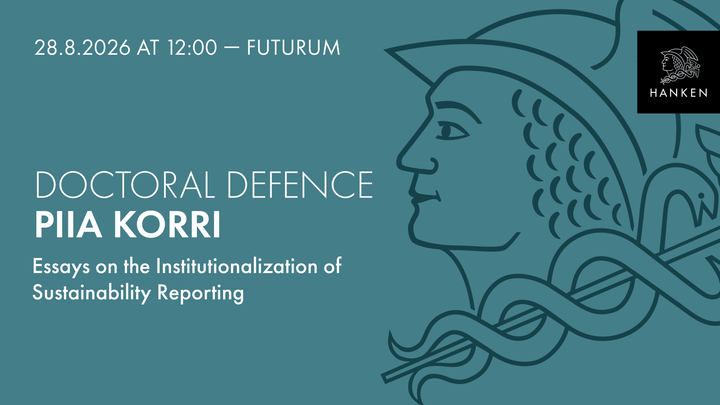
Sustainability reporting may appear primarily as a compliance requirement or communication practice, but behind reporting requirements lies a longer process through which practices and expectations develop and gradually become established. In her doctoral thesis, Piia Korri studies the factors shaping the institutionalisation of sustainability reporting.
Political priorities differ across jurisdictions, contributing to different regulatory environments for sustainability reporting. In the U.S., sustainability reporting is less regulated at the federal level than in the EU.
“When reporting is less standardised, there is more room for corporate culture to influence disclosure practices and ESG ratings, potentially affecting investors and others who rely on this information,” Korri explains.
Regulatory differences across jurisdictions do not, however, mean that firms are influenced only by the rules of their home jurisdiction. Korri finds that regulation can also have cross-border effects: following the implementation of the EU’s Non-Financial Reporting Directive, U.S. firms with EU subsidiaries showed greater improvements in sustainability transparency and performance than the comparison firms.
“Foreign subsidiaries can expose multinational firms to regulatory developments outside their home jurisdiction. These effects can extend to the parent company, even when it falls outside the regulation’s direct scope,” Korri says.
Even in the EU, where sustainability reporting has become increasingly regulated over time, standardisation involves trade-offs. Stakeholders involved in developing sustainability reporting standards bring different priorities and perspectives to the process. This can create tensions between ambitions for broader change and established ways of working, as well as between flexibility and more prescriptive reporting requirements.
“The same requirements can support the aims of some stakeholder groups while imposing costs or constraints on others,” Korri explains.
Overall, the findings show that sustainability reporting is shaped by several factors: corporate culture and practices, the cross-border spillover effects of regulation, and interactions among stakeholders involved in standard-setting.
You can read the whole thesis here: Essays on the Institutionalization of Sustainability Reporting
More information:
Piia Korri
E-mail: piia.korri@hanken.fi
Piia Korri will defend her thesis “Essays on the Institutionalization of Sustainability Reporting” on 28 August 2026 at noon at Hanken School of Economics, Arkadiankatu 22, Helsinki. The doctoral defence will be held on site in auditorium Futurum and will not be available online.
Opponent: Laura Muro, professor of accounting and international business sustainability, Saint Louis University Madrid
Custos: Hanna Silvola, associate professor, Hanken School of Economics
Contacts
Marlene GünsbergSenior Communications Specialist
Tel:040 3521212marlene.gunsberg@hanken.fiAbout
Hanken School of Economics is a leading, internationally accredited university with over a hundred years of experience in education and research in economics and business administration. The research is of a high standard and constitutes the foundation of all teaching. Hanken has close ties to the business community and an active alumni network with over 16 000 alumni in 70 countries worldwide.
Alternative languages
Subscribe to releases from Svenska handelshögskolan
Subscribe to all the latest releases from Svenska handelshögskolan by registering your e-mail address below. You can unsubscribe at any time.
Latest releases from Svenska handelshögskolan
Ny studie granskar Oatlys omdebatterade mjölkkampanj23.9.2026 09:03:14 EEST | Pressmeddelande
Varumärkesaktivism blir allt vanligare när företag väljer att ta ställning i samhällsfrågor, men aktivismen är inte riskfri. I en ny studie har forskare analyserat hur det växtbaserade livsmedelsföretaget Oatly hanterade den kritikstorm som följde efter företagets uppmärksammade mjölkkampanj i Finland.
Uusi tutkimus tarkastelee Oatlyn kohua herättänyttä maitokampanjaa23.9.2026 09:03:14 EEST | Tiedote
Yritysaktivismi yleistyy jatkuvasti yritysten ottaessa kantaa yhteiskunnallisiin kysymyksiin. Aktivismiin liittyy kuitenkin myös riskejä. Tuoreessa tutkimuksessa tutkijat ovat analysoineet, miten kasvipohjaisia elintarvikkeita valmistava Oatly hallitsi yritystä kohdannutta kritiikkiaaltoa sen näkyvän maitokampanjan jälkeen Suomessa.
New study examines Oatly's controversial milk campaign in Finland23.9.2026 09:03:14 EEST | Press release
Brand activism is becoming increasingly common as companies take a stand on societal issues. However, activism is not without risks. In a new study, researchers have analysed how the plant-based food company Oatly managed the criticism that followed its high-profile milk campaign in Finland.
Hanken bäst i Finland och bland de tre främsta i Norden7.9.2026 09:53:19 EEST | Pressmeddelande
Svenska handelshögskolans (Hanken) magisterutbildning stiger till plats 56 i världen i årets upplaga av Financial Times Masters in Management-rankning. Resultatet placerar Hanken i topp i Finland och bland de tre främsta handelshögskolorna i Norden.
Hanken paras Suomessa ja kolmen parhaan joukossa Pohjoismaissa7.9.2026 09:53:19 EEST | Tiedote
Kauppakorkeakoulu Hankenin maisterikoulutus nousee sijalle 56 maailmassa tämän vuoden Financial Times Masters in Management -rankingissa. Tulos nostaa Hankenin Suomen kärkeen ja Pohjoismaiden kolmen parhaan kauppakorkeakoulun joukkoon.
In our pressroom you can read all our latest releases, find our press contacts, images, documents and other relevant information about us.
Visit our pressroom