Contactless payments reached almost EUR 10 billion in April–June
3.9.2026 10:00:00 EEST | Suomen Pankki | Press release
Finnish bank cards were used for more payments in April–June than in the corresponding period last year. Already more than one-fifth of card payments were remote payments, i.e. card payments initiated on a computer or in a mobile application.
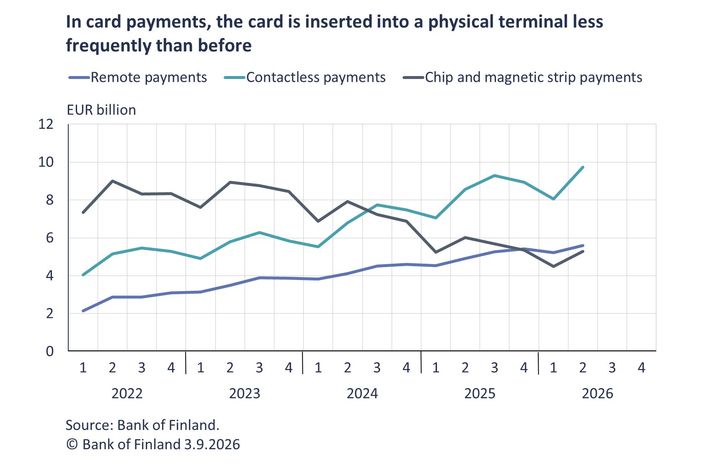
In the second quarter of 2026, Finnish payment cards were used in card payments totalling EUR 20.6 billion, which was 6% more than in April–June 2025. The total number of card payments made with Finnish payment cards over the same period was 680 million, representing an increase of 4% year-on-year.
The total value of contactless payments in the second quarter of 2026 was EUR 9.7 billion, which was EUR 1.2 billion (13%) more than in the corresponding period a year earlier. In April–June 2026, 47% of the total value of card payments was paid using the contactless feature, meaning that the share of contactless payments increased by 3 percentage points in value terms from a year earlier. Meanwhile, a total of 463 million card payments were made by contactless payment, 5% more than in the second quarter of 2025.
Finnish payment cards were used for 141 million remote payments in the second quarter of 2026, which was 13% more than in the same period a year earlier. The total value of remote card payments (EUR 6 billion) was 14% higher than in the second quarter a year earlier. Cards are used to pay remotely, for example, for online shopping in web browsers, in-app purchases and person-to-person card payments. Remote card payments accounted for 27% of the value of all card payments in April–June 2026. The share has increased steadily, having been more than 10 percentage points lower four years ago.
Payments by chip or magnetic stripe have been decreasing. In the second quarter of 2026, payments by chip or magnetic stripe totalled EUR 5.3 billion, which was 12% less than in the corresponding period a year earlier.
Some of the figures discussed in this news release have been published in the payment statistics dashboard.
The statistical data are also available via an API from the Bank of Finland’s open data portal. For details, see https://www.suomenpankki.fi/en/statistics/open-data/?epslanguage=en
The next quarterly news release on payment statistics will be published at 10 a.m. on 16 December 2026.
Further information
- Usva Topo, tel. +358 9 183 2056, email: usva.topo(at)bof.fi.
- Olli Tuomikoski, tel. +358 9 183 2925, email: olli.tuomikoski(at)bof.fi.
Links
Bank of Finland
The Bank of Finland is the national monetary authority and central bank of Finland. At the same time, it is also a part of the Eurosystem, which is responsible for monetary policy and other central bank tasks in the euro area and administers use of the world’s second largest currency – the euro.
Alternative languages
Subscribe to releases from Suomen Pankki
Subscribe to all the latest releases from Suomen Pankki by registering your e-mail address below. You can unsubscribe at any time.
Latest releases from Suomen Pankki
Why central banks cannot always “look through” supply shocks21.10.2026 11:00:00 EEST | Blog
When inflation rises into the 5-6% range, firms may reprice more frequently just as households begin revising expectations more aggressively. These channels can reinforce one another, making early and credible policy action more valuable.
Kutsu medialle: Suomen Pankin julkinen kuuleminen eduskunnan talousvaliokunnassa 20.10. klo 12.0014.10.2026 14:00:00 EEST | Kutsu
Talousvaliokunta järjestää kansanedustajille ja medialle avoimen, Eduskunnan pankkivaltuuston kertomuksen 2025 käsittelyyn liittyvän julkisen kuulemisen tiistaina 20.10.2026 klo 12.00 Pikkuparlamentin auditoriossa (Arkadiankatu 3).
Centralbankskrediternas roll i styrningen av Eurosystemets räntor ökar när likviditeten minskar14.10.2026 11:02:29 EEST | Pressmeddelande
När affärsbankernas inlåning i centralbanken, dvs. centralbankslikviditeten, minskar, kommer styrningen av de korta penningmarknadsräntorna basera sig allt mer på en aktiv penningmarknad och Eurosystemets likviditetstillförande refinansieringstransaktioner. Beloppet av centralbanksinlåning minskar till följd av förfall av de värdepapper som Eurosystemet köpte under perioden med låg inflation och under coronapandemin.
Likviditeetin vähentyessä eurojärjestelmän luottojen rooli korkojen ohjauksessa kasvaa14.10.2026 11:02:29 EEST | Tiedote
Eurojärjestelmä ohjaa jatkossa lyhyitä rahamarkkinakorkoja aktiivisen rahamarkkinan ja keskuspankkiluottojen avulla, kun liikepankkien keskuspankkitalletusten määrä eli keskuspankkilikviditeetti vähenee. Talletusten määrä vähenee, kun eurojärjestelmän hitaan inflaation ja koronapandemian aikana ostamat arvopaperit erääntyvät.
Role of the Eurosystem’s refinancing operations in interest rate steering will grow as liquidity declines14.10.2026 11:02:29 EEST | Press release
As the volume of central bank liquidity declines, the Eurosystem will conduct its steering of short-term money market interest rates via an active money market and its refinancing operations. Central bank liquidity means central bank deposits held by commercial banks, i.e. central bank reserves. The amount of central bank reserves is declining as the debt securities purchased by the Eurosystem during the low inflation period and the COVID-19 pandemic mature.
In our pressroom you can read all our latest releases, find our press contacts, images, documents and other relevant information about us.
Visit our pressroom