
Housing corporations’ drawdowns of new loans decreased in September 2026 from the year earlier
28.10.2026 10:00:00 EET | Suomen Pankki | Press release
In September 2026, Finnish housing corporations drew down nearly 39% less in new loans than a year earlier. In January–September 2026, housing corporations drew down nearly 17% less in new loans than in the corresponding period in 2025.
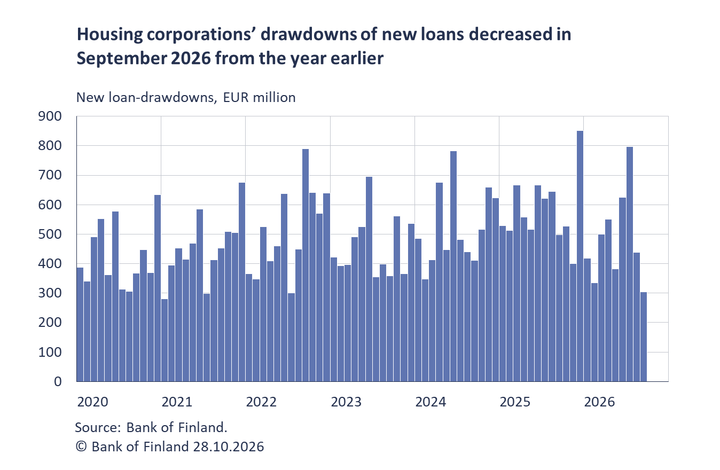
In September 2026, Finnish housing corporations drew down a total of EUR 304 million of new loans from credit institutions operating in Finland. The drawdowns were nearly 39% below the level in September 2025. This is the smallest volume of monthly drawdowns since July 2022. In January–September 2026, housing corporations drew down a total of EUR 4.3 billion in new loans, which is nearly 17% less than in the corresponding period in 2025.
In July 2026, the volume of new loans drawn by housing corporations was larger than usual, totalling nearly EUR 800 million. The increase in the volume of drawdowns was due to the pension reform that entered into force in July, which was reflected also in the demand for other corporate loans 1. The decline in the volume of loan drawdowns throughout the year 2026 is however partly due to the decrease in construction activity. According to Statistics Finland, construction starts of blocks of flats decreased in January-August 2026 by 18% from the year-earlier period. The government has granted less interest-subsidy authorisation for 2026 than in previous years, contributing to a decline in starts of state-subsidised housing production, too 2.
Despite the decrease in new drawdowns, the stock of loans to housing corporations continued to grow and was EUR 47.0 billion in September 2026. The annual growth rate of the loan stock was 2.7%, i.e. slightly higher than a year earlier. Compared with previous years, the growth rate was however relatively slow. For example, only three years ago, the stock of loans to housing corporations grew at an annual rate of 5%.
Of the stock of loans to housing corporations, slightly over half were loans granted to private domestic limited liability housing companies (housing companies) in August 2026 3. The rest is mainly loans to other public housing corporations and other private domestic housing corporations 4. In August 2026, slightly less than 13% of the stock of loans to housing companies was accounted for by companies established no more than five years earlier. The loan stock of new housing companies has contracted for already several years. In contrast, the stock of loans to housing companies established 10–30 years ago and those established more than 50 years ago has grown for already a longer period.
The average interest rate on the stock of loans to housing corporations has risen with the general level of interest rates. In September 2026, the average interest rate on the loan stock was 3.35%, compared with 2.97% only a year earlier. Of the loans, 84% were linked to Euribor rates at the end of September 2026.
Loans
In September 2026, drawdowns of new housing loans by Finnish households amounted to EUR 1.3 billion, an increase of EUR 10 million compared with the corresponding period a year earlier. Of the newly drawn housing loans, buy-to-let mortgages accounted for EUR 130 million. The average interest rate on new housing loans increased from August to 3.54% in September. At the end of September 2026, the housing loan stock stood at EUR 105.5 billion, and its annual growth rate was −0.2%. Buy-to-let mortgages accounted for EUR 9.3 billion of the housing loan stock. At the end of September, Finnish households’ loan stock included EUR 17.4 billion of consumer credit and EUR 18.0 billion of other loans.
Finnish non-financial corporations drew down new loans 5 worth EUR 2.1 billion in September. The average interest rate on the new corporate loan drawdowns rose from August and stood at 4.49% in September. At the end of September, the stock of loans granted to Finnish non-financial corporations totalled EUR 113.7 billion.
Deposits
At the end of September 2026, the total stock of Finnish households’ deposits was EUR 118.1 billion, with an average interest rate of 0.94%. Overnight deposits accounted for EUR 71.8 billion and deposits with an agreed maturity for EUR 17.8 billion of the total deposit stock. In September, Finnish households concluded new agreements on deposits with an agreed maturity worth EUR 1.7 billion. The average interest rate on new deposits with an agreed maturity was 2.85% in September.
Further information
- Olli Tuomikoski, tel. +358 9 183 2925, email: olli.tuomikoski(at)bof.fi
- Markus Aaltonen, tel. +358 9 183 2395, email: markus.aaltonen(at)bof.fi.
The next news release on money and banking statistics will be published at 10:00 on 27 November 2026.
Related statistical data and graphs are also available on the Bank of Finland website: https://www.suomenpankki.fi/en/statistics/.
The statistical data are also available via an API from the Bank of Finland’s open data portal. For details, see https://www.suomenpankki.fi/en/statistics/open-data/.
1 Growth rate of the corporate loan stock accelerated in summer 2026.
2 The Centre for State-Subsidised Housing Construction (Varke) statistics on State-subsidised new-build housing construction and the use of interest-subsidy authorisations https://www.varke.fi/fi/tilastot-ja-julkaisut/valtion-tukema-asuntotuotanto (in Finnish).
3 Bank of Finland website on housing corporation loan statistics based on credit data collection (in Finnish). The figures for September 2026 will be published on 12 November 2026.
4 Housing corporations other than limited liability housing companies include, for example, private rental housing groups, real estate partnerships, public mainly municipality-owned rental housing companies and entities designated as non-profit by the Housing Finance and Development Centre of Finland (ARA), including rental housing providers.
5 Excluding overdrafts and credit card credit.
Links
Bank of Finland
The Bank of Finland is the national monetary authority and central bank of Finland. At the same time, it is also a part of the Eurosystem, which is responsible for monetary policy and other central bank tasks in the euro area and administers use of the world’s second largest currency – the euro.
Alternative languages
Subscribe to releases from Suomen Pankki
Subscribe to all the latest releases from Suomen Pankki by registering your e-mail address below. You can unsubscribe at any time.
Latest releases from Suomen Pankki
En överföring i euro är ofta det förmånligaste alternativet för betalningar mellan de nordiska länderna28.10.2026 11:15:00 EET | Nyheter
Enligt en gemensam studie som tagits fram av centralbankerna i Danmark, Finland, Island, Norge och Sverige medför betalningar mellan de nordiska länderna fortfarande betydande kostnader för hushållen. I studien granskas kostnaderna för överföringar och kortbetalningar mellan de nordiska länderna.
Euromääräinen tilisiirto on Pohjoismaiden välillä usein edullisin vaihtoehto28.10.2026 11:15:00 EET | Uutinen
Tanskan, Suomen, Islannin, Norjan ja Ruotsin keskuspankkien yhteisen raportin mukaan Pohjoismaiden välisestä maksamisesta aiheutuu kotitalouksille edelleen merkittäviä kustannuksia. Raportissa tarkastellaan Pohjoismaiden välisten tilisiirtojen ja korttimaksujen kustannuksia.
Bank transfers between Nordic countries are often cheapest when denominated in euros28.10.2026 11:15:00 EET | News
According to a joint report by the central banks of Denmark, Finland, Iceland, Norway and Sweden, cross-border payments between Nordic countries still generate significant costs for households. The report examines the costs of making bank transfers and card payments between the Nordic countries.
Kutsu medialle: Kiinan talouden ennuste vuosille 2026–2028 - Ilmoittaudu embargojakelulistalle ja osallistujaksi Kiina-tietoiskuun27.10.2026 11:38:58 EET | Kutsu
Miltä näyttää Kiinan talous lähivuosina? Suomen Pankin nousevien talouksien tutkimuslaitos BOFIT julkaisee päivitetyn Kiinan talouden ennusteen vuosille 2026–2028 maanantaina 2.11. klo 7.00. BOFIT Kiina-tietoisku järjestetään 2.11.2026 klo 12.30–14.30.
Why central banks cannot always “look through” supply shocks21.10.2026 11:00:00 EEST | Blog
When inflation rises into the 5-6% range, firms may reprice more frequently just as households begin revising expectations more aggressively. These channels can reinforce one another, making early and credible policy action more valuable.
In our pressroom you can read all our latest releases, find our press contacts, images, documents and other relevant information about us.
Visit our pressroom