
Growth in Finland's cormorant population levelled off
11.9.2025 09:00:00 EEST | Suomen ympäristökeskus | Press release
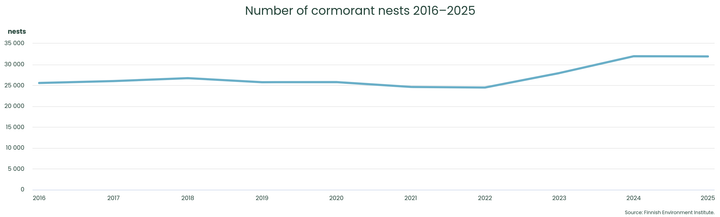
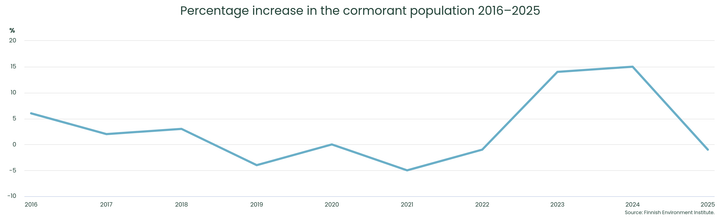
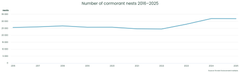
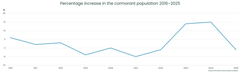
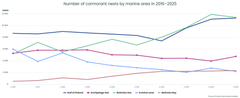
In the summer of 2025, approximately 31,910 cormorant nests were counted in Finland. The breeding population decreased by one percent from the previous summer, approximately 280 nests. The change from last year is significant, as in the summer of 2024 the population growth was 15 percent, with 32,190 nests.
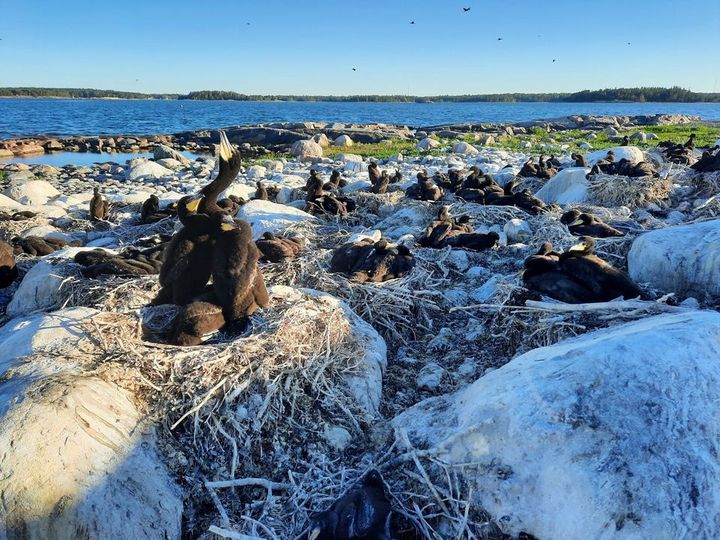
"The exceptional growth observed in the previous two summers now appears to have come to a halt, and there has been no significant influx of nesting birds from other Baltic Sea countries," says researcher Pekka Rusanen from the Finnish Environment Institute (Syke).
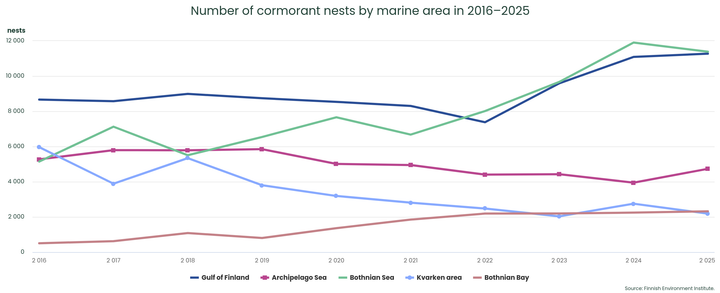
The largest increase in marine areas, 13%, was observed in the Archipelago Sea, where the number of nests increased by ca 560. This was due to the doubling of a Masku colony to over a thousand nests.
In the Gulf of Finland and the Bothnian Bay, the increase was only a couple of percent, with ca 180 nests in the Gulf of Finland and 75 in the Bothnian Bay. In the Kvarken, the number of nests decreased by as much as a fifth, 560 nests, and in the Bothnian Sea by four percent, 520 nests.
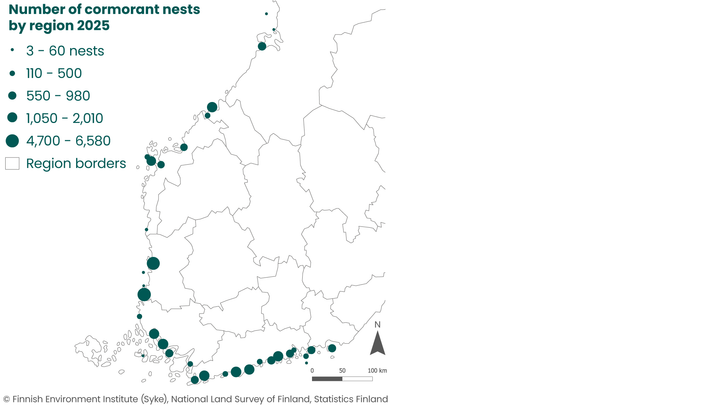
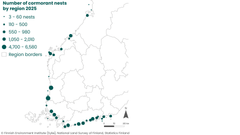
Approximately 15,900 cormorant nests were counted in the Gulf of Bothnia, which was a thousand fewer than the previous summer. There were ca 11,390 nests in the Bothnian Sea, almost all of them in Satakunta, 2,190 in the Kvarken, and 2,320 in the Bothnian Bay. Approximately 11,270 nests were counted in the Gulf of Finland and 4,730 in the Archipelago Sea. As in previous years, only one colony of about a dozen nests were observed inland, in Päijänne-Tavastia. The colony on the coastal lake in Pori decreased by almost a quarter to ca 1,470 nests.
More than a third of the cormorant nests were located both in the Bothnian Sea and the Gulf of Finland, 15% in the Archipelago Sea, and 7% both in the Kvarken and the Bothnian Bay.
Eight colonies with over a thousand nests
Totally 67 colonies of cormorants were observed in Finland, nesting on a total of 104 islets or islands, and nine of the colonies nesting in small groups on sea marks, line markers or lighthouses.
Cormorant colonies with over a thousand nests were located in Pori (2 pcs.), Rauma, Masku, Turku, Raasepori, Espoo and Porvoo. These colonies accounted for more than half of the entire cormorant population in Finland. The largest colony, near the port of Rauma, decreased by more than a thousand nests to just under 6,600 nests.
At the municipal level, the number of cormorant nests increased most in Pori, by ca 840, and in Masku, by 490 nests. In Siikajoki, Uusikaarlepyy, Salo, Inkoo, Siuntio, Helsinki and Loviisa, the population grew by ca 100–300 nests in each municipality.
The population declined most significantly in Rauma, with 1,075 nests, and in Mustasaari, with 810 nests. In Kristiinankaupunki, Kirkkonummi, Porvoo and Hamina, the population declined by ca 200–300 nests in each municipality.
As in the previous summer, the total nesting area was ca 76 hectares. The proportion of cormorants nesting in trees continued to grow and already comprised two-thirds of the total number of nests, whereas six years earlier the proportion was only a quarter. In the inner archipelago, closer to human settlements, the proportion of colonies nesting in trees has increased due to increased predation by white-tailed eagles.
New colonies from the Bothnian Bay to the eastern Gulf of Finland
Seven new colonies were found in Oulu, Siikajoki, Kokkola, Vaasa, Taivassalo, Sipoo and Loviisa. The new colonies comprised a total of ca 1,670 nests. In addition, three colonies continued nesting after a couple of years' break. Of the colonies observed last year, only five small ones became deserted.
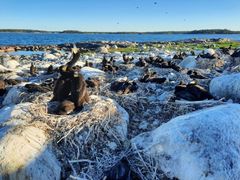
Cormorant colonies were illegally disturbed in at least Maalahti, Korsnäs, Kristiinankaupunki and Hamina. In early May, nesting was prevented on two islets in Maalahti and Korsnäs, resulting in the creation of a new colony of over 500 nests in the Vaasa archipelago. In Hamina, all the eggs from a colony of about 300 nests were collected at the turn of June. "As a result of nesting being prevented or nests being destroyed, cormorants change their nesting sites, which may end up in areas more sensitive from a human perspective," Rusanen notes.
Cormorant is a returnee species
The cormorant is protected in Finland around the year under the Nature Conservation Act and is not on the EU's list of huntable species. In the Baltic Sea the cormorant has returned to its original breeding grounds and is not handled in Finland´s National Strategy on Invasive Alien Species.
Monitoring of the cormorant population is coordinated by the Finnish Environment Institute Syke. The monitoring collects basic information on the ecology and distribution of the species. We warmly thank all the over 60 people who participated in the census, search, and inspection of cormorant colonies in the summer of 2025!
More information
Researcher Pekka Rusanen, Finnish Environment Institute, tel. +358 29 525 1580, forename.surname@syke.fi
Keywords
Contacts
Media service at Finnish Environment Institute
Our Media Service provides information on research, helps journalists find experts for interviews and provides photos for media use.
Our Communication experts will answer your inquiries on weekdays from 9 am to 4 pm.
Images
Documents
Finnish Environment Institute - We build hope through research.
Finnish Environment Institute
Latokartanonkaari 11
00790 Helsinki
+358 295 251 000
It is time to move beyond solving environmental problems one by one, to systemic sustainability transformations. The Finnish Environment Institute (Syke) contributes to building a sustainable society through research, information and services. The Finnish Environment Institute is a research institute with 700 experts and researchers located in Helsinki, Oulu, Jyväskylä and Joensuu.

Subscribe to releases from Suomen ympäristökeskus
Subscribe to all the latest releases from Suomen ympäristökeskus by registering your e-mail address below. You can unsubscribe at any time.
Latest releases from Suomen ympäristökeskus
Östersjöns tillstånd är fortfarande långt från målen – uppföljning som sträcker sig från kustvatten till öppet hav visar varför18.9.2026 08:30:00 EEST | Pressmeddelande
I augusti genomförde Finlands miljöcentral två uppföljningsresor i Östersjön: havsforskningsfartyget Aranda samlade in information från öppet hav och ms Hessu från Skärgårdshavet och kusten. Övergödning är fortfarande Östersjöns största miljöproblem. Enligt den statusbedömning av kustvattnen som publicerades i juni har endast sex procent av Finlands kustvatten god status. Färska mätningar och modelleringar ger en uppdaterad lägesbild av hur näringsbelastningen från land syns i kustvattnen och på öppet hav och varför havets tillstånd fortfarande är långt från målen.
The state of the Baltic Sea still far from the objectives – monitoring extending from coastal waters to the open sea explains why18.9.2026 08:30:00 EEST | Press release
In August, the Finnish Environment Institute carried out two monitoring cruises in the Baltic Sea: Research vessel Aranda collected data from the open sea and M/S Hessu from the Archipelago Sea and the coast. Eutrophication remains the biggest environmental problem in the Baltic Sea. According to the status assessment of coastal waters, published in June, only six per cent of Finnish coastal waters are in a good state. Recent measurements and modelling provide an updated situational picture of how nutrient pollution from land is reflected in coastal waters and the open sea, and why the state of the sea is still far from the objectives.
Itämeren tila on yhä kaukana tavoitteista – rannikkovesistä avomerelle ulottuva seuranta kertoo miksi18.9.2026 08:30:00 EEST | Tiedote
Suomen ympäristökeskus toteutti elokuussa Itämerellä kaksi seurantamatkaa: merentutkimusalus Aranda keräsi tietoa avomereltä ja ms Hessu Saaristomereltä ja rannikolta. Rehevöityminen on edelleen Itämeren suurin ympäristöongelma. Kesäkuussa julkaistun rannikkovesien tila-arvion mukaan vain kuusi prosenttia Suomen rannikkovesistä on hyvässä tilassa. Tuoreet mittaukset ja mallinnukset tarjoavat päivitetyn tilannekuvan siitä, miten maalta tuleva ravinnekuormitus näkyy rannikkovesissä ja avomerellä, ja miksi meren tila on edelleen kaukana tavoitteista.
Nostot medialle 21.–25.9.2026: Miksi Itämeren tila on yhä kaukana tavoitteista? Metsien ennallistamisessa etsitään tasapainoa metsäluonnon tilan parantamisen ja metsätalouden välillä17.9.2026 13:46:33 EEST | Tiedote
Hei! Tässä tiedoksesi meillä Suomen ympäristökeskuksessa ensi viikolla ilmestyviä tiedotteita, uutisia, kampanjoita, blogeja ja uutiskirjeitä. Mukana myös tulevia tapahtumia ja webinaareja. Jakelemme mediakatsauksen torstaisin STT:n kautta. Koosteet löytyvät myös STT-uutishuoneesta, josta voit tilata kaikki Suomen ympäristökeskuksen tiedotteet.
Metsien ennallistamisessa etsitään tasapainoa metsäluonnon tilan parantamisen ja metsätalouden välillä16.9.2026 14:55:34 EEST | Tiedote
Metsäluonnon ekologista tilaa on mahdollista parantaa yhteistyössä metsätalouden kanssa, painottavat Suomen ympäristökeskuksen (Syke) tutkijat. Arvokkaimpia kohteita voidaan suojella, kun taas muualla luonnon tilaa voidaan parantaa metsätalouden rinnalla ennallistamisasetuksen avulla.
In our pressroom you can read all our latest releases, find our press contacts, images, documents and other relevant information about us.
Visit our pressroom