The risk of extensive blue-green algae blooms remains significant in open sea areas
4.6.2026 09:34:55 EEST | Suomen ympäristökeskus | Press release
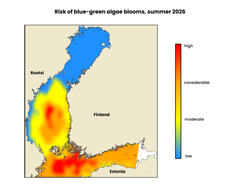
A high risk of blue-green algae blooms persists in open sea areas close to Finland. In the Gulf of Finland, the risk of blue-green algae blooms is significant.
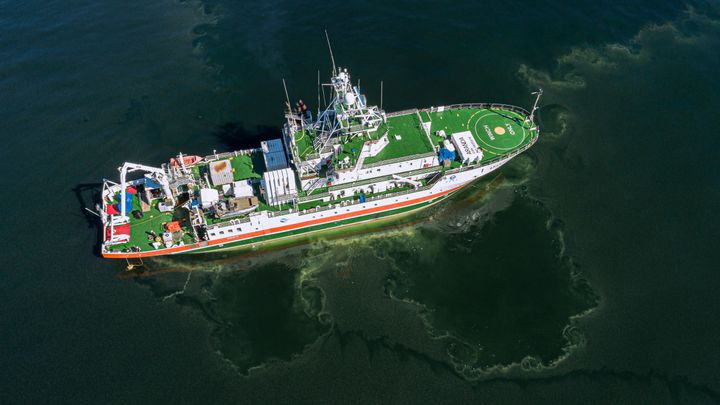
The nutrient situation in open seas continues to maintain a high risk of blue-green algae blooms in the open sea areas close to Finland. The risk of large blue-green algae blooms is high in the northern part of the main Baltic Sea basin, to the south of the Archipelago Sea and in central parts of the Bothnian Sea. The risk is significant in the Gulf of Finland and remains low in the Bothnian Bay. Large blooms may occur locally throughout the coastal area.
Phosphorus in surface water promotes mass occurrences of blue-green algae
Phosphorus bioavailable for phytoplankton remained in surface waters after the spring bloom in the open sea areas of the north, with the exception of the Bothnian Bay. This nutrient surplus provides a good springboard for blue-green algae growth.
Due to the weather conditions last winter, the water layers in the Gulf of Finland did not mix. This reduced the amount of phosphorus from the water layers close to the bottom that ended up in the surface water, and the phosphorus concentration close to the surface was lower in the Gulf of Finland than in the previous year.
“Despite the positive development in the surface water status, the risk of blue-green algae blooms in the Gulf of Finland was only reduced slightly, or to the level of significant risk. The reason for this is the generally high phosphorus level in the Gulf of Finland, which has persisted throughout the 2000s. This is why extensive blue-green algae blooms are possible in favourable weather conditions every summer,” says Jouni Lehtoranta, Senior Research Scientist at the Finnish Environment Institute.
The risk of blue-green algae blooms remains low in open sea areas of the Bothnian Bay
The risk of blue-green algae occurring in the Bothnian Sea has increased significantly over the past decade. In the Bothnian Bay, the scarcity of phosphorus still does not favour mass occurrences of blue-green algae in the open sea.
The blue-green algae species in the blooms occurring along the Bothnian Bay coast have differed from those in other coastal areas of Finland. The reason for this may be the extremely low phosphorus levels in the waters of the Bothnian Bay.
“Phosphorus is the limiting factor for algae growth in the Bothnian Bay, whereas in other open sea areas close to Finland, this factor is nitrogen. The dominant blue-green algae species in nitrogen-limited areas include Nodularia spumigena, Aphanizomenon flosaquae and Dolichospermum spp. These species may produce large blue-green algae blooms in the open sea. The dominant species on the phosphorus-limited Bothnian Bay coast are those in the genera Planktothrix and Phormidium, which are incapable of nitrogen fixation”, says Sirpa Lehtinen, Senior Research Scientist, who coordinates phytoplankton monitoring for marine resources management.
Blue-green algae blooms most commonly occur between Midsummer and late August. The cell division of blue-green algae accelerates when there is plenty of sunlight and the sea water is warm. Blue-green algae blooms occur after a few weeks of warm and sunny weather, especially if winds are slack during this period. Algal blooms mainly consist of blue-green algae cells that are in poor condition and no longer able to regulate their depth position in water. Blue-green algae blooms may also occur well into the autumn and even under the ice in winter.
Marine monitoring is also needed to predict blue-green algae risk. To model the blue-green algae risk, the Finnish Environment Institute’s open sea monitoring datasets and coastal monitoring data were used. Alg@line monitoring carried out by commercial ships as well as satellite images produced additional data.
Finnish Environment Institute will not publish weekly blue-green algae bulletins this summer due to austerity measures
This summer, the Finnish Environment Institute will not publish weekly bulletins of the general blue-green algae situation. The reason for this is government funding cuts. Blue-green algae observations will be available in online services.
The algae situation in inland waterways is monitored by the Finnish Supervisory Agency, which communicates about it as necessary. Monitoring the blue-green algae situation and water quality in official bathing areas and providing information about them through their channels is up to the municipalities and cities.
Blue-green algae should be treated with caution
Blue-green algae can produce various toxins, including skin or eye irritants. Blue-green algae should always be treated with caution. In particular, young children and pets should be kept out of water containing blue-green algae. Water with blue-green algae must not be used in the sauna, or for washing or irrigation.
Seek medical attention if you suspect a poisoning, or take your pet to a vet. Contact the Poison Information Centre for further instructions if necessary.
Blue-green algae observations in online services maintained by the Finnish Environment Institute:
Keywords
Contacts
Risk assessment of blue-green algae blooms in open sea areas close to Finland:
Senior research scientist Jouni Lehtoranta, Finnish Environment Institute, firstname.lastname@syke.fi, tel. +358 295 251 363
Changes in communications about blue-green algae situation:
Communication director Aino Laine, Finnish Environment Institute, firstname.lastname@syke.fi, tel. +358 295 252 138
Communication specialist Eija Järvinen, Finnish Environment Institute, firstname.lastname@syke.fi, tel. +358 295 251 242
Media service at Finnish Environment Institute
Our Media Service provides information on research, helps journalists find experts for interviews and provides photos for media use.
Our Communication experts will answer your inquiries on weekdays from 9 am to 4 pm.
Images
Finnish Environment Institute - We build hope through research.
Finnish Environment Institute
Latokartanonkaari 11
00790 Helsinki
+358 295 251 000
It is time to move beyond solving environmental problems one by one, to systemic sustainability transformations. The Finnish Environment Institute (Syke) contributes to building a sustainable society through research, information and services. The Finnish Environment Institute is a research institute with 700 experts and researchers located in Helsinki, Oulu, Jyväskylä and Joensuu.

Subscribe to releases from Suomen ympäristökeskus
Subscribe to all the latest releases from Suomen ympäristökeskus by registering your e-mail address below. You can unsubscribe at any time.
Latest releases from Suomen ympäristökeskus
Östersjöns tillstånd är fortfarande långt från målen – uppföljning som sträcker sig från kustvatten till öppet hav visar varför18.9.2026 08:30:00 EEST | Pressmeddelande
I augusti genomförde Finlands miljöcentral två uppföljningsresor i Östersjön: havsforskningsfartyget Aranda samlade in information från öppet hav och ms Hessu från Skärgårdshavet och kusten. Övergödning är fortfarande Östersjöns största miljöproblem. Enligt den statusbedömning av kustvattnen som publicerades i juni har endast sex procent av Finlands kustvatten god status. Färska mätningar och modelleringar ger en uppdaterad lägesbild av hur näringsbelastningen från land syns i kustvattnen och på öppet hav och varför havets tillstånd fortfarande är långt från målen.
The state of the Baltic Sea still far from the objectives – monitoring extending from coastal waters to the open sea explains why18.9.2026 08:30:00 EEST | Press release
In August, the Finnish Environment Institute carried out two monitoring cruises in the Baltic Sea: Research vessel Aranda collected data from the open sea and M/S Hessu from the Archipelago Sea and the coast. Eutrophication remains the biggest environmental problem in the Baltic Sea. According to the status assessment of coastal waters, published in June, only six per cent of Finnish coastal waters are in a good state. Recent measurements and modelling provide an updated situational picture of how nutrient pollution from land is reflected in coastal waters and the open sea, and why the state of the sea is still far from the objectives.
Itämeren tila on yhä kaukana tavoitteista – rannikkovesistä avomerelle ulottuva seuranta kertoo miksi18.9.2026 08:30:00 EEST | Tiedote
Suomen ympäristökeskus toteutti elokuussa Itämerellä kaksi seurantamatkaa: merentutkimusalus Aranda keräsi tietoa avomereltä ja ms Hessu Saaristomereltä ja rannikolta. Rehevöityminen on edelleen Itämeren suurin ympäristöongelma. Kesäkuussa julkaistun rannikkovesien tila-arvion mukaan vain kuusi prosenttia Suomen rannikkovesistä on hyvässä tilassa. Tuoreet mittaukset ja mallinnukset tarjoavat päivitetyn tilannekuvan siitä, miten maalta tuleva ravinnekuormitus näkyy rannikkovesissä ja avomerellä, ja miksi meren tila on edelleen kaukana tavoitteista.
Nostot medialle 21.–25.9.2026: Miksi Itämeren tila on yhä kaukana tavoitteista? Metsien ennallistamisessa etsitään tasapainoa metsäluonnon tilan parantamisen ja metsätalouden välillä17.9.2026 13:46:33 EEST | Tiedote
Hei! Tässä tiedoksesi meillä Suomen ympäristökeskuksessa ensi viikolla ilmestyviä tiedotteita, uutisia, kampanjoita, blogeja ja uutiskirjeitä. Mukana myös tulevia tapahtumia ja webinaareja. Jakelemme mediakatsauksen torstaisin STT:n kautta. Koosteet löytyvät myös STT-uutishuoneesta, josta voit tilata kaikki Suomen ympäristökeskuksen tiedotteet.
Metsien ennallistamisessa etsitään tasapainoa metsäluonnon tilan parantamisen ja metsätalouden välillä16.9.2026 14:55:34 EEST | Tiedote
Metsäluonnon ekologista tilaa on mahdollista parantaa yhteistyössä metsätalouden kanssa, painottavat Suomen ympäristökeskuksen (Syke) tutkijat. Arvokkaimpia kohteita voidaan suojella, kun taas muualla luonnon tilaa voidaan parantaa metsätalouden rinnalla ennallistamisasetuksen avulla.
In our pressroom you can read all our latest releases, find our press contacts, images, documents and other relevant information about us.
Visit our pressroom