
Finland's cormorant population decreased by seven per cent
14.9.2026 08:22:00 EEST | Suomen ympäristökeskus | Press release
Both the number of nests and the number of occupied colonies were clearly below the levels of the previous two years.
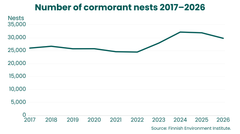
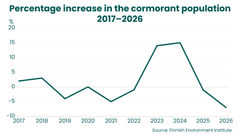
In the summer of 2026, approximately 29,780 cormorant nests were counted in Finland. The breeding population decreased by approximately seven per cent from the previous year, or by just over 2,000 nests. The number of occupied colonies also decreased clearly.
“The cormorant breeding population dropped from the level of the previous two years. In both 2024 and 2025, approximately 32,000 cormorant nests were counted in Finland. The harsh winter may have contributed to the decline, as cormorants were observed to suffer during winter storms in different parts of the Baltic Sea,” says Senior Researcher Kim Jaatinen from the Finnish Environment Institute.
Bothnian Sea became the largest breeding area
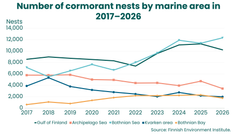
In summer 2026, approximately 12,300 cormorant nests were counted in the Bothnian Sea, 10,200 in the Gulf of Finland, 3,400 in the Archipelago Sea, 2,000 in Kvarken and 1,750 in the Bothnian Bay.
For the first time, the Bothnian Sea clearly had the highest number of cormorant nests. The number of nests in the area increased by approximately one thousand from the previous year. At the same time, the number of nests in the Gulf of Finland decreased by just over one thousand.
In the Archipelago Sea, the number of nests decreased by more than a quarter, or approximately 1,300 nests. The number also decreased by approximately 550 nests in the Bothnian Bay and by approximately 200 in Kvarken.
As in recent years, only one inland cormorant colony was observed, in Päijät-Häme, where just over 20 nests were counted.
Number of colonies decreased clearly
Cormorant nesting was observed in 53 different colonies this year, 14 fewer than in 2025. Nests were found on a total of 96 islets or islands, compared with 103 occupied islets and islands in the previous year. In addition, cormorants nested on 12 sea marks, line markers or lighthouses.
No entirely new colonies were found this year, but existing colonies occupied a few new islands.
The largest number of colonies was abandoned in Kokkola. Four colonies located further out in the archipelago were abandoned, and the area's cormorants concentrated in one colony closer to the coast. Predation by white-tailed eagles may have contributed to the change.
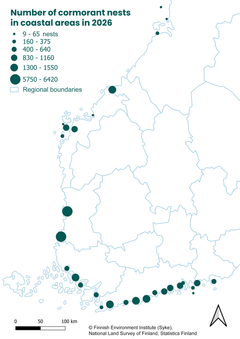
Rauma continued to have more nesting cormorants than any other municipality in Finland. Approximately 6,400 nests were counted in Finland's largest colony, located in the port of Rauma, around 150 fewer than the previous year.
The number of nests increased most in Pori. The city's three colonies had a total of approximately 5,750 nests, around one thousand more than in 2025. In Porvoo, by contrast, the number of nests decreased the most: approximately 1,930 nests were counted, around 750 fewer than in the previous year.
Cormorant is now a game species
On 1 September 2026, the cormorant changed from a species protected under the Nature Conservation Act to a game species protected throughout the year under the Hunting Act. At the same time, so-called protective hunting became possible: cormorants may be hunted under a general derogation, including within 300 metres of fishing gear. In future, protective hunting of cormorants is possible from 1 August to 28 February.
Following the change to game-species status, responsibility for monitoring the cormorant population will transfer from the Finnish Environment Institute to the Natural Resources Institute Finland.
Long-term monitoring shows changes in the population
The Finnish Environment Institute has monitored the development of the cormorant population since the species returned to Finland’s breeding bird fauna in the 1990s. The cormorant disappeared from Finland and the entire Baltic Sea region in the early 20th century as a result of persecution. The first new breeding was recorded in Finland in 1996, when there were around ten breeding pairs. By 2009, there were already around 16,000 pairs.
The population grew rapidly until the mid-2010s and more slowly thereafter, reaching its highest level to date in 2024. Long-term monitoring has provided a reliable knowledge base for assessing changes in the cormorant population and for decision-making concerning the species.
More than 40 birdwatchers participated in the census, search and inspection of cormorant colonies in summer 2026. The Finnish Environment Institute thanks everyone who took part in the monitoring for their valuable work.
Keywords
Contacts
Kim JaatinenSenior ResearcherFinnish Environment Institute (Syke)
Tel:+358 29 525 1370forename.surname@syke.fiAleksi MikolaResearcherFinnish Environment Institute (Syke)
Tel:+358 29 525 1038forename.surname@syke.fiMedia service at Finnish Environment Institute
Our Media Service provides information on research, helps journalists find experts for interviews and provides photos for media use.
Our Communication experts will answer your inquiries on weekdays from 9 am to 4 pm.
Images
Finnish Environment Institute - We build hope through research.
Finnish Environment Institute
Latokartanonkaari 11
00790 Helsinki
+358 295 251 000
It is time to move beyond solving environmental problems one by one, to systemic sustainability transformations. The Finnish Environment Institute (Syke) contributes to building a sustainable society through research, information and services. The Finnish Environment Institute is a research institute with 700 experts and researchers located in Helsinki, Oulu, Jyväskylä and Joensuu.

Subscribe to releases from Suomen ympäristökeskus
Subscribe to all the latest releases from Suomen ympäristökeskus by registering your e-mail address below. You can unsubscribe at any time.
Latest releases from Suomen ympäristökeskus
Finlands skarvpopulation minskade med sju procent14.9.2026 08:21:00 EEST | Pressmeddelande
Både antalet bon och antalet bebodda kolonier låg klart under nivån för de två föregående åren.
Suomen merimetsokanta pieneni seitsemän prosenttia14.9.2026 08:20:00 EEST | Tiedote
Sekä pesien että asuttujen yhdyskuntien määrä jäi selvästi kahden edellisvuoden tasoa pienemmäksi.
Nostot medialle 14.–18.9.2026: Miten merimetsokanta kehittyi? Jo 91 kuntaa haluaa lisätä kasviproteiinia ruokapalveluissaan, uusi opas kokoaa keinot10.9.2026 13:55:31 EEST | Tiedote
Hei! Tässä tiedoksesi meillä Suomen ympäristökeskuksessa ensi viikolla ilmestyviä tiedotteita, uutisia, kampanjoita, blogeja ja uutiskirjeitä. Mukana myös tulevia tapahtumia ja webinaareja. Jakelemme mediakatsauksen torstaisin STT:n kautta. Koosteet löytyvät myös STT-uutishuoneesta, josta voit tilata kaikki Suomen ympäristökeskuksen tiedotteet.
Ensi vuonna yhä useampi ajoneuvo, työkone ja intermodaalikontti on tarkastettava F-kaasuvuotojen varalta3.9.2026 11:01:38 EEST | Tiedote
F-kaasuja sisältäviä kylmä- ja ilmastointilaitteita koskeva vuototarkastusvelvollisuus laajenee 12.3.2027. Laitteiden haltijoiden ja huoltoyritysten kannattaa varautua uusiin tarkastus- ja kirjanpitovaatimuksiin hyvissä ajoin.
Syken mediaviikko 31.8.–4.9.2026: Uusia ajoneuvoja F-kaasujen vuototarkastusten piiriin | Valokuvakilpailussa etsitään luonnon ja ihmisen hyvinvointia tukevia maisemia27.8.2026 13:45:59 EEST | Tiedote
Hei! Tässä tiedoksesi meillä Suomen ympäristökeskuksessa ensi viikolla ilmestyviä tiedotteita, uutisia, kampanjoita, blogeja ja uutiskirjeitä. Mukana myös tulevia tapahtumia ja webinaareja. Jakelemme mediakatsauksen torstaisin STT:n kautta. Koosteet löytyvät myös STT-uutishuoneesta, josta voit tilata kaikki Suomen ympäristökeskuksen tiedotteet.
In our pressroom you can read all our latest releases, find our press contacts, images, documents and other relevant information about us.
Visit our pressroom