The number of transboundary environmental impact assessment procedures is increasing
25.2.2026 12:52:40 EET | Suomen ympäristökeskus | Press release
The Espoo Convention on environmental impact assessment in a transboundary context turns 35. With the green transition and the energy transition, the number of these assessment procedures has increased dramatically in recent years.

The Convention on Environmental Impact Assessment in a Transboundary Context (Espoo Convention) by the United Nations Economic Commission for Europe (UNECE) was adopted in Espoo on 25 February 1991. The convention promotes the rights of citizens and stakeholders to participate in environmental decision-making.
The Espoo Convention and its Protocol on Strategic Environmental Impact Assessment (The Protocol on SEA) oblige the parties to assess the potential transboundary environmental impacts of various projects and plans and programmes prepared by authorities, including land use plans, well before their implementation. The convention lays down the obligations of the parties to the convention to inform, consult and negotiate when the significant and likely environmental impacts of the activities may extend to the territory of other countries. The purpose of the environmental impact assessment (EIA) procedure is to investigate, mitigate or prevent the harmful environmental impacts of projects. The assessment of the effects of plans and programmes on the environment (SEA) refers to the assessment of the impacts of plans and programmes drawn up by authorities during their preparation phase.
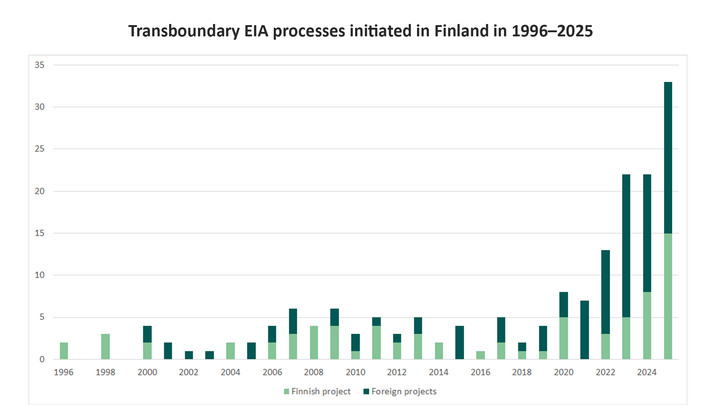
The Finnish Environment Institute (Syke) has carried out information, negotiation and consultation tasks referred to in the Espoo Convention and the SEA Protocol in Finland since 2023. In this time, the number of transboundary EIA procedures has increased dramatically. A total of 77 procedures have been launched during Syke’s term of office in 2023–2025, which is around 40 per cent of all procedures initiated after 1996.
“EU countries’ investments in energy production projects related to the green transition, such as wind power, are increasing, and development is not expected to slow down in the coming years. This means that the number of international hearings will probably also increase,” says Jenni Juslén, Head of Services at the Finnish Environment Institute.
A total of 99 transboundary EIA procedures were ongoing at the end of 2025. A multi-stage process may take several years. During the process, the authorities and citizens of the relevant countries are consulted and issues related to environmental and health impacts are discussed.
Energy production is emphasised in project types
Most of the new transboundary EIA procedures are related to energy production projects, such as onshore and offshore wind power, nuclear power and hydrogen projects. Recently, completely new types of projects have also emerged.
“For example, last July, Sweden notified Finland of an EIA procedure for a project seeking a permit to extract polymetallic aggregates called manganese nodules from the bottom of the Bay of Bothnia in the Swedish EEZ. Finland has announced that it will participate in the EIA procedure of this project, allowing Finns to comment on the matter,” says Julianna Reunanen, Senior Officer at the Finnish Environment Institute.
Another recent new project type is nuclear power plants with small nuclear modular reactors. Transboundary EIA procedures concerning small modular reactors are under way for projects planned in the Nordic countries.
Sometimes a project has several countries of origin, and the impacts may also extend to several countries. Such multilateral EIA procedures are ongoing, for example for hydrogen pipeline routes related to energy independence and security of supply in Europe.
The Espoo Convention provides opportunities to exert influence
The Espoo Convention promotes citizens’ rights to participate in environmental decision-making. The aim is to ensure that residents and other parties in the affected area are informed about projects, plans and programmes that may affect their environment and can participate in the impact assessment and, consequently, in project planning. This way, Finns have the opportunity to give feedback and influence projects in other countries.
The Finnish Environment Institute announces all ongoing procedures on its website and publishes the referrals concerning them in lausuntopalvelu.fi. Syke also maintains the relevant websites in the environment.fi service.
Keywords
Contacts
Jenni Juslén, Head of Services, tel. +358 295 252 387, firstname.lastname@syke.fi
Julianna Reunanen, Senior Officer, tel. +358 295 252 390, firstname.lastname@syke.fi
Contacts related to international environmental impact assessments: transboundaryEIA.SEA@syke.fi
Eija Järvinen, Communication Specialist, tel. +358 295 251 242, firstname.lastname@syke.fi
Media service at Finnish Environment Institute
Our Media Service provides information on research, helps journalists find experts for interviews and provides photos for media use.
Our Communication experts will answer your inquiries on weekdays from 9 am to 4 pm.
Images
Links
- More information on transboundary environmental impact assessments and projects (environment.fi)
- Announcements related to transboundary environmental impact assessments on the website of the Finnish Environment Institute (in Finnish)
- Requests for opinions related to transboundary environmental impact assessments are published in lausuntopalvelu.fi
Finnish Environment Institute - We build hope through research.
Finnish Environment Institute
Latokartanonkaari 11
00790 Helsinki
+358 295 251 000
It is time to move beyond solving environmental problems one by one, to systemic sustainability transformations. The Finnish Environment Institute (Syke) contributes to building a sustainable society through research, information and services. The Finnish Environment Institute is a research institute with 700 experts and researchers located in Helsinki, Oulu, Jyväskylä and Joensuu.
Subscribe to releases from Suomen ympäristökeskus
Subscribe to all the latest releases from Suomen ympäristökeskus by registering your e-mail address below. You can unsubscribe at any time.
Latest releases from Suomen ympäristökeskus
Nostot medialle 2.–6.11.2026 | Maankäyttöpaineet Saamenmaalla ja miten muovin kiertotaloutta vauhditetaan seuraavalla hallituskaudella?29.10.2026 12:53:51 EET | Tiedote
Hei! Tässä tiedoksesi meillä Suomen ympäristökeskuksessa ensi viikolla ilmestyviä tiedotteita, uutisia, kampanjoita, blogeja ja uutiskirjeitä. Mukana myös tulevia tapahtumia ja webinaareja. Jakelemme mediakatsauksen torstaisin STT:n kautta. Koosteet löytyvät myös STT-uutishuoneesta, josta voit tilata kaikki Suomen ympäristökeskuksen tiedotteet.
Gypsum could reduce agricultural phosphorus loading around the Baltic Sea region26.10.2026 09:00:00 EET | Press release
Gypsum treatment reduced phosphorus losses from agricultural soils in the GYPREG project trials conducted in different countries. The results support wider use of the method across the Baltic Sea region, but broader implementation requires local research, effective logistics, appropriate regulation and long-term funding.
Gips kunde minska jordbrukets fosforbelastning i stora delar av Östersjöområdet26.10.2026 09:00:00 EET | Pressmeddelande
Gipsbehandling minskade fosforläckaget från åkermark i GYPREG-projektets försök i olika länder. Resultaten stöder en bredare användning av metoden i Östersjöområdet, men ett bredare införande förutsätter lokal forskningskunskap, fungerande logistik, tydlig reglering och långsiktig finansiering.
Kipsi voisi vähentää maatalouden fosforikuormitusta laajasti Itämeren alueella26.10.2026 09:00:00 EET | Tiedote
Kipsikäsittely vähensi fosforin huuhtoutumista eri maiden peltomaista GYPREG-projektin kokeissa. Tulokset tukevat menetelmän laajempaa hyödyntämistä Itämeren alueella, mutta käyttöönotto edellyttää paikallista tutkimustietoa, toimivaa logistiikkaa, sääntelyä ja pysyvää rahoitusta.
Tutkimus: Energiakriisi lisäsi puunpolttoa ja arjen energiasäästöä omakotitaloissa26.10.2026 06:00:00 EET | Tiedote
Lähes kaikki sähkölämmitteisten omakotitalojen asukkaat pyrkivät hillitsemään energiakustannuksia talven 2022–2023 energiakriisin aikana. Valtaosa turvautui nopeasti toteutettaviin säästötoimiin, mutta vain harvat investoivat pysyviin energiaratkaisuihin.
In our pressroom you can read all our latest releases, find our press contacts, images, documents and other relevant information about us.
Visit our pressroom