Towards a cleaner Baltic Sea by reducing fishing related plastic waste
18.3.2026 09:20:50 EET | Suomen ympäristökeskus | Press release
Press release by the Finnish Environment Institute and Keep the Archipelago Tidy Association:
Preventing marine litter is far more effective and far less costly than cleaning it up afterwards. This is one of the key takeaways from the three-year cross-border environmental project Re:Fish, which tackled the plastic pollution from recreational fishing in the Central Baltic Sea.
Funded by the EU Interreg Central Baltic Programme, Re:Fish brought together Håll Sverige Rent (Sweden), the Finnish Environment Institute, Keep the Archipelago Clean Association (Finland), and the Estonian Marine Institute at University of Tartu on how to address the issue of abandoned, lost, and discarded recreational fishing gear.
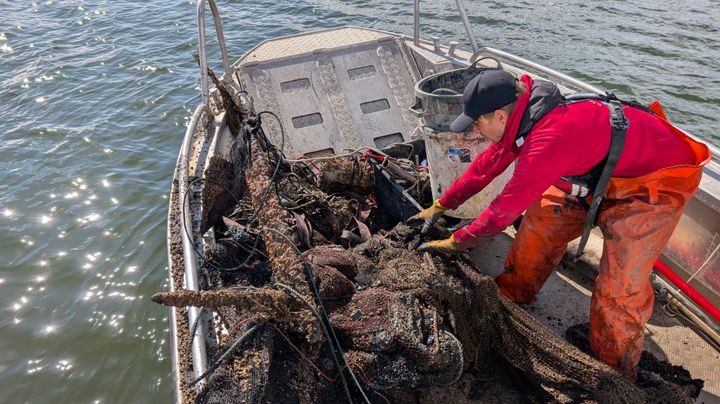
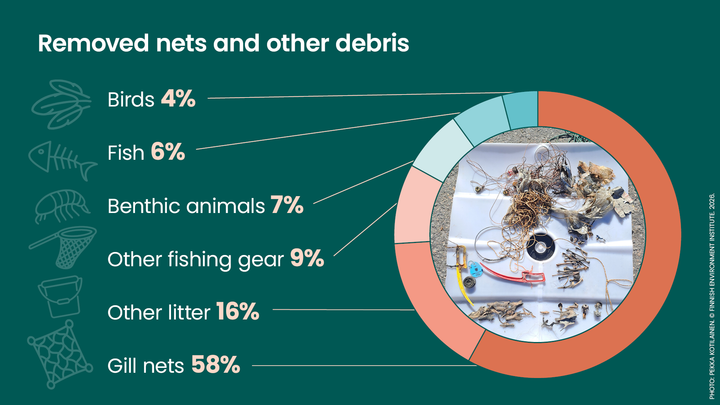
Through coordinated dragging and diving operations, the project cleaned 225 km² of Baltic Sea coastal waters. This resulted in the removal of 8,763 metres of gillnets and 2,044 kg of abandoned fishing gear. Some of the retrieved gillnets were analysed to assess their potential for material reuse. In addition, recycling stations for end-of-life fishing gear were established in Finland and Estonia.
The project also collected 1,237 kg of additional marine litter from the Baltic Sea and surrounding beaches. These efforts help to restore marine habitats and prevent long-term environmental damage. Lost fishing gear, often referred to as “ghost gear”, can continue catching and trapping fish and wildlife for decades, contributing to habitat degradation, entanglement, and ingestion by marine organisms.
Cleaning coastal regions near Rauma, Uusikaupunki, Kustavi and Helsinki
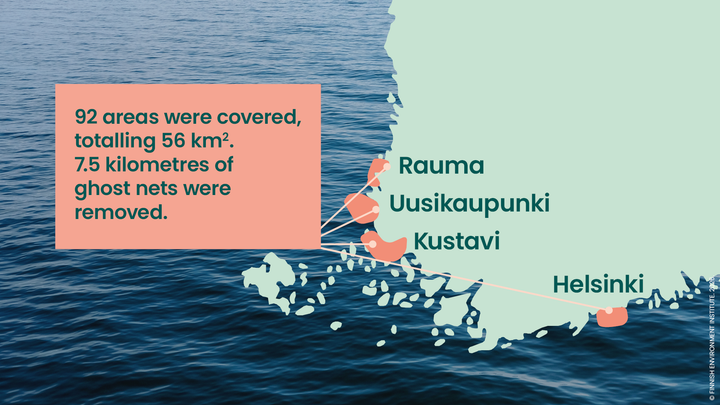
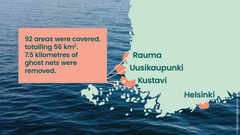
In Finland, ghost nets and other fishing gear were removed from the coastal areas of Rauma, Uusikaupunki, Kustavi, and Helsinki. The dragging operation targeted 92 areas known for active recreational fishing. The dragging and diving operations covered a total of 56 km², and altogether 7.5 kilometers of nets were lifted from the sea. This is only a small portion of all the fishing gear that ends up on the seabed, as earlier studies have estimated that recreational fishers lose a couple of thousand nets—up to 60 kilometers of netting—each year in Finland’s marine areas.
"The oldest plastic nets we removed had license tags from 1983 and 1990. Some nets were even older and made of cotton. This gives clear evidence of the scope of the problem and how long the nets persist in the environment", states Pekka Kotilainen, Senior Researcher at the Finnish Environment Institute.
Material could be recycled
Fishing nets containing plastic were also collected from recreational fishers at ten service points in the Archipelago Sea. Nearly 1,700 kilograms of nets were returned to the service points arranged by the Keep the Archipelago Tidy Association. Some of the nets were sent to LAB University of Applied Sciences for material analysis to determine how the nets could be safely and efficiently used as raw material for new products.
“Material analysis revealed that the properties of the nets were very close to those of virgin plastic types. Plate-like samples were produced from the nets’ float and lead lines, and this material could be used, for example, in industry,” says project manager Carolin Kolmeder from the Keep the Archipelago Tidy Association.
The material analysis also examined compliance with the EU’s chemical legislation regarding substances of very high concern (SVHCs). Their concentration was less than 0.1% of the total weight of the net material, meaning the safety requirements were met.
Carolin Kolmeder notes that the results of the material analysis are still preliminary. “Only a small sample of the nets that could potentially be recycled in Finland was sent for analysis. However, the preliminary results suggest that it is possible to give the nets a new life in a new form.”
Building Awareness
While clean-up operations delivered visible results, Re:Fish placed equal emphasis on behavioural research, stakeholder engagement, and policy alignment. Surveys were conducted to better understand recreational fishers’ attitudes and practices regarding gear loss. The findings, combined with insights gathered through workshops involving government authorities, organisations, retailers, and producers, provide a strong foundation for more effective future strategies and policy implementation.
The results also offer guidance on compliance with the EU Single-Use Plastics Directive (SUP Directive). Since January 2025, producers and sellers of plastic fishing gear have been required to take responsibility for collecting end-of-life gear and ensuring proper waste management. Comprehensive project reports will be published in 2026 via the Central Baltic Programme and partners’ websites.
Throughout the project, public awareness campaigns and events reached more than 8.6 million people across Finland, Sweden, and Estonia, further strengthening responsible practices in recreational fishing.
A Model for Cross-Border Cooperation
The EU Interreg Central Baltic Programme Secretariat has highlighted Re:Fish as “a strong example of hands-on environmental action that combines practical retrieval with preventive measures and citizen engagement.”
The project’s strength lies in its cross-border collaboration, bringing together authorities, researchers, recreational fishers, and youth from three countries to share knowledge and scale solutions.
The Finnish Environment Institute’s Rosgis reporting service, promoted throughout the project, is an effective tool enabling citizens around the Baltic Sea to report lost fishing gear and other litter. It is published in five languages Finnish, English, Estonian, Latvian and Swedish. By strengthening public participation and citizen science, it contributes directly to a cleaner marine environment.
Keywords
Contacts
Senior researcher Pekka Kotilainen, Finnish Environment Institute, +358 295 251 317, e-mail: firstname.lastname@syke.fi
Project manager Carolin Kolmeder, Keep the Archipelago Tidy Association, tel. +358 40 458 9156, e.mail: firstname.lastname@pssry.fi
Communication specialist Eija Järvinen, Finnish Environment Institute, tel. +358 295 251 242, e-mail: firstname.lastname@syke.fi
Media service at Finnish Environment Institute
Our Media Service provides information on research, helps journalists find experts for interviews and provides photos for media use.
Our Communication experts will answer your inquiries on weekdays from 9 am to 4 pm.
Images
Links
Finnish Environment Institute - We build hope through research.
Finnish Environment Institute
Latokartanonkaari 11
00790 Helsinki
+358 295 251 000
It is time to move beyond solving environmental problems one by one, to systemic sustainability transformations. The Finnish Environment Institute (Syke) contributes to building a sustainable society through research, information and services. The Finnish Environment Institute is a research institute with 700 experts and researchers located in Helsinki, Oulu, Jyväskylä and Joensuu.

Subscribe to releases from Suomen ympäristökeskus
Subscribe to all the latest releases from Suomen ympäristökeskus by registering your e-mail address below. You can unsubscribe at any time.
Latest releases from Suomen ympäristökeskus
Syken mediaviikko 31.8.–4.9.2026: Uusia ajoneuvoja F-kaasujen vuototarkastusten piiriin | Valokuvakilpailussa etsitään luonnon ja ihmisen hyvinvointia tukevia maisemia27.8.2026 13:45:59 EEST | Tiedote
Hei! Tässä tiedoksesi meillä Suomen ympäristökeskuksessa ensi viikolla ilmestyviä tiedotteita, uutisia, kampanjoita, blogeja ja uutiskirjeitä. Mukana myös tulevia tapahtumia ja webinaareja. Jakelemme mediakatsauksen torstaisin STT:n kautta. Koosteet löytyvät myös STT-uutishuoneesta, josta voit tilata kaikki Suomen ympäristökeskuksen tiedotteet.
Saaristomeren ekologisesti merkittävät vedenalaiset meriluontoalueet tunnistettu27.8.2026 08:59:15 EEST | Tiedote
Saaristomereltä on tunnistettu 46 ekologisesti merkittävää merialuetta. Kartoituksen tavoitteena on tukea meriluonnon suojelua ja luontoarvojen huomioimista alueidenkäytön suunnittelussa. Turku aikoo ottaa kartoituksen tiedot käyttöön kaupungin luonnonsuojelualueohjelman valmistelussa. Alueita esitellään tänään Turussa Itämeripäivän tapahtumassa.
Skärgårdshavets ekologiskt betydelsefulla undervattensområden har identifierats27.8.2026 08:55:00 EEST | Pressmeddelande
I Skärgårdshavet har 46 lokalt ekologiskt betydelsefulla havsområden identifierats. Syftet med kartläggningen är att stödja skyddet av havsnaturen och säkerställa att naturvärden beaktas i kommunernas och landskapets planering av områdesanvändningen. Åbo stad kommer att använda kartläggningsuppgifterna i beredningen av stadens program för naturskyddsområden. Områdena presenteras idag vid Östersjödagens evenemang i Åbo.
Färre ungar bland städernas vitkindade gäss än förra året24.8.2026 11:35:28 EEST | Pressmeddelande
Antalet vitkindade gäss som häckar i städerna förblev stabilt, men färre ungar observerades än förra året.
Kaupunkien valkoposkihanhilla poikasia vähemmän kuin viime vuonna24.8.2026 08:00:00 EEST | Tiedote
Kaupungeissa pesivien valkoposkihanhien määrä pysyi vakaana, mutta poikasia havaittiin vähemmän kuin viime vuonna.
In our pressroom you can read all our latest releases, find our press contacts, images, documents and other relevant information about us.
Visit our pressroom